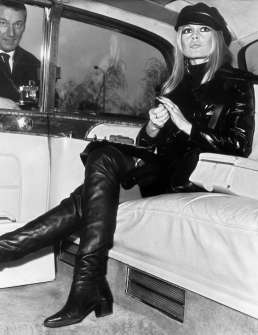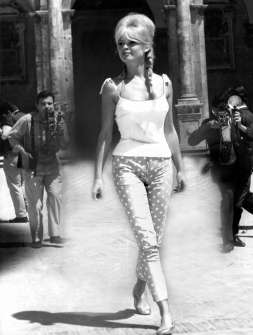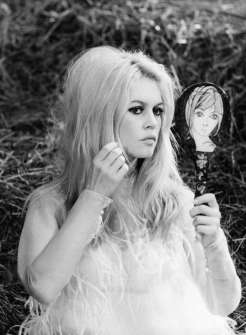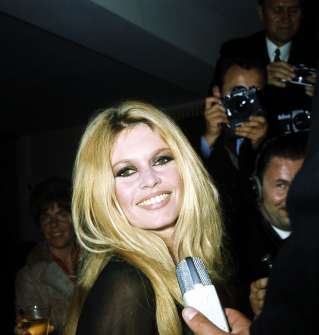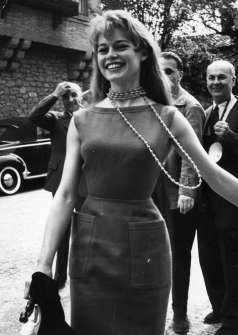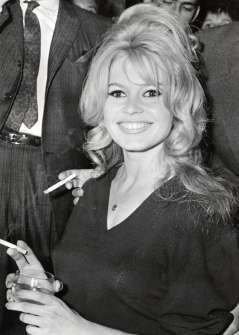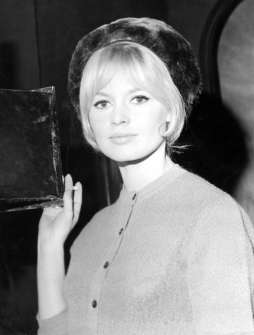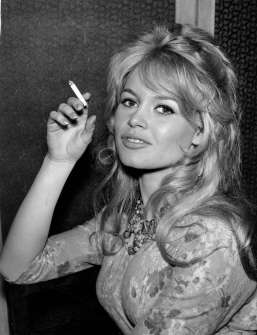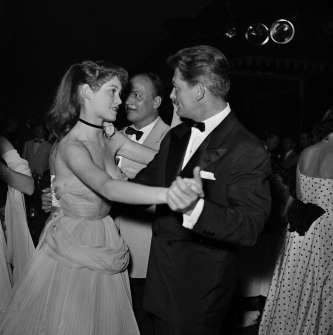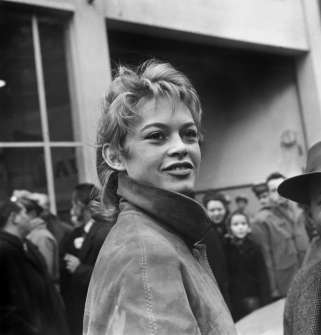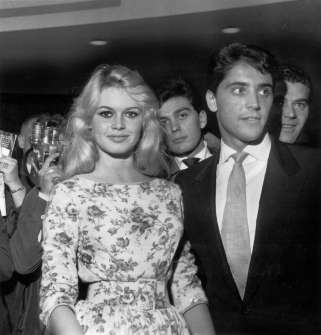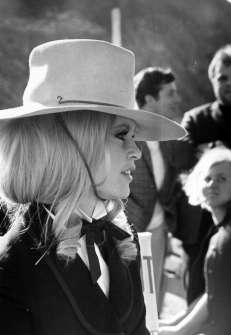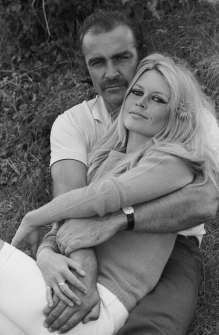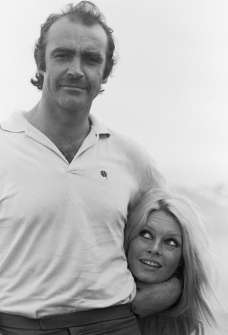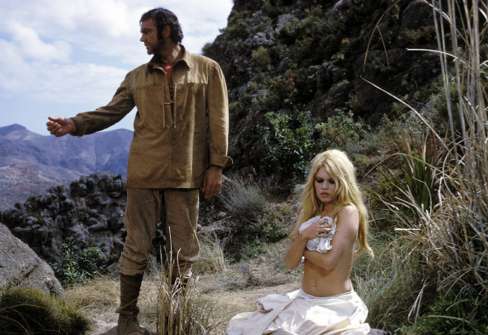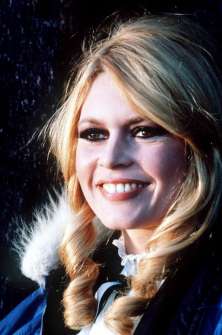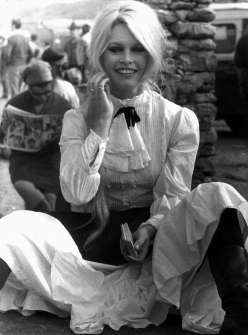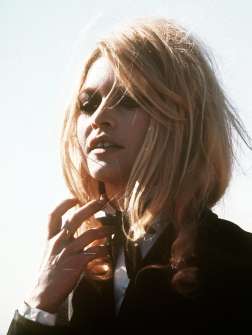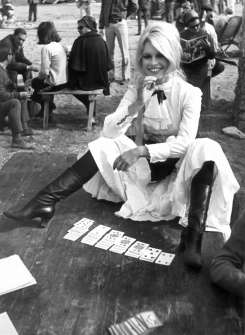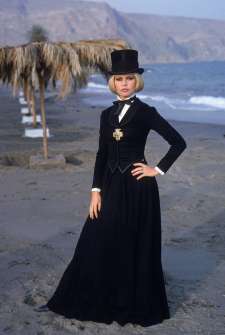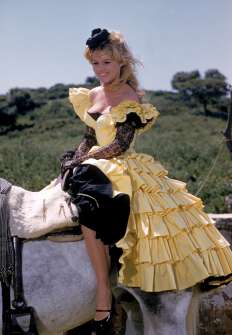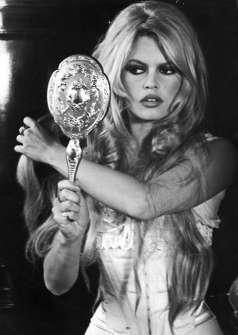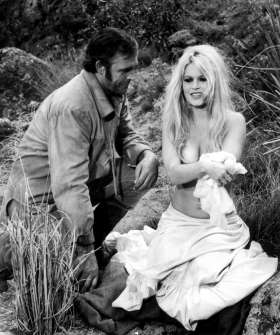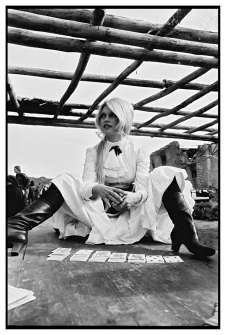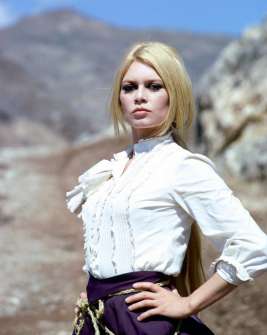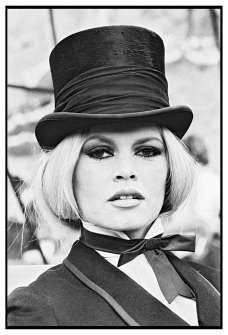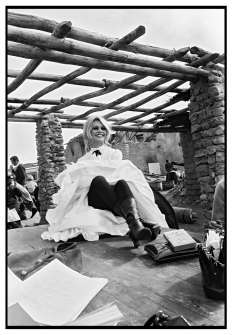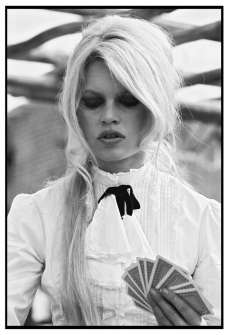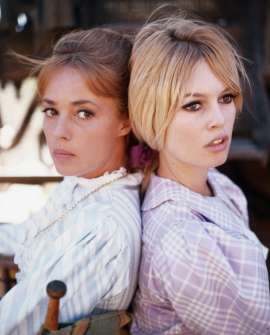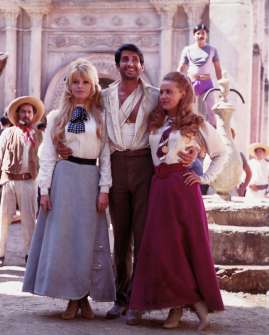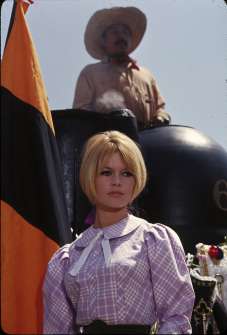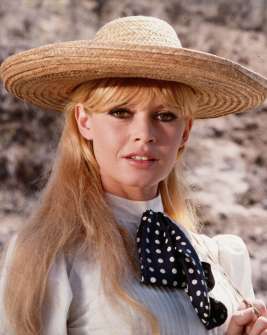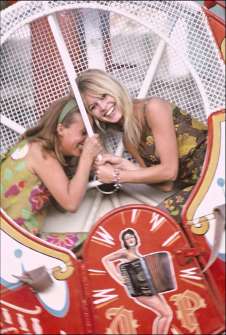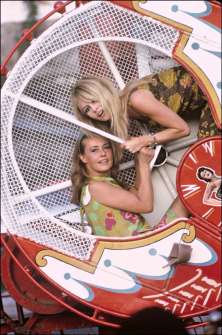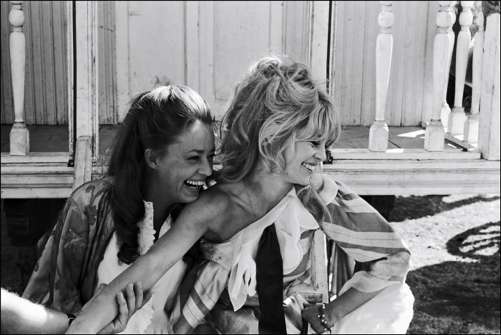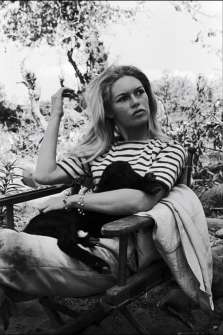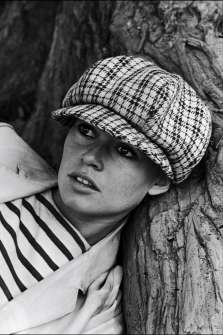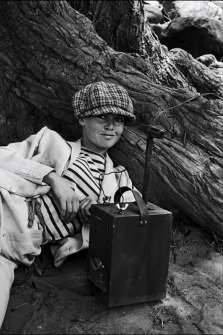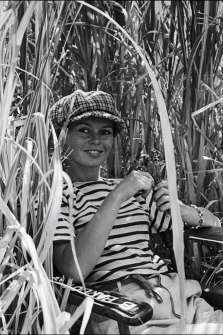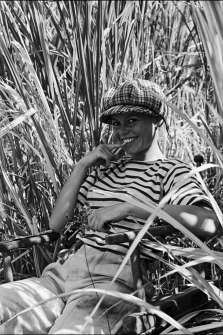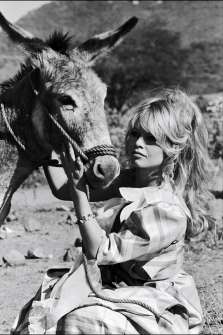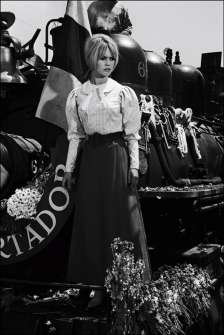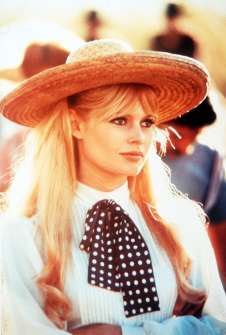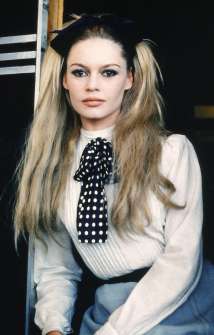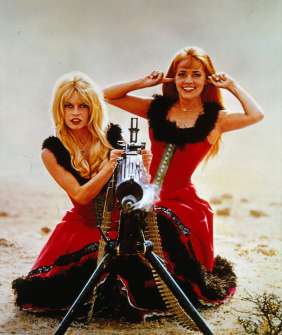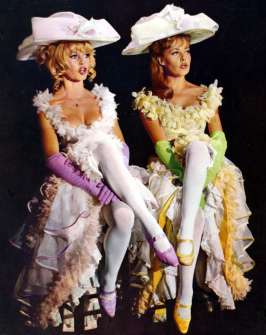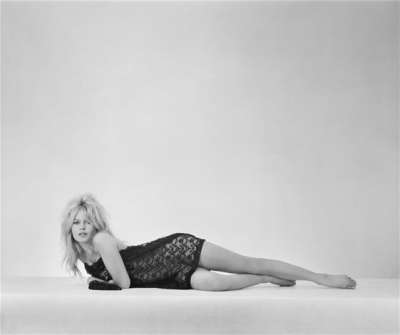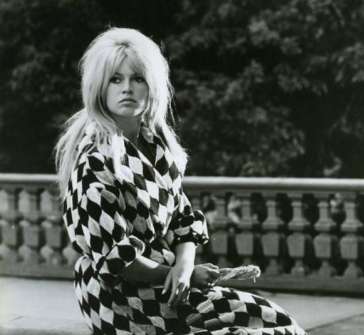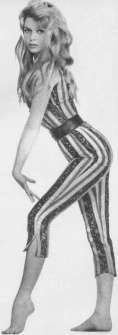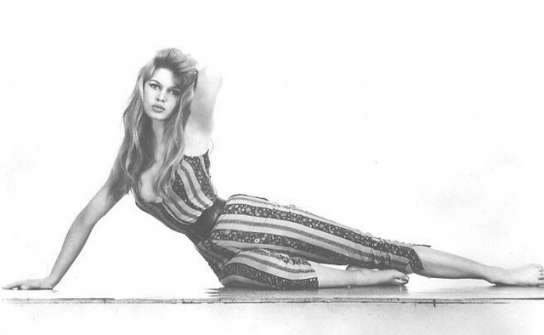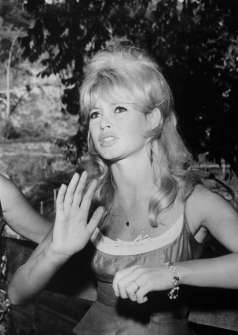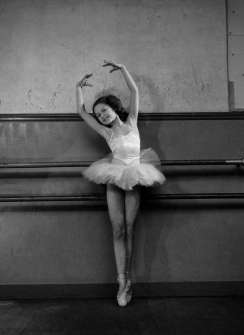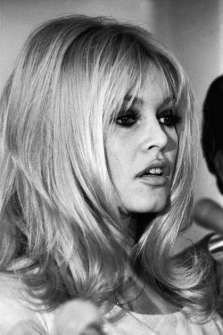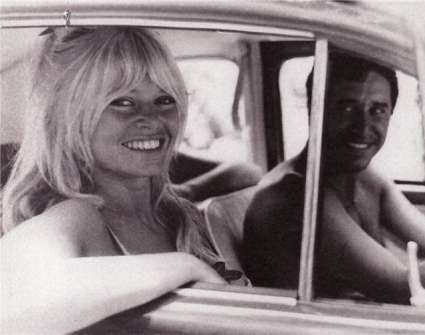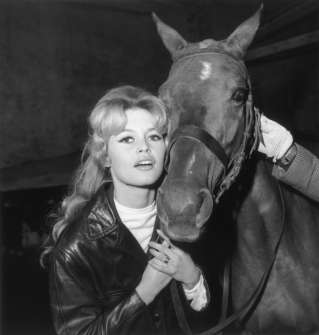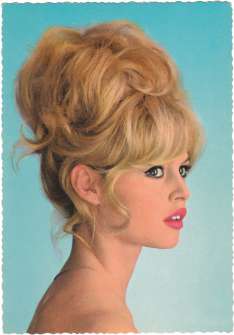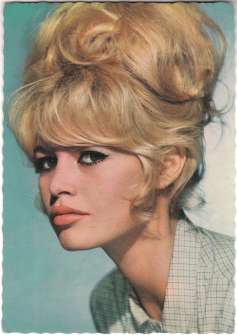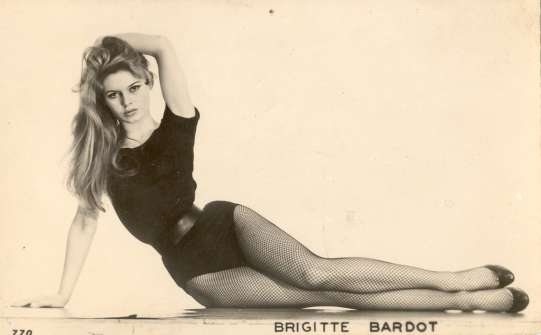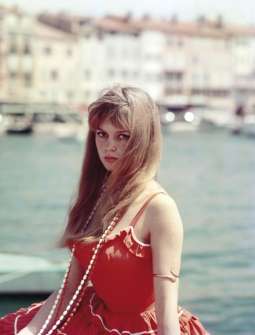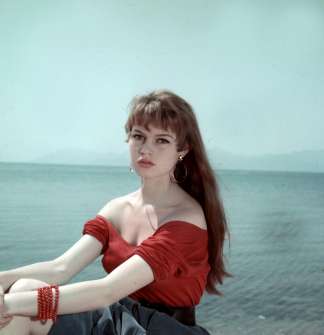
Brigitte Bardot and Easter
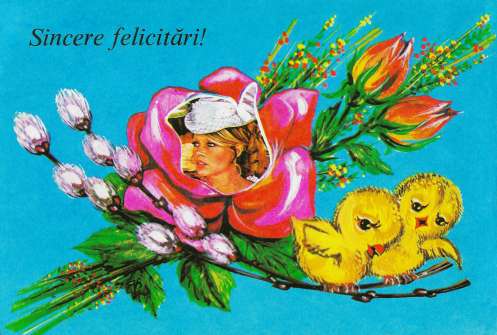
Romanian postcard by Casa Filmului Acin, no. 235.Dear friends,we wish you all: Happy Easter! Frohe Ostern! Joyeuses Pâques ! ¡Feliz Pascua! ¡Feliz Páscoa! Glad påsk! Счастливой Пасхи! ハッピーイースターVrolijk Pasen!Easter Sunday is a festive, family-oriented day in the Netherlands. People prepare festive breakfasts, brunches or lunches. They may also search for and eat chocolate eggs that are supposedly delivered by the Easter hare.Enjoy it! And, please check out our blog European Film Star Postcards.
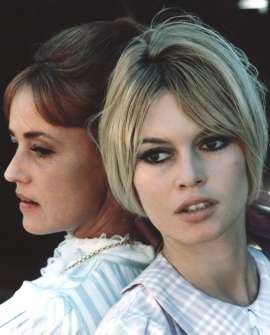
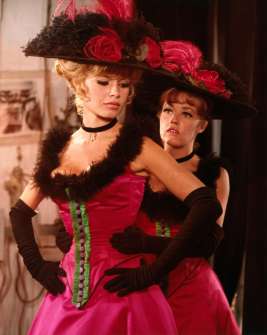
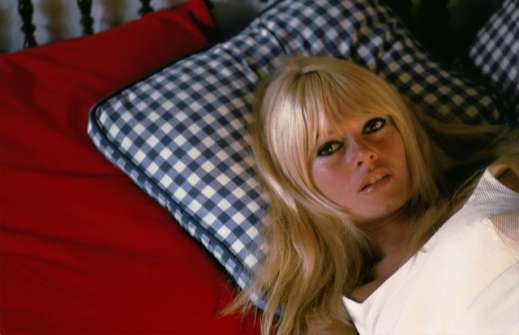
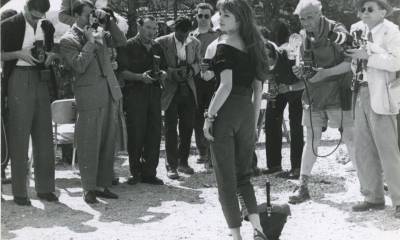
Brigitte Bardot in Vie privée (1962)
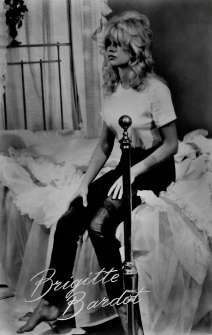
Dutch postcard by Uitg. Takken, Utrecht, no. AX 5022. Photo: Metro Goldwyn Mayer. Brigitte Bardot in Vie privée / Private Life (Louis Malle, 1962).French actress Brigitte Bardot (1934) died on 28 December 2025, at the age of 91. In the 1950s, she was the sex kitten of the European film industry. BB starred in 48 films, performed in numerous musical shows, and recorded 80 songs. After her retirement in 1973, she became an animal rights activist. In the coming weeks, we will continue to post a BB postcard every day to remember her as she once was.Brigitte Bardot was born in Paris in 1934. Her father, Louis Bardot, had an engineering degree and worked with his father in the family business. Her mother, Ann-Marie Mucel, was 14 years younger than Brigitte's father, and they married in 1933. Brigitte's mother encouraged her daughter to take up music and dance. At the age of 13, she entered the Conservatoire Nationale de Danse to study ballet. By the time she was 15, Brigitte was trying to launch a modelling career and found herself on the cover of the French magazine Elle in May 1949. Her incredible beauty was readily apparent, and Brigitte was noticed by Roger Vadim, then an assistant to the film director Marc Allegrét. Vadim was infatuated with Bardot and encouraged her to start working as a film actress. BB was 18 when she debuted in the comedy Le Trou Normand / Crazy for Love (Jean Boyer, 1952). In the same year, she married Vadim. Brigitte wanted to marry him when she was 17, but her parents quashed any marriage plans until she turned 18. In April 1953, she attended the Cannes Film Festival, where she received massive media attention. She soon was every man's idea of the girl he'd like to meet in Paris. From 1952 to 1956, she appeared in seventeen films. Her films were generally lightweight romantic dramas in which she was cast as an ingénue or siren, often with an element of undress. In 1953, she made her first US production, Un acte d'amour / Act of Love (Anatole Litvak, 1953) with Kirk Douglas, but she continued to make films in France.Roger Vadim was not content with the light fare his wife was offered. He felt Brigitte Bardot was being undersold. Looking for something more like an art film to push her as a serious actress, he showcased her in Et Dieu créa la femme / ...And God Created Woman (Roger Vadim, 1956). This film, about an immoral teenager in a respectable small-town setting, was a smash success on both sides of the Atlantic. Craig Butler at AllMovie: "It's easy enough to say that ...And God Created Woman is much more important for its historical significance than for its actual quality as a film, and that's true to an extent. The immense popularity, due to its willingness to directly embrace an exploration of sex as well as its willingness to show a degree of nudity that was remarkably daring for its day, demonstrated that audiences were willing to view subject matter that was considered too racy for the average moviegoer. This had both positive (freedom to explore, especially for the French filmmakers of the time) and negative (freedom to exploit) consequences, but its impact is undeniable. It's also true that Woman is not a great work of art, not with a story that is ultimately rather thin, some painful dialogue, and an attitude toward its characters and their sexuality that is unclear and inconsistent. Yet Woman is still fascinating, due in no small part to the presence of Brigitte Bardot in the role that made her an international star and sex symbol. She's not demonstrating great acting here, although her performance is actually good and much better than necessary, and her legendary mambo scene at the climax is nothing short of sensational." During the filming of Et Dieu créa la femme / And God Created Woman (Roger Vadim, 1956), directed by her husband, Brigitte Bardot had an affair with her co-star, Jean-Louis Trintignant, who at the time was married to French actress Stéphane Audran. Her divorce from Vadim followed, but they remained friends and collaborated in later work.Et Dieu créa la femme / ...And God Created Woman (Roger Vadim, 1956) helped elevate Brigitte Bardot's international status. The film took the USA by storm, her explosive sexuality being unlike anything seen in the States since the days of the 'flapper' in the 1920s. It gave rise to the phrase 'sex kitten', and fascination with her in America consisted of magazine photographs and dubbed over French films - good, bad or indifferent, her films drew audiences - mainly men - into theatres like lemmings. BB appeared in light comedies like Doctor at Large (Ralph Thomas, 1957) - the third of the British 'Doctor' series starring Dirk Bogarde - and Une Parisienne / La Parisienne (Michel Boisrond, 1957), which suited her acting skills best. However, she was a sensation in the crime drama En cas de malheur / Love is My Profession (Claude Autant-Lara, 1958). Hal Erickson at AllMovie: "This Brigitte Bardot vehicle ran into stiff opposition from the Catholic Legion of Decency, severely limiting its U.S. distribution. Bardot plays a nubile small-time thief named Yvette, who becomes the mistress of influential defence attorney Andre (Jean Gabin). Though Andre can shower Yvette with jewels and furs, he cannot "buy" her heart, and thus it is that it belongs to handsome young student Mazzetti (Franco Interlenghi). Alas, Yvette is no judge of human nature: attractive though Mazzetti can be, he has a dangerous and deadly side. En Cas de Malheur contains a nude scene that has since been reprinted in freeze-frame form innumerable times by both film-history books and girlie magazines." Photographer Sam Lévin's photos contributed considerably to her image of sensuality and slight immorality. One of Lévin's pictures shows Brigitte, dressed in a white corset. It is said that around 1960, postcards with this photograph outsold in Paris those of the Eiffel Tower.Brigitte Bardot divorced Vadim in 1957, and in 1959 she married actor Jacques Charrier, with whom she starred in Babette s'en va-t-en guerre / Babette Goes to War (Christian-Jaque, 1959). The paparazzi preyed upon her marriage, while she and her husband clashed over the direction of her career
Her films became more substantial, but this brought a heavy pressure of dual celebrity as she sought critical acclaim while remaining a glamour model for most of the world. Vie privée / Private Life (1962), directed by Louis Malle, has more than an element of autobiography in it. James Travers at French Films: "Brigitte Bardot hadn’t quite reached the high point of her career when she agreed to make this film with high-profile New Wave film director Louis Malle. Even so, the pressure of being a living icon was obviously beginning to get to France’s sex goddess, and Vie privée is as much an attempt by Bardot to come to terms with her celebrity as anything else. Malle is clearly fascinated by Bardot, and the documentary approach he adopts for this film reinforces the impression that it is more a biography of the actress than a work of fiction. Of course, it’s not entirely biographical, but the story is remarkably close to Bardot’s own life and comes pretty close to predicting how her career would end." The scene in which, returning to her apartment, Bardot's character is harangued in the elevator by a middle-aged cleaning lady calling her offensive names was based on an actual incident, and is a resonant image of celebrity in the mid-20th century. Soon afterwards, Bardot withdrew to the seclusion of Southern France.Brigitte Bardot's other husbands were German millionaire Playboy Gunter Sachs and right-wing politician Bernard d'Ormale. She is reputed to have had relationships with many other men, including Samy Frey, her co-star in La Vérité / The Truth (Henri-Georges Clouzot, 1960), and musicians Serge Gainsbourg and Sacha Distel. In 1963, Brigitte Bardot starred in Jean-Luc Godard's critically acclaimed film Le Mépris / Contempt (Jean-Luc Godard, 1963) opposite Michel Piccoli. She was also featured along with such notable actors as Alain Delon in Amours célèbres / Famous Love Affairs (Michel Boisrond, 1961) and Histoires extraordinaires /Tales of Mystery (Louis Malle, 1968), Jeanne Moreau in Viva Maria! (Louis Malle, 1965), Sean Connery in Shalako (Edward Dmytryk, 1968), and Claudia Cardinale in Les Pétroleuses / Petroleum Girls (Christian-Jaque, 1971). She participated in various musical shows and recorded many popular songs in the 1960s and 1970s, mostly in collaboration with Serge Gainsbourg, Bob Zagury and Sacha Distel, including 'Harley Davidson', 'Le Soleil De Ma Vie' (the cover of Stevie Wonder's 'You Are the Sunshine of My Life') and the notorious 'Je t'aime... moi non plus'.Brigitte Bardot’s film career showed a steady decline in the late 1960s and early 1970s. In 1973, just before her fortieth birthday, she announced her retirement. She chose to use her fame to promote animal rights. In 1976, she established the Brigitte Bardot Foundation for the Welfare and Protection of Animals. She became a vegetarian and raised three million French francs to fund the foundation by auctioning off jewellery and many personal belongings. For this work, she was awarded the Légion d’honneur in 1984. During the 1990s, she was also outspoken in her criticism of immigration, interracial relationships, Islam in France and homosexuality. Her husband Bernard d'Ormal was a former adviser of the far-right Front National party. Bardot has been convicted five times for 'inciting racial hatred'. More fun is that Bardot is recognised for popularising bikini swimwear, in such early films as Manina / Woman without a Veil (Willy Rozier, 1952), in her appearances at Cannes and in many photo shoots. Bardot also brought into fashion the 'choucroute' ('Sauerkraut') hairstyle (a sort of beehive hairstyle) and gingham clothes after wearing a checkered pink dress, designed by Jacques Esterel, at her wedding to Charrier. The fashions of the 1960s looked effortlessly right and spontaneous on her. Time Magazine: "She is the princess of pout, the countess of come hither. Brigitte Bardot exuded a carefree, naïve sexuality that brought a whole new audience to French films."Sources: Denny Jackson (IMDb), Hal Erickson (AllMovie), Craig Butler (AllMovie), James Travers (French Films), French Films, Wikipedia and IMDb.And please check out our blog European Film Star Postcards.
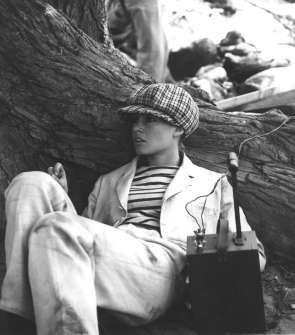
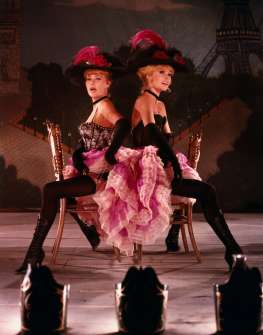
Brigitte Bardot in Amours célèbres (1961)
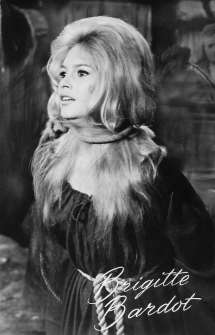
Dutch postcard by Uitg. Takken, Utrecht, no. 4805. Photo: N.V. City-Film. Brigitte Bardot in Amours célèbres / Famous Love Affairs (Michel Boisrond, 1961).French actress Brigitte Bardot (1934) died on 28 December 2025, at the age of 91. In the 1950s, she was the sex kitten of the European film industry. BB starred in 48 films, performed in numerous musical shows, and recorded 80 songs. After her retirement in 1973, she became an animal rights activist. In the coming weeks, we will continue to post a BB postcard every day to remember her as she once was.Brigitte Bardot was born in Paris in 1934. Her father, Louis Bardot, had an engineering degree and worked with his father in the family business. Her mother, Ann-Marie Mucel, was 14 years younger than Brigitte's father, and they married in 1933. Brigitte's mother encouraged her daughter to take up music and dance. At the age of 13, she entered the Conservatoire Nationale de Danse to study ballet. By the time she was 15, Brigitte was trying to launch a modelling career and found herself on the cover of the French magazine Elle in May 1949. Her incredible beauty was readily apparent, and Brigitte was noticed by Roger Vadim, then an assistant to the film director Marc Allegrét. Vadim was infatuated with Bardot and encouraged her to start working as a film actress. BB was 18 when she debuted in the comedy Le Trou Normand / Crazy for Love (Jean Boyer, 1952). In the same year, she married Vadim. Brigitte wanted to marry him when she was 17, but her parents quashed any marriage plans until she turned 18. In April 1953, she attended the Cannes Film Festival, where she received massive media attention. She soon was every man's idea of the girl he'd like to meet in Paris. From 1952 to 1956, she appeared in seventeen films. Her films were generally lightweight romantic dramas in which she was cast as an ingénue or siren, often with an element of undress. In 1953, she made her first US production, Un acte d'amour / Act of Love (Anatole Litvak, 1953) with Kirk Douglas, but she continued to make films in France.Roger Vadim was not content with the light fare his wife was offered. He felt Brigitte Bardot was being undersold. Looking for something more like an art film to push her as a serious actress, he showcased her in Et Dieu créa la femme / ...And God Created Woman (Roger Vadim, 1956). This film, about an immoral teenager in a respectable small-town setting, was a smash success on both sides of the Atlantic. Craig Butler at AllMovie: "It's easy enough to say that ...And God Created Woman is much more important for its historical significance than for its actual quality as a film, and that's true to an extent. The immense popularity, due to its willingness to directly embrace an exploration of sex as well as its willingness to show a degree of nudity that was remarkably daring for its day, demonstrated that audiences were willing to view subject matter that was considered too racy for the average moviegoer. This had both positive (freedom to explore, especially for the French filmmakers of the time) and negative (freedom to exploit) consequences, but its impact is undeniable. It's also true that Woman is not a great work of art, not with a story that is ultimately rather thin, some painful dialogue, and an attitude toward its characters and their sexuality that is unclear and inconsistent. Yet Woman is still fascinating, due in no small part to the presence of Brigitte Bardot in the role that made her an international star and sex symbol. She's not demonstrating great acting here, although her performance is actually good and much better than necessary, and her legendary mambo scene at the climax is nothing short of sensational." During the filming of Et Dieu créa la femme / And God Created Woman (Roger Vadim, 1956), directed by her husband, Brigitte Bardot had an affair with her co-star, Jean-Louis Trintignant, who at the time was married to French actress Stéphane Audran. Her divorce from Vadim followed, but they remained friends and collaborated in later work.Et Dieu créa la femme / ...And God Created Woman (Roger Vadim, 1956) helped elevate Brigitte Bardot's international status. The film took the USA by storm, her explosive sexuality being unlike anything seen in the States since the days of the 'flapper' in the 1920s. It gave rise to the phrase 'sex kitten', and fascination with her in America consisted of magazine photographs and dubbed over French films - good, bad or indifferent, her films drew audiences - mainly men - into theatres like lemmings. BB appeared in light comedies like Doctor at Large (Ralph Thomas, 1957) - the third of the British 'Doctor' series starring Dirk Bogarde - and Une Parisienne / La Parisienne (Michel Boisrond, 1957), which suited her acting skills best. However, she was a sensation in the crime drama En cas de malheur / Love is My Profession (Claude Autant-Lara, 1958). Hal Erickson at AllMovie: "This Brigitte Bardot vehicle ran into stiff opposition from the Catholic Legion of Decency, severely limiting its U.S. distribution. Bardot plays a nubile small-time thief named Yvette, who becomes the mistress of influential defence attorney Andre (Jean Gabin). Though Andre can shower Yvette with jewels and furs, he cannot "buy" her heart, and thus it is that it belongs to handsome young student Mazzetti (Franco Interlenghi). Alas, Yvette is no judge of human nature: attractive though Mazzetti can be, he has a dangerous and deadly side. En Cas de Malheur contains a nude scene that has since been reprinted in freeze-frame form innumerable times by both film-history books and girlie magazines." Photographer Sam Lévin's photos contributed considerably to her image of sensuality and slight immorality. One of Lévin's pictures shows Brigitte, dressed in a white corset. It is said that around 1960, postcards with this photograph outsold in Paris those of the Eiffel Tower.Brigitte Bardot divorced Vadim in 1957, and in 1959 she married actor Jacques Charrier, with whom she starred in Babette s'en va-t-en guerre / Babette Goes to War (Christian-Jaque, 1959). The paparazzi preyed upon her marriage, while she and her husband clashed over the direction of her career
Her films became more substantial, but this brought a heavy pressure of dual celebrity as she sought critical acclaim while remaining a glamour model for most of the world. Vie privée / Private Life (1962), directed by Louis Malle, has more than an element of autobiography in it. James Travers at French Films: "Brigitte Bardot hadn’t quite reached the high point of her career when she agreed to make this film with high-profile New Wave film director Louis Malle. Even so, the pressure of being a living icon was obviously beginning to get to France’s sex goddess, and Vie privée is as much an attempt by Bardot to come to terms with her celebrity as anything else. Malle is clearly fascinated by Bardot, and the documentary approach he adopts for this film reinforces the impression that it is more a biography of the actress than a work of fiction. Of course, it’s not entirely biographical, but the story is remarkably close to Bardot’s own life and comes pretty close to predicting how her career would end." The scene in which, returning to her apartment, Bardot's character is harangued in the elevator by a middle-aged cleaning lady calling her offensive names was based on an actual incident, and is a resonant image of celebrity in the mid-20th century. Soon afterwards, Bardot withdrew to the seclusion of Southern France.Brigitte Bardot's other husbands were German millionaire Playboy Gunter Sachs and right-wing politician Bernard d'Ormale. She is reputed to have had relationships with many other men, including Samy Frey, her co-star in La Vérité / The Truth (Henri-Georges Clouzot, 1960), and musicians Serge Gainsbourg and Sacha Distel. In 1963, Brigitte Bardot starred in Jean-Luc Godard's critically acclaimed film Le Mépris / Contempt (Jean-Luc Godard, 1963) opposite Michel Piccoli. She was also featured along with such notable actors as Alain Delon in Amours célèbres / Famous Love Affairs (Michel Boisrond, 1961) and Histoires extraordinaires /Tales of Mystery (Louis Malle, 1968), Jeanne Moreau in Viva Maria! (Louis Malle, 1965), Sean Connery in Shalako (Edward Dmytryk, 1968), and Claudia Cardinale in Les Pétroleuses / Petroleum Girls (Christian-Jaque, 1971). She participated in various musical shows and recorded many popular songs in the 1960s and 1970s, mostly in collaboration with Serge Gainsbourg, Bob Zagury and Sacha Distel, including 'Harley Davidson', 'Le Soleil De Ma Vie' (the cover of Stevie Wonder's 'You Are the Sunshine of My Life') and the notorious 'Je t'aime... moi non plus'.Brigitte Bardot’s film career showed a steady decline in the late 1960s and early 1970s. In 1973, just before her fortieth birthday, she announced her retirement. She chose to use her fame to promote animal rights. In 1976, she established the Brigitte Bardot Foundation for the Welfare and Protection of Animals. She became a vegetarian and raised three million French francs to fund the foundation by auctioning off jewellery and many personal belongings. For this work, she was awarded the Légion d’honneur in 1984. During the 1990s, she was also outspoken in her criticism of immigration, interracial relationships, Islam in France and homosexuality. Her husband Bernard d'Ormal was a former adviser of the far-right Front National party. Bardot has been convicted five times for 'inciting racial hatred'. More fun is that Bardot is recognised for popularising bikini swimwear, in such early films as Manina / Woman without a Veil (Willy Rozier, 1952), in her appearances at Cannes and in many photo shoots. Bardot also brought into fashion the 'choucroute' ('Sauerkraut') hairstyle (a sort of beehive hairstyle) and gingham clothes after wearing a checkered pink dress, designed by Jacques Esterel, at her wedding to Charrier. The fashions of the 1960s looked effortlessly right and spontaneous on her. Time Magazine: "She is the princess of pout, the countess of come hither. Brigitte Bardot exuded a carefree, naïve sexuality that brought a whole new audience to French films."Sources: Denny Jackson (IMDb), Hal Erickson (AllMovie), Craig Butler (AllMovie), James Travers (French Films), French Films, Wikipedia and IMDb.And please check out our blog European Film Star Postcards.
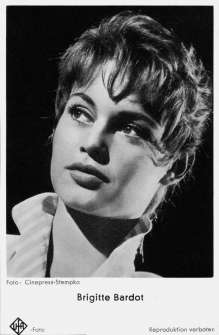
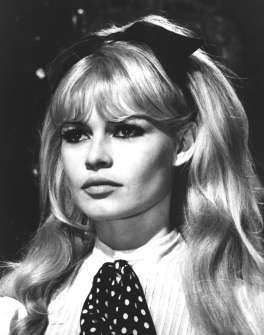
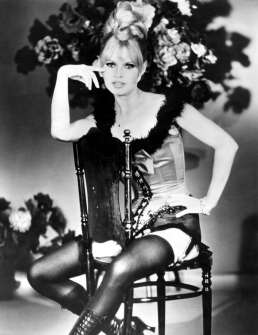
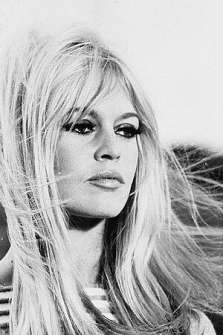
Brigitte Bardot
West German postcard by Ufa-Foto, a supplement by Film Freund, no. 15, 1956. Photo: Cinepress / Stempka.French actress Brigitte Bardot (1934) died on 28 December 2025, at the age of 91. In the 1950s, she was the sex kitten of the European film industry. BB starred in 48 films, performed in numerous musical shows, and recorded 80 songs. After her retirement in 1973, she became an animal rights activist. In the coming weeks, we will continue to post a BB postcard every day to remember her as she once was.Brigitte Bardot was born in Paris in 1934. Her father, Louis Bardot, had an engineering degree and worked with his father in the family business. Her mother, Ann-Marie Mucel, was 14 years younger than Brigitte's father, and they married in 1933. Brigitte's mother encouraged her daughter to take up music and dance. At the age of 13, she entered the Conservatoire Nationale de Danse to study ballet. By the time she was 15, Brigitte was trying to launch a modelling career and found herself on the cover of the French magazine Elle in May 1949. Her incredible beauty was readily apparent, and Brigitte was noticed by Roger Vadim, then an assistant to the film director Marc Allegrét. Vadim was infatuated with Bardot and encouraged her to start working as a film actress. BB was 18 when she debuted in the comedy Le Trou Normand / Crazy for Love (Jean Boyer, 1952). In the same year, she married Vadim. Brigitte wanted to marry him when she was 17, but her parents quashed any marriage plans until she turned 18. In April 1953, she attended the Cannes Film Festival, where she received massive media attention. She soon was every man's idea of the girl he'd like to meet in Paris. From 1952 to 1956, she appeared in seventeen films. Her films were generally lightweight romantic dramas in which she was cast as an ingénue or siren, often with an element of undress. In 1953, she made her first US production, Un acte d'amour / Act of Love (Anatole Litvak, 1953) with Kirk Douglas, but she continued to make films in France.Roger Vadim was not content with the light fare his wife was offered. He felt Brigitte Bardot was being undersold. Looking for something more like an art film to push her as a serious actress, he showcased her in Et Dieu créa la femme / ...And God Created Woman (Roger Vadim, 1956). This film, about an immoral teenager in a respectable small-town setting, was a smash success on both sides of the Atlantic. Craig Butler at AllMovie: "It's easy enough to say that ...And God Created Woman is much more important for its historical significance than for its actual quality as a film, and that's true to an extent. The immense popularity, due to its willingness to directly embrace an exploration of sex as well as its willingness to show a degree of nudity that was remarkably daring for its day, demonstrated that audiences were willing to view subject matter that was considered too racy for the average moviegoer. This had both positive (freedom to explore, especially for the French filmmakers of the time) and negative (freedom to exploit) consequences, but its impact is undeniable. It's also true that Woman is not a great work of art, not with a story that is ultimately rather thin, some painful dialogue, and an attitude toward its characters and their sexuality that is unclear and inconsistent. Yet Woman is still fascinating, due in no small part to the presence of Brigitte Bardot in the role that made her an international star and sex symbol. She's not demonstrating great acting here, although her performance is actually good and much better than necessary, and her legendary mambo scene at the climax is nothing short of sensational." During the filming of Et Dieu créa la femme / And God Created Woman (Roger Vadim, 1956), directed by her husband, Brigitte Bardot had an affair with her co-star, Jean-Louis Trintignant, who at the time was married to French actress Stéphane Audran. Her divorce from Vadim followed, but they remained friends and collaborated in later work.Et Dieu créa la femme / ...And God Created Woman (Roger Vadim, 1956) helped elevate Brigitte Bardot's international status. The film took the USA by storm, her explosive sexuality being unlike anything seen in the States since the days of the 'flapper' in the 1920s. It gave rise to the phrase 'sex kitten', and fascination with her in America consisted of magazine photographs and dubbed over French films - good, bad or indifferent, her films drew audiences - mainly men - into theatres like lemmings. BB appeared in light comedies like Doctor at Large (Ralph Thomas, 1957) - the third of the British 'Doctor' series starring Dirk Bogarde - and Une Parisienne / La Parisienne (Michel Boisrond, 1957), which suited her acting skills best. However, she was a sensation in the crime drama En cas de malheur / Love is My Profession (Claude Autant-Lara, 1958). Hal Erickson at AllMovie: "This Brigitte Bardot vehicle ran into stiff opposition from the Catholic Legion of Decency, severely limiting its U.S. distribution. Bardot plays a nubile small-time thief named Yvette, who becomes the mistress of influential defence attorney Andre (Jean Gabin). Though Andre can shower Yvette with jewels and furs, he cannot "buy" her heart, and thus it is that it belongs to handsome young student Mazzetti (Franco Interlenghi). Alas, Yvette is no judge of human nature: attractive though Mazzetti can be, he has a dangerous and deadly side. En Cas de Malheur contains a nude scene that has since been reprinted in freeze-frame form innumerable times by both film-history books and girlie magazines." Photographer Sam Lévin's photos contributed considerably to her image of sensuality and slight immorality. One of Lévin's pictures shows Brigitte, dressed in a white corset. It is said that around 1960, postcards with this photograph outsold in Paris those of the Eiffel Tower.Brigitte Bardot divorced Vadim in 1957, and in 1959 she married actor Jacques Charrier, with whom she starred in Babette s'en va-t-en guerre / Babette Goes to War (Christian-Jaque, 1959). The paparazzi preyed upon her marriage, while she and her husband clashed over the direction of her career
Her films became more substantial, but this brought a heavy pressure of dual celebrity as she sought critical acclaim while remaining a glamour model for most of the world. Vie privée / Private Life (1962), directed by Louis Malle, has more than an element of autobiography in it. James Travers at French Films: "Brigitte Bardot hadn’t quite reached the high point of her career when she agreed to make this film with high-profile New Wave film director Louis Malle. Even so, the pressure of being a living icon was obviously beginning to get to France’s sex goddess, and Vie privée is as much an attempt by Bardot to come to terms with her celebrity as anything else. Malle is clearly fascinated by Bardot, and the documentary approach he adopts for this film reinforces the impression that it is more a biography of the actress than a work of fiction. Of course, it’s not entirely biographical, but the story is remarkably close to Bardot’s own life and comes pretty close to predicting how her career would end." The scene in which, returning to her apartment, Bardot's character is harangued in the elevator by a middle-aged cleaning lady calling her offensive names was based on an actual incident, and is a resonant image of celebrity in the mid-20th century. Soon afterwards, Bardot withdrew to the seclusion of Southern France.Brigitte Bardot's other husbands were German millionaire Playboy Gunter Sachs and right-wing politician Bernard d'Ormale. She is reputed to have had relationships with many other men, including Samy Frey, her co-star in La Vérité / The Truth (Henri-Georges Clouzot, 1960), and musicians Serge Gainsbourg and Sacha Distel. In 1963, Brigitte Bardot starred in Jean-Luc Godard's critically acclaimed film Le Mépris / Contempt (Jean-Luc Godard, 1963) opposite Michel Piccoli. She was also featured along with such notable actors as Alain Delon in Amours célèbres / Famous Love Affairs (Michel Boisrond, 1961) and Histoires extraordinaires /Tales of Mystery (Louis Malle, 1968), Jeanne Moreau in Viva Maria! (Louis Malle, 1965), Sean Connery in Shalako (Edward Dmytryk, 1968), and Claudia Cardinale in Les Pétroleuses / Petroleum Girls (Christian-Jaque, 1971). She participated in various musical shows and recorded many popular songs in the 1960s and 1970s, mostly in collaboration with Serge Gainsbourg, Bob Zagury and Sacha Distel, including 'Harley Davidson', 'Le Soleil De Ma Vie' (the cover of Stevie Wonder's 'You Are the Sunshine of My Life') and the notorious 'Je t'aime... moi non plus'.Brigitte Bardot’s film career showed a steady decline in the late 1960s and early 1970s. In 1973, just before her fortieth birthday, she announced her retirement. She chose to use her fame to promote animal rights. In 1976, she established the Brigitte Bardot Foundation for the Welfare and Protection of Animals. She became a vegetarian and raised three million French francs to fund the foundation by auctioning off jewellery and many personal belongings. For this work, she was awarded the Légion d’honneur in 1984. During the 1990s, she was also outspoken in her criticism of immigration, interracial relationships, Islam in France and homosexuality. Her husband Bernard d'Ormal was a former adviser of the far-right Front National party. Bardot has been convicted five times for 'inciting racial hatred'. More fun is that Bardot is recognised for popularising bikini swimwear, in such early films as Manina / Woman without a Veil (Willy Rozier, 1952), in her appearances at Cannes and in many photo shoots. Bardot also brought into fashion the 'choucroute' ('Sauerkraut') hairstyle (a sort of beehive hairstyle) and gingham clothes after wearing a checkered pink dress, designed by Jacques Esterel, at her wedding to Charrier. The fashions of the 1960s looked effortlessly right and spontaneous on her. Time Magazine: "She is the princess of pout, the countess of come hither. Brigitte Bardot exuded a carefree, naïve sexuality that brought a whole new audience to French films."Sources: Denny Jackson (IMDb), Hal Erickson (AllMovie), Craig Butler (AllMovie), James Travers (French Films), French Films, Wikipedia and IMDb.And please check out our blog European Film Star Postcards.
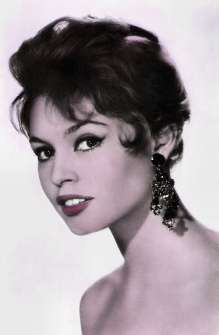
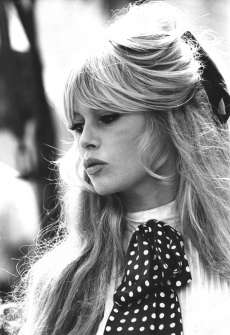
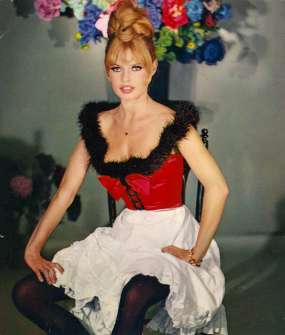
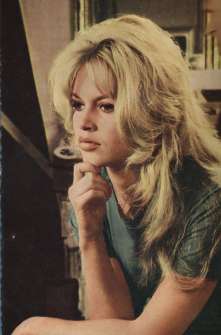
Brigitte Bardot
Yugoslav postcard by Studio Sombor, no. 202.French actress Brigitte Bardot (1934) died on 28 December 2025, at the age of 91. In the 1950s, she was the sex kitten of the European film industry. BB starred in 48 films, performed in numerous musical shows, and recorded 80 songs. After her retirement in 1973, she became an animal rights activist. In the coming weeks, we will continue to post a BB postcard every day to remember her as she once was.Brigitte Bardot was born in Paris in 1934. Her father, Louis Bardot, had an engineering degree and worked with his father in the family business. Her mother, Ann-Marie Mucel, was 14 years younger than Brigitte's father, and they married in 1933. Brigitte's mother encouraged her daughter to take up music and dance. At the age of 13, she entered the Conservatoire Nationale de Danse to study ballet. By the time she was 15, Brigitte was trying to launch a modelling career and found herself on the cover of the French magazine Elle in May 1949. Her incredible beauty was readily apparent, and Brigitte was noticed by Roger Vadim, then an assistant to the film director Marc Allegrét. Vadim was infatuated with Bardot and encouraged her to start working as a film actress. BB was 18 when she debuted in the comedy Le Trou Normand / Crazy for Love (Jean Boyer, 1952). In the same year, she married Vadim. Brigitte wanted to marry him when she was 17, but her parents quashed any marriage plans until she turned 18. In April 1953, she attended the Cannes Film Festival, where she received massive media attention. She soon was every man's idea of the girl he'd like to meet in Paris. From 1952 to 1956, she appeared in seventeen films. Her films were generally lightweight romantic dramas in which she was cast as an ingénue or siren, often with an element of undress. In 1953, she made her first US production, Un acte d'amour / Act of Love (Anatole Litvak, 1953) with Kirk Douglas, but she continued to make films in France.Roger Vadim was not content with the light fare his wife was offered. He felt Brigitte Bardot was being undersold. Looking for something more like an art film to push her as a serious actress, he showcased her in Et Dieu créa la femme / ...And God Created Woman (Roger Vadim, 1956). This film, about an immoral teenager in a respectable small-town setting, was a smash success on both sides of the Atlantic. Craig Butler at AllMovie: "It's easy enough to say that ...And God Created Woman is much more important for its historical significance than for its actual quality as a film, and that's true to an extent. The immense popularity, due to its willingness to directly embrace an exploration of sex as well as its willingness to show a degree of nudity that was remarkably daring for its day, demonstrated that audiences were willing to view subject matter that was considered too racy for the average moviegoer. This had both positive (freedom to explore, especially for the French filmmakers of the time) and negative (freedom to exploit) consequences, but its impact is undeniable. It's also true that Woman is not a great work of art, not with a story that is ultimately rather thin, some painful dialogue, and an attitude toward its characters and their sexuality that is unclear and inconsistent. Yet Woman is still fascinating, due in no small part to the presence of Brigitte Bardot in the role that made her an international star and sex symbol. She's not demonstrating great acting here, although her performance is actually good and much better than necessary, and her legendary mambo scene at the climax is nothing short of sensational." During the filming of Et Dieu créa la femme / And God Created Woman (Roger Vadim, 1956), directed by her husband, Brigitte Bardot had an affair with her co-star, Jean-Louis Trintignant, who at the time was married to French actress Stéphane Audran. Her divorce from Vadim followed, but they remained friends and collaborated in later work.Et Dieu créa la femme / ...And God Created Woman (Roger Vadim, 1956) helped elevate Brigitte Bardot's international status. The film took the USA by storm, her explosive sexuality being unlike anything seen in the States since the days of the 'flapper' in the 1920s. It gave rise to the phrase 'sex kitten', and fascination with her in America consisted of magazine photographs and dubbed over French films - good, bad or indifferent, her films drew audiences - mainly men - into theatres like lemmings. BB appeared in light comedies like Doctor at Large (Ralph Thomas, 1957) - the third of the British 'Doctor' series starring Dirk Bogarde - and Une Parisienne / La Parisienne (Michel Boisrond, 1957), which suited her acting skills best. However, she was a sensation in the crime drama En cas de malheur / Love is My Profession (Claude Autant-Lara, 1958). Hal Erickson at AllMovie: "This Brigitte Bardot vehicle ran into stiff opposition from the Catholic Legion of Decency, severely limiting its U.S. distribution. Bardot plays a nubile small-time thief named Yvette, who becomes the mistress of influential defence attorney Andre (Jean Gabin). Though Andre can shower Yvette with jewels and furs, he cannot "buy" her heart, and thus it is that it belongs to handsome young student Mazzetti (Franco Interlenghi). Alas, Yvette is no judge of human nature: attractive though Mazzetti can be, he has a dangerous and deadly side. En Cas de Malheur contains a nude scene that has since been reprinted in freeze-frame form innumerable times by both film-history books and girlie magazines." Photographer Sam Lévin's photos contributed considerably to her image of sensuality and slight immorality. One of Lévin's pictures shows Brigitte, dressed in a white corset. It is said that around 1960, postcards with this photograph outsold in Paris those of the Eiffel Tower.Brigitte Bardot divorced Vadim in 1957, and in 1959 she married actor Jacques Charrier, with whom she starred in Babette s'en va-t-en guerre / Babette Goes to War (Christian-Jaque, 1959). The paparazzi preyed upon her marriage, while she and her husband clashed over the direction of her career
Her films became more substantial, but this brought a heavy pressure of dual celebrity as she sought critical acclaim while remaining a glamour model for most of the world. Vie privée / Private Life (1962), directed by Louis Malle, has more than an element of autobiography in it. James Travers at French Films: "Brigitte Bardot hadn’t quite reached the high point of her career when she agreed to make this film with high-profile New Wave film director Louis Malle. Even so, the pressure of being a living icon was obviously beginning to get to France’s sex goddess, and Vie privée is as much an attempt by Bardot to come to terms with her celebrity as anything else. Malle is clearly fascinated by Bardot, and the documentary approach he adopts for this film reinforces the impression that it is more a biography of the actress than a work of fiction. Of course, it’s not entirely biographical, but the story is remarkably close to Bardot’s own life and comes pretty close to predicting how her career would end." The scene in which, returning to her apartment, Bardot's character is harangued in the elevator by a middle-aged cleaning lady calling her offensive names was based on an actual incident, and is a resonant image of celebrity in the mid-20th century. Soon afterwards, Bardot withdrew to the seclusion of Southern France.Brigitte Bardot's other husbands were German millionaire Playboy Gunter Sachs and right-wing politician Bernard d'Ormale. She is reputed to have had relationships with many other men, including Samy Frey, her co-star in La Vérité / The Truth (Henri-Georges Clouzot, 1960), and musicians Serge Gainsbourg and Sacha Distel. In 1963, Brigitte Bardot starred in Jean-Luc Godard's critically acclaimed film Le Mépris / Contempt (Jean-Luc Godard, 1963) opposite Michel Piccoli. She was also featured along with such notable actors as Alain Delon in Amours célèbres / Famous Love Affairs (Michel Boisrond, 1961) and Histoires extraordinaires /Tales of Mystery (Louis Malle, 1968), Jeanne Moreau in Viva Maria! (Louis Malle, 1965), Sean Connery in Shalako (Edward Dmytryk, 1968), and Claudia Cardinale in Les Pétroleuses / Petroleum Girls (Christian-Jaque, 1971). She participated in various musical shows and recorded many popular songs in the 1960s and 1970s, mostly in collaboration with Serge Gainsbourg, Bob Zagury and Sacha Distel, including 'Harley Davidson', 'Le Soleil De Ma Vie' (the cover of Stevie Wonder's 'You Are the Sunshine of My Life') and the notorious 'Je t'aime... moi non plus'.Brigitte Bardot’s film career showed a steady decline in the late 1960s and early 1970s. In 1973, just before her fortieth birthday, she announced her retirement. She chose to use her fame to promote animal rights. In 1976, she established the Brigitte Bardot Foundation for the Welfare and Protection of Animals. She became a vegetarian and raised three million French francs to fund the foundation by auctioning off jewellery and many personal belongings. For this work, she was awarded the Légion d’honneur in 1984. During the 1990s, she was also outspoken in her criticism of immigration, interracial relationships, Islam in France and homosexuality. Her husband Bernard d'Ormal was a former adviser of the far-right Front National party. Bardot has been convicted five times for 'inciting racial hatred'. More fun is that Bardot is recognised for popularising bikini swimwear, in such early films as Manina / Woman without a Veil (Willy Rozier, 1952), in her appearances at Cannes and in many photo shoots. Bardot also brought into fashion the 'choucroute' ('Sauerkraut') hairstyle (a sort of beehive hairstyle) and gingham clothes after wearing a checkered pink dress, designed by Jacques Esterel, at her wedding to Charrier. The fashions of the 1960s looked effortlessly right and spontaneous on her. Time Magazine: "She is the princess of pout, the countess of come hither. Brigitte Bardot exuded a carefree, naïve sexuality that brought a whole new audience to French films."Sources: Denny Jackson (IMDb), Hal Erickson (AllMovie), Craig Butler (AllMovie), James Travers (French Films), French Films, Wikipedia and IMDb.And please check out our blog European Film Star Postcards.
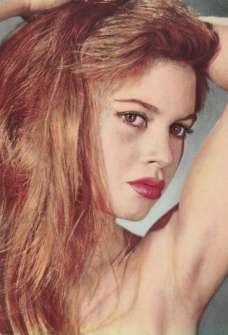
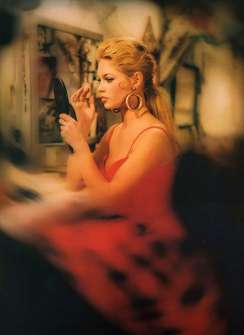
Brigitte Bardot
Austrian postcard by H. u. D. Hubmann, Wien, no. 32. Licence holder for Austria of Ufa, Berlin-Tempelhof. Photo: Unifrance Film.French actress Brigitte Bardot (1934) died on 28 December 2025, at the age of 91. In the 1950s, she was the sex kitten of the European film industry. BB starred in 48 films, performed in numerous musical shows, and recorded 80 songs. After her retirement in 1973, she became an animal rights activist. In the coming weeks, we will continue to post a BB postcard every day to remember her as she once was.Brigitte Bardot was born in Paris in 1934. Her father, Louis Bardot, had an engineering degree and worked with his father in the family business. Her mother, Ann-Marie Mucel, was 14 years younger than Brigitte's father, and they married in 1933. Brigitte's mother encouraged her daughter to take up music and dance. At the age of 13, she entered the Conservatoire Nationale de Danse to study ballet. By the time she was 15, Brigitte was trying to launch a modelling career and found herself on the cover of the French magazine Elle in May 1949. Her incredible beauty was readily apparent, and Brigitte was noticed by Roger Vadim, then an assistant to the film director Marc Allegrét. Vadim was infatuated with Bardot and encouraged her to start working as a film actress. BB was 18 when she debuted in the comedy Le Trou Normand / Crazy for Love (Jean Boyer, 1952). In the same year, she married Vadim. Brigitte wanted to marry him when she was 17, but her parents quashed any marriage plans until she turned 18. In April 1953, she attended the Cannes Film Festival, where she received massive media attention. She soon was every man's idea of the girl he'd like to meet in Paris. From 1952 to 1956, she appeared in seventeen films. Her films were generally lightweight romantic dramas in which she was cast as an ingénue or siren, often with an element of undress. In 1953, she made her first US production, Un acte d'amour / Act of Love (Anatole Litvak, 1953) with Kirk Douglas, but she continued to make films in France.Roger Vadim was not content with the light fare his wife was offered. He felt Brigitte Bardot was being undersold. Looking for something more like an art film to push her as a serious actress, he showcased her in Et Dieu créa la femme / ...And God Created Woman (Roger Vadim, 1956). This film, about an immoral teenager in a respectable small-town setting, was a smash success on both sides of the Atlantic. Craig Butler at AllMovie: "It's easy enough to say that ...And God Created Woman is much more important for its historical significance than for its actual quality as a film, and that's true to an extent. The immense popularity, due to its willingness to directly embrace an exploration of sex as well as its willingness to show a degree of nudity that was remarkably daring for its day, demonstrated that audiences were willing to view subject matter that was considered too racy for the average moviegoer. This had both positive (freedom to explore, especially for the French filmmakers of the time) and negative (freedom to exploit) consequences, but its impact is undeniable. It's also true that Woman is not a great work of art, not with a story that is ultimately rather thin, some painful dialogue, and an attitude toward its characters and their sexuality that is unclear and inconsistent. Yet Woman is still fascinating, due in no small part to the presence of Brigitte Bardot in the role that made her an international star and sex symbol. She's not demonstrating great acting here, although her performance is actually good and much better than necessary, and her legendary mambo scene at the climax is nothing short of sensational." During the filming of Et Dieu créa la femme / And God Created Woman (Roger Vadim, 1956), directed by her husband, Brigitte Bardot had an affair with her co-star, Jean-Louis Trintignant, who at the time was married to French actress Stéphane Audran. Her divorce from Vadim followed, but they remained friends and collaborated in later work.Et Dieu créa la femme / ...And God Created Woman (Roger Vadim, 1956) helped elevate Brigitte Bardot's international status. The film took the USA by storm, her explosive sexuality being unlike anything seen in the States since the days of the 'flapper' in the 1920s. It gave rise to the phrase 'sex kitten', and fascination with her in America consisted of magazine photographs and dubbed over French films - good, bad or indifferent, her films drew audiences - mainly men - into theatres like lemmings. BB appeared in light comedies like Doctor at Large (Ralph Thomas, 1957) - the third of the British 'Doctor' series starring Dirk Bogarde - and Une Parisienne / La Parisienne (Michel Boisrond, 1957), which suited her acting skills best. However, she was a sensation in the crime drama En cas de malheur / Love is My Profession (Claude Autant-Lara, 1958). Hal Erickson at AllMovie: "This Brigitte Bardot vehicle ran into stiff opposition from the Catholic Legion of Decency, severely limiting its U.S. distribution. Bardot plays a nubile small-time thief named Yvette, who becomes the mistress of influential defence attorney Andre (Jean Gabin). Though Andre can shower Yvette with jewels and furs, he cannot "buy" her heart, and thus it is that it belongs to handsome young student Mazzetti (Franco Interlenghi). Alas, Yvette is no judge of human nature: attractive though Mazzetti can be, he has a dangerous and deadly side. En Cas de Malheur contains a nude scene that has since been reprinted in freeze-frame form innumerable times by both film-history books and girlie magazines." Photographer Sam Lévin's photos contributed considerably to her image of sensuality and slight immorality. One of Lévin's pictures shows Brigitte, dressed in a white corset. It is said that around 1960, postcards with this photograph outsold in Paris those of the Eiffel Tower.Brigitte Bardot divorced Vadim in 1957, and in 1959 she married actor Jacques Charrier, with whom she starred in Babette s'en va-t-en guerre / Babette Goes to War (Christian-Jaque, 1959). The paparazzi preyed upon her marriage, while she and her husband clashed over the direction of her career
Her films became more substantial, but this brought a heavy pressure of dual celebrity as she sought critical acclaim while remaining a glamour model for most of the world. Vie privée / Private Life (1962), directed by Louis Malle, has more than an element of autobiography in it. James Travers at French Films: "Brigitte Bardot hadn’t quite reached the high point of her career when she agreed to make this film with high-profile New Wave film director Louis Malle. Even so, the pressure of being a living icon was obviously beginning to get to France’s sex goddess, and Vie privée is as much an attempt by Bardot to come to terms with her celebrity as anything else. Malle is clearly fascinated by Bardot, and the documentary approach he adopts for this film reinforces the impression that it is more a biography of the actress than a work of fiction. Of course, it’s not entirely biographical, but the story is remarkably close to Bardot’s own life and comes pretty close to predicting how her career would end." The scene in which, returning to her apartment, Bardot's character is harangued in the elevator by a middle-aged cleaning lady calling her offensive names was based on an actual incident, and is a resonant image of celebrity in the mid-20th century. Soon afterwards, Bardot withdrew to the seclusion of Southern France.Brigitte Bardot's other husbands were German millionaire Playboy Gunter Sachs and right-wing politician Bernard d'Ormale. She is reputed to have had relationships with many other men, including Samy Frey, her co-star in La Vérité / The Truth (Henri-Georges Clouzot, 1960), and musicians Serge Gainsbourg and Sacha Distel. In 1963, Brigitte Bardot starred in Jean-Luc Godard's critically acclaimed film Le Mépris / Contempt (Jean-Luc Godard, 1963) opposite Michel Piccoli. She was also featured along with such notable actors as Alain Delon in Amours célèbres / Famous Love Affairs (Michel Boisrond, 1961) and Histoires extraordinaires /Tales of Mystery (Louis Malle, 1968), Jeanne Moreau in Viva Maria! (Louis Malle, 1965), Sean Connery in Shalako (Edward Dmytryk, 1968), and Claudia Cardinale in Les Pétroleuses / Petroleum Girls (Christian-Jaque, 1971). She participated in various musical shows and recorded many popular songs in the 1960s and 1970s, mostly in collaboration with Serge Gainsbourg, Bob Zagury and Sacha Distel, including 'Harley Davidson', 'Le Soleil De Ma Vie' (the cover of Stevie Wonder's 'You Are the Sunshine of My Life') and the notorious 'Je t'aime... moi non plus'.Brigitte Bardot’s film career showed a steady decline in the late 1960s and early 1970s. In 1973, just before her fortieth birthday, she announced her retirement. She chose to use her fame to promote animal rights. In 1976, she established the Brigitte Bardot Foundation for the Welfare and Protection of Animals. She became a vegetarian and raised three million French francs to fund the foundation by auctioning off jewellery and many personal belongings. For this work, she was awarded the Légion d’honneur in 1984. During the 1990s, she was also outspoken in her criticism of immigration, interracial relationships, Islam in France and homosexuality. Her husband Bernard d'Ormal was a former adviser of the far-right Front National party. Bardot has been convicted five times for 'inciting racial hatred'. More fun is that Bardot is recognised for popularising bikini swimwear, in such early films as Manina / Woman without a Veil (Willy Rozier, 1952), in her appearances at Cannes and in many photo shoots. Bardot also brought into fashion the 'choucroute' ('Sauerkraut') hairstyle (a sort of beehive hairstyle) and gingham clothes after wearing a checkered pink dress, designed by Jacques Esterel, at her wedding to Charrier. The fashions of the 1960s looked effortlessly right and spontaneous on her. Time Magazine: "She is the princess of pout, the countess of come hither. Brigitte Bardot exuded a carefree, naïve sexuality that brought a whole new audience to French films."Sources: Denny Jackson (IMDb), Hal Erickson (AllMovie), Craig Butler (AllMovie), James Travers (French Films), French Films, Wikipedia and IMDb.And please check out our blog European Film Star Postcards.
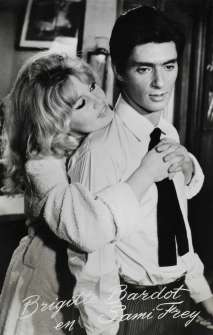
Brigitte Bardot and Sami Frey in La vérité (1960)
Dutch postcard by Uitg. Takken, Utrecht, no. AX 4522. Brigitte Bardot and Sami Frey in La vérité / The Truth (Henri-Georges Clouzot, 1960).French actress Brigitte Bardot (1934) died on 28 December 2025, at the age of 91. In the 1950s, she was the sex kitten of the European film industry. BB starred in 48 films, performed in numerous musical shows, and recorded 80 songs. After her retirement in 1973, she became an animal rights activist. In the coming weeks, we will continue to post a BB postcard every day to remember her as she once was.Brigitte Bardot was born in Paris in 1934. Her father, Louis Bardot, had an engineering degree and worked with his father in the family business. Her mother, Ann-Marie Mucel, was 14 years younger than Brigitte's father, and they married in 1933. Brigitte's mother encouraged her daughter to take up music and dance. At the age of 13, she entered the Conservatoire Nationale de Danse to study ballet. By the time she was 15, Brigitte was trying to launch a modelling career and found herself on the cover of the French magazine Elle in May 1949. Her incredible beauty was readily apparent, and Brigitte was noticed by Roger Vadim, then an assistant to the film director Marc Allegrét. Vadim was infatuated with Bardot and encouraged her to start working as a film actress. BB was 18 when she debuted in the comedy Le Trou Normand / Crazy for Love (Jean Boyer, 1952). In the same year, she married Vadim. Brigitte wanted to marry him when she was 17, but her parents quashed any marriage plans until she turned 18. In April 1953, she attended the Cannes Film Festival, where she received massive media attention. She soon was every man's idea of the girl he'd like to meet in Paris. From 1952 to 1956, she appeared in seventeen films. Her films were generally lightweight romantic dramas in which she was cast as an ingénue or siren, often with an element of undress. In 1953, she made her first US production, Un acte d'amour / Act of Love (Anatole Litvak, 1953) with Kirk Douglas, but she continued to make films in France.Roger Vadim was not content with the light fare his wife was offered. He felt Brigitte Bardot was being undersold. Looking for something more like an art film to push her as a serious actress, he showcased her in Et Dieu créa la femme / ...And God Created Woman (Roger Vadim, 1956). This film, about an immoral teenager in a respectable small-town setting, was a smash success on both sides of the Atlantic. Craig Butler at AllMovie: "It's easy enough to say that ...And God Created Woman is much more important for its historical significance than for its actual quality as a film, and that's true to an extent. The immense popularity, due to its willingness to directly embrace an exploration of sex as well as its willingness to show a degree of nudity that was remarkably daring for its day, demonstrated that audiences were willing to view subject matter that was considered too racy for the average moviegoer. This had both positive (freedom to explore, especially for the French filmmakers of the time) and negative (freedom to exploit) consequences, but its impact is undeniable. It's also true that Woman is not a great work of art, not with a story that is ultimately rather thin, some painful dialogue, and an attitude toward its characters and their sexuality that is unclear and inconsistent. Yet Woman is still fascinating, due in no small part to the presence of Brigitte Bardot in the role that made her an international star and sex symbol. She's not demonstrating great acting here, although her performance is actually good and much better than necessary, and her legendary mambo scene at the climax is nothing short of sensational." During the filming of Et Dieu créa la femme / And God Created Woman (Roger Vadim, 1956), directed by her husband, Brigitte Bardot had an affair with her co-star, Jean-Louis Trintignant, who at the time was married to French actress Stéphane Audran. Her divorce from Vadim followed, but they remained friends and collaborated in later work.Et Dieu créa la femme / ...And God Created Woman (Roger Vadim, 1956) helped elevate Brigitte Bardot's international status. The film took the USA by storm, her explosive sexuality being unlike anything seen in the States since the days of the 'flapper' in the 1920s. It gave rise to the phrase 'sex kitten', and fascination with her in America consisted of magazine photographs and dubbed over French films - good, bad or indifferent, her films drew audiences - mainly men - into theatres like lemmings. BB appeared in light comedies like Doctor at Large (Ralph Thomas, 1957) - the third of the British 'Doctor' series starring Dirk Bogarde - and Une Parisienne / La Parisienne (Michel Boisrond, 1957), which suited her acting skills best. However, she was a sensation in the crime drama En cas de malheur / Love is My Profession (Claude Autant-Lara, 1958). Hal Erickson at AllMovie: "This Brigitte Bardot vehicle ran into stiff opposition from the Catholic Legion of Decency, severely limiting its U.S. distribution. Bardot plays a nubile small-time thief named Yvette, who becomes the mistress of influential defence attorney Andre (Jean Gabin). Though Andre can shower Yvette with jewels and furs, he cannot "buy" her heart, and thus it is that it belongs to handsome young student Mazzetti (Franco Interlenghi). Alas, Yvette is no judge of human nature: attractive though Mazzetti can be, he has a dangerous and deadly side. En Cas de Malheur contains a nude scene that has since been reprinted in freeze-frame form innumerable times by both film-history books and girlie magazines." Photographer Sam Lévin's photos contributed considerably to her image of sensuality and slight immorality. One of Lévin's pictures shows Brigitte, dressed in a white corset. It is said that around 1960, postcards with this photograph outsold in Paris those of the Eiffel Tower.Brigitte Bardot divorced Vadim in 1957, and in 1959 she married actor Jacques Charrier, with whom she starred in Babette s'en va-t-en guerre / Babette Goes to War (Christian-Jaque, 1959). The paparazzi preyed upon her marriage, while she and her husband clashed over the direction of her career
Her films became more substantial, but this brought a heavy pressure of dual celebrity as she sought critical acclaim while remaining a glamour model for most of the world. Vie privée / Private Life (1962), directed by Louis Malle, has more than an element of autobiography in it. James Travers at French Films: "Brigitte Bardot hadn’t quite reached the high point of her career when she agreed to make this film with high-profile New Wave film director Louis Malle. Even so, the pressure of being a living icon was obviously beginning to get to France’s sex goddess, and Vie privée is as much an attempt by Bardot to come to terms with her celebrity as anything else. Malle is clearly fascinated by Bardot, and the documentary approach he adopts for this film reinforces the impression that it is more a biography of the actress than a work of fiction. Of course, it’s not entirely biographical, but the story is remarkably close to Bardot’s own life and comes pretty close to predicting how her career would end." The scene in which, returning to her apartment, Bardot's character is harangued in the elevator by a middle-aged cleaning lady calling her offensive names was based on an actual incident, and is a resonant image of celebrity in the mid-20th century. Soon afterwards, Bardot withdrew to the seclusion of Southern France.Brigitte Bardot's other husbands were German millionaire Playboy Gunter Sachs and right-wing politician Bernard d'Ormale. She is reputed to have had relationships with many other men, including Samy Frey, her co-star in La Vérité / The Truth (Henri-Georges Clouzot, 1960), and musicians Serge Gainsbourg and Sacha Distel. In 1963, Brigitte Bardot starred in Jean-Luc Godard's critically acclaimed film Le Mépris / Contempt (Jean-Luc Godard, 1963) opposite Michel Piccoli. She was also featured along with such notable actors as Alain Delon in Amours célèbres / Famous Love Affairs (Michel Boisrond, 1961) and Histoires extraordinaires /Tales of Mystery (Louis Malle, 1968), Jeanne Moreau in Viva Maria! (Louis Malle, 1965), Sean Connery in Shalako (Edward Dmytryk, 1968), and Claudia Cardinale in Les Pétroleuses / Petroleum Girls (Christian-Jaque, 1971). She participated in various musical shows and recorded many popular songs in the 1960s and 1970s, mostly in collaboration with Serge Gainsbourg, Bob Zagury and Sacha Distel, including 'Harley Davidson', 'Le Soleil De Ma Vie' (the cover of Stevie Wonder's 'You Are the Sunshine of My Life') and the notorious 'Je t'aime... moi non plus'.Brigitte Bardot’s film career showed a steady decline in the late 1960s and early 1970s. In 1973, just before her fortieth birthday, she announced her retirement. She chose to use her fame to promote animal rights. In 1976, she established the Brigitte Bardot Foundation for the Welfare and Protection of Animals. She became a vegetarian and raised three million French francs to fund the foundation by auctioning off jewellery and many personal belongings. For this work, she was awarded the Légion d’honneur in 1984. During the 1990s, she was also outspoken in her criticism of immigration, interracial relationships, Islam in France and homosexuality. Her husband Bernard d'Ormal was a former adviser of the far-right Front National party. Bardot has been convicted five times for 'inciting racial hatred'. More fun is that Bardot is recognised for popularising bikini swimwear, in such early films as Manina / Woman without a Veil (Willy Rozier, 1952), in her appearances at Cannes and in many photo shoots. Bardot also brought into fashion the 'choucroute' ('Sauerkraut') hairstyle (a sort of beehive hairstyle) and gingham clothes after wearing a checkered pink dress, designed by Jacques Esterel, at her wedding to Charrier. The fashions of the 1960s looked effortlessly right and spontaneous on her. Time Magazine: "She is the princess of pout, the countess of come hither. Brigitte Bardot exuded a carefree, naïve sexuality that brought a whole new audience to French films."Sources: Denny Jackson (IMDb), Hal Erickson (AllMovie), Craig Butler (AllMovie), James Travers (French Films), French Films, Wikipedia and IMDb.And please check out our blog European Film Star Postcards.
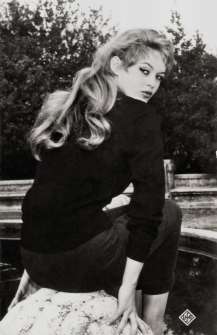
Brigitte Bardot
Dutch postcard by Gebr. Spanjersberg, N.V., Rotterdam. Dutch licence holder for Universum-Film Aktiengesellschaft, Berlin-Tempelhof (Ufa), no. 1080. Photo: Ufa.French actress Brigitte Bardot (1934) died on 28 December 2025, at the age of 91. In the 1950s, she was the sex kitten of the European film industry. BB starred in 48 films, performed in numerous musical shows, and recorded 80 songs. After her retirement in 1973, she became an animal rights activist. In the coming weeks, we will continue to post a BB postcard every day to remember her as she once was.Brigitte Bardot was born in Paris in 1934. Her father, Louis Bardot, had an engineering degree and worked with his father in the family business. Her mother, Ann-Marie Mucel, was 14 years younger than Brigitte's father, and they married in 1933. Brigitte's mother encouraged her daughter to take up music and dance. At the age of 13, she entered the Conservatoire Nationale de Danse to study ballet. By the time she was 15, Brigitte was trying to launch a modelling career and found herself on the cover of the French magazine Elle in May 1949. Her incredible beauty was readily apparent, and Brigitte was noticed by Roger Vadim, then an assistant to the film director Marc Allegrét. Vadim was infatuated with Bardot and encouraged her to start working as a film actress. BB was 18 when she debuted in the comedy Le Trou Normand / Crazy for Love (Jean Boyer, 1952). In the same year, she married Vadim. Brigitte wanted to marry him when she was 17, but her parents quashed any marriage plans until she turned 18. In April 1953, she attended the Cannes Film Festival, where she received massive media attention. She soon was every man's idea of the girl he'd like to meet in Paris. From 1952 to 1956, she appeared in seventeen films. Her films were generally lightweight romantic dramas in which she was cast as an ingénue or siren, often with an element of undress. In 1953, she made her first US production, Un acte d'amour / Act of Love (Anatole Litvak, 1953) with Kirk Douglas, but she continued to make films in France.Roger Vadim was not content with the light fare his wife was offered. He felt Brigitte Bardot was being undersold. Looking for something more like an art film to push her as a serious actress, he showcased her in Et Dieu créa la femme / ...And God Created Woman (Roger Vadim, 1956). This film, about an immoral teenager in a respectable small-town setting, was a smash success on both sides of the Atlantic. Craig Butler at AllMovie: "It's easy enough to say that ...And God Created Woman is much more important for its historical significance than for its actual quality as a film, and that's true to an extent. The immense popularity, due to its willingness to directly embrace an exploration of sex as well as its willingness to show a degree of nudity that was remarkably daring for its day, demonstrated that audiences were willing to view subject matter that was considered too racy for the average moviegoer. This had both positive (freedom to explore, especially for the French filmmakers of the time) and negative (freedom to exploit) consequences, but its impact is undeniable. It's also true that Woman is not a great work of art, not with a story that is ultimately rather thin, some painful dialogue, and an attitude toward its characters and their sexuality that is unclear and inconsistent. Yet Woman is still fascinating, due in no small part to the presence of Brigitte Bardot in the role that made her an international star and sex symbol. She's not demonstrating great acting here, although her performance is actually good and much better than necessary, and her legendary mambo scene at the climax is nothing short of sensational." During the filming of Et Dieu créa la femme / And God Created Woman (Roger Vadim, 1956), directed by her husband, Brigitte Bardot had an affair with her co-star, Jean-Louis Trintignant, who at the time was married to French actress Stéphane Audran. Her divorce from Vadim followed, but they remained friends and collaborated in later work.Et Dieu créa la femme / ...And God Created Woman (Roger Vadim, 1956) helped elevate Brigitte Bardot's international status. The film took the USA by storm, her explosive sexuality being unlike anything seen in the States since the days of the 'flapper' in the 1920s. It gave rise to the phrase 'sex kitten', and fascination with her in America consisted of magazine photographs and dubbed over French films - good, bad or indifferent, her films drew audiences - mainly men - into theatres like lemmings. BB appeared in light comedies like Doctor at Large (Ralph Thomas, 1957) - the third of the British 'Doctor' series starring Dirk Bogarde - and Une Parisienne / La Parisienne (Michel Boisrond, 1957), which suited her acting skills best. However, she was a sensation in the crime drama En cas de malheur / Love is My Profession (Claude Autant-Lara, 1958). Hal Erickson at AllMovie: "This Brigitte Bardot vehicle ran into stiff opposition from the Catholic Legion of Decency, severely limiting its U.S. distribution. Bardot plays a nubile small-time thief named Yvette, who becomes the mistress of influential defence attorney Andre (Jean Gabin). Though Andre can shower Yvette with jewels and furs, he cannot "buy" her heart, and thus it is that it belongs to handsome young student Mazzetti (Franco Interlenghi). Alas, Yvette is no judge of human nature: attractive though Mazzetti can be, he has a dangerous and deadly side. En Cas de Malheur contains a nude scene that has since been reprinted in freeze-frame form innumerable times by both film-history books and girlie magazines." Photographer Sam Lévin's photos contributed considerably to her image of sensuality and slight immorality. One of Lévin's pictures shows Brigitte, dressed in a white corset. It is said that around 1960, postcards with this photograph outsold in Paris those of the Eiffel Tower.Brigitte Bardot divorced Vadim in 1957, and in 1959 she married actor Jacques Charrier, with whom she starred in Babette s'en va-t-en guerre / Babette Goes to War (Christian-Jaque, 1959). The paparazzi preyed upon her marriage, while she and her husband clashed over the direction of her career
Her films became more substantial, but this brought a heavy pressure of dual celebrity as she sought critical acclaim while remaining a glamour model for most of the world. Vie privée / Private Life (1962), directed by Louis Malle, has more than an element of autobiography in it. James Travers at French Films: "Brigitte Bardot hadn’t quite reached the high point of her career when she agreed to make this film with high-profile New Wave film director Louis Malle. Even so, the pressure of being a living icon was obviously beginning to get to France’s sex goddess, and Vie privée is as much an attempt by Bardot to come to terms with her celebrity as anything else. Malle is clearly fascinated by Bardot, and the documentary approach he adopts for this film reinforces the impression that it is more a biography of the actress than a work of fiction. Of course, it’s not entirely biographical, but the story is remarkably close to Bardot’s own life and comes pretty close to predicting how her career would end." The scene in which, returning to her apartment, Bardot's character is harangued in the elevator by a middle-aged cleaning lady calling her offensive names was based on an actual incident, and is a resonant image of celebrity in the mid-20th century. Soon afterwards, Bardot withdrew to the seclusion of Southern France.Brigitte Bardot's other husbands were German millionaire Playboy Gunter Sachs and right-wing politician Bernard d'Ormale. She is reputed to have had relationships with many other men, including Samy Frey, her co-star in La Vérité / The Truth (Henri-Georges Clouzot, 1960), and musicians Serge Gainsbourg and Sacha Distel. In 1963, Brigitte Bardot starred in Jean-Luc Godard's critically acclaimed film Le Mépris / Contempt (Jean-Luc Godard, 1963) opposite Michel Piccoli. She was also featured along with such notable actors as Alain Delon in Amours célèbres / Famous Love Affairs (Michel Boisrond, 1961) and Histoires extraordinaires /Tales of Mystery (Louis Malle, 1968), Jeanne Moreau in Viva Maria! (Louis Malle, 1965), Sean Connery in Shalako (Edward Dmytryk, 1968), and Claudia Cardinale in Les Pétroleuses / Petroleum Girls (Christian-Jaque, 1971). She participated in various musical shows and recorded many popular songs in the 1960s and 1970s, mostly in collaboration with Serge Gainsbourg, Bob Zagury and Sacha Distel, including 'Harley Davidson', 'Le Soleil De Ma Vie' (the cover of Stevie Wonder's 'You Are the Sunshine of My Life') and the notorious 'Je t'aime... moi non plus'.Brigitte Bardot’s film career showed a steady decline in the late 1960s and early 1970s. In 1973, just before her fortieth birthday, she announced her retirement. She chose to use her fame to promote animal rights. In 1976, she established the Brigitte Bardot Foundation for the Welfare and Protection of Animals. She became a vegetarian and raised three million French francs to fund the foundation by auctioning off jewellery and many personal belongings. For this work, she was awarded the Légion d’honneur in 1984. During the 1990s, she was also outspoken in her criticism of immigration, interracial relationships, Islam in France and homosexuality. Her husband Bernard d'Ormal was a former adviser of the far-right Front National party. Bardot has been convicted five times for 'inciting racial hatred'. More fun is that Bardot is recognised for popularising bikini swimwear, in such early films as Manina / Woman without a Veil (Willy Rozier, 1952), in her appearances at Cannes and in many photo shoots. Bardot also brought into fashion the 'choucroute' ('Sauerkraut') hairstyle (a sort of beehive hairstyle) and gingham clothes after wearing a checkered pink dress, designed by Jacques Esterel, at her wedding to Charrier. The fashions of the 1960s looked effortlessly right and spontaneous on her. Time Magazine: "She is the princess of pout, the countess of come hither. Brigitte Bardot exuded a carefree, naïve sexuality that brought a whole new audience to French films."Sources: Denny Jackson (IMDb), Hal Erickson (AllMovie), Craig Butler (AllMovie), James Travers (French Films), French Films, Wikipedia and IMDb.And please check out our blog European Film Star Postcards.
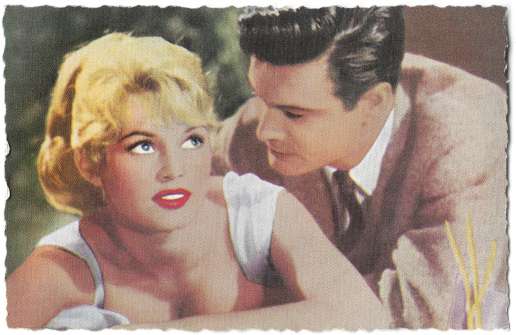
Brigitte Bardot and Louis Jourdan in La mariée est trop belle (1956)
West German collector card by Druckerei Hanns Uhrig, Frankfurt a. M. / NF Films. Photo: Pathé-Cinema. Brigitte Bardot and Louis Jourdan in La mariée est trop belle / The Bride Is Much Too Beautiful (Pierre Gaspard-Huit, 1956).French actress Brigitte Bardot (1934) died on 28 December 2025, at the age of 91. In the 1950s, she was the sex kitten of the European film industry. BB starred in 48 films, performed in numerous musical shows, and recorded 80 songs. After her retirement in 1973, she became an animal rights activist. In the coming weeks, we will continue to post a BB postcard every day to remember her as she once was.Brigitte Bardot was born in Paris in 1934. Her father, Louis Bardot, had an engineering degree and worked with his father in the family business. Her mother, Ann-Marie Mucel, was 14 years younger than Brigitte's father, and they married in 1933. Brigitte's mother encouraged her daughter to take up music and dance. At the age of 13, she entered the Conservatoire Nationale de Danse to study ballet. By the time she was 15, Brigitte was trying to launch a modelling career and found herself on the cover of the French magazine Elle in May 1949. Her incredible beauty was readily apparent, and Brigitte was noticed by Roger Vadim, then an assistant to the film director Marc Allegrét. Vadim was infatuated with Bardot and encouraged her to start working as a film actress. BB was 18 when she debuted in the comedy Le Trou Normand / Crazy for Love (Jean Boyer, 1952). In the same year, she married Vadim. Brigitte wanted to marry him when she was 17, but her parents quashed any marriage plans until she turned 18. In April 1953, she attended the Cannes Film Festival, where she received massive media attention. She soon was every man's idea of the girl he'd like to meet in Paris. From 1952 to 1956, she appeared in seventeen films. Her films were generally lightweight romantic dramas in which she was cast as an ingénue or siren, often with an element of undress. In 1953, she made her first US production, Un acte d'amour / Act of Love (Anatole Litvak, 1953) with Kirk Douglas, but she continued to make films in France.Roger Vadim was not content with the light fare his wife was offered. He felt Brigitte Bardot was being undersold. Looking for something more like an art film to push her as a serious actress, he showcased her in Et Dieu créa la femme / ...And God Created Woman (Roger Vadim, 1956). This film, about an immoral teenager in a respectable small-town setting, was a smash success on both sides of the Atlantic. Craig Butler at AllMovie: "It's easy enough to say that ...And God Created Woman is much more important for its historical significance than for its actual quality as a film, and that's true to an extent. The immense popularity, due to its willingness to directly embrace an exploration of sex as well as its willingness to show a degree of nudity that was remarkably daring for its day, demonstrated that audiences were willing to view subject matter that was considered too racy for the average moviegoer. This had both positive (freedom to explore, especially for the French filmmakers of the time) and negative (freedom to exploit) consequences, but its impact is undeniable. It's also true that Woman is not a great work of art, not with a story that is ultimately rather thin, some painful dialogue, and an attitude toward its characters and their sexuality that is unclear and inconsistent. Yet Woman is still fascinating, due in no small part to the presence of Brigitte Bardot in the role that made her an international star and sex symbol. She's not demonstrating great acting here, although her performance is actually good and much better than necessary, and her legendary mambo scene at the climax is nothing short of sensational." During the filming of Et Dieu créa la femme / And God Created Woman (Roger Vadim, 1956), directed by her husband, Brigitte Bardot had an affair with her co-star, Jean-Louis Trintignant, who at the time was married to French actress Stéphane Audran. Her divorce from Vadim followed, but they remained friends and collaborated in later work.Et Dieu créa la femme / ...And God Created Woman (Roger Vadim, 1956) helped elevate Brigitte Bardot's international status. The film took the USA by storm, her explosive sexuality being unlike anything seen in the States since the days of the 'flapper' in the 1920s. It gave rise to the phrase 'sex kitten', and fascination with her in America consisted of magazine photographs and dubbed over French films - good, bad or indifferent, her films drew audiences - mainly men - into theatres like lemmings. BB appeared in light comedies like Doctor at Large (Ralph Thomas, 1957) - the third of the British 'Doctor' series starring Dirk Bogarde - and Une Parisienne / La Parisienne (Michel Boisrond, 1957), which suited her acting skills best. However, she was a sensation in the crime drama En cas de malheur / Love is My Profession (Claude Autant-Lara, 1958). Hal Erickson at AllMovie: "This Brigitte Bardot vehicle ran into stiff opposition from the Catholic Legion of Decency, severely limiting its U.S. distribution. Bardot plays a nubile small-time thief named Yvette, who becomes the mistress of influential defence attorney Andre (Jean Gabin). Though Andre can shower Yvette with jewels and furs, he cannot "buy" her heart, and thus it is that it belongs to handsome young student Mazzetti (Franco Interlenghi). Alas, Yvette is no judge of human nature: attractive though Mazzetti can be, he has a dangerous and deadly side. En Cas de Malheur contains a nude scene that has since been reprinted in freeze-frame form innumerable times by both film-history books and girlie magazines." Photographer Sam Lévin's photos contributed considerably to her image of sensuality and slight immorality. One of Lévin's pictures shows Brigitte, dressed in a white corset. It is said that around 1960, postcards with this photograph outsold in Paris those of the Eiffel Tower.Brigitte Bardot divorced Vadim in 1957, and in 1959 she married actor Jacques Charrier, with whom she starred in Babette s'en va-t-en guerre / Babette Goes to War (Christian-Jaque, 1959). The paparazzi preyed upon her marriage, while she and her husband clashed over the direction of her career
Her films became more substantial, but this brought a heavy pressure of dual celebrity as she sought critical acclaim while remaining a glamour model for most of the world. Vie privée / Private Life (1962), directed by Louis Malle, has more than an element of autobiography in it. James Travers at French Films: "Brigitte Bardot hadn’t quite reached the high point of her career when she agreed to make this film with high-profile New Wave film director Louis Malle. Even so, the pressure of being a living icon was obviously beginning to get to France’s sex goddess, and Vie privée is as much an attempt by Bardot to come to terms with her celebrity as anything else. Malle is clearly fascinated by Bardot, and the documentary approach he adopts for this film reinforces the impression that it is more a biography of the actress than a work of fiction. Of course, it’s not entirely biographical, but the story is remarkably close to Bardot’s own life and comes pretty close to predicting how her career would end." The scene in which, returning to her apartment, Bardot's character is harangued in the elevator by a middle-aged cleaning lady calling her offensive names was based on an actual incident, and is a resonant image of celebrity in the mid-20th century. Soon afterwards, Bardot withdrew to the seclusion of Southern France.Brigitte Bardot's other husbands were German millionaire Playboy Gunter Sachs and right-wing politician Bernard d'Ormale. She is reputed to have had relationships with many other men, including Samy Frey, her co-star in La Vérité / The Truth (Henri-Georges Clouzot, 1960), and musicians Serge Gainsbourg and Sacha Distel. In 1963, Brigitte Bardot starred in Jean-Luc Godard's critically acclaimed film Le Mépris / Contempt (Jean-Luc Godard, 1963) opposite Michel Piccoli. She was also featured along with such notable actors as Alain Delon in Amours célèbres / Famous Love Affairs (Michel Boisrond, 1961) and Histoires extraordinaires /Tales of Mystery (Louis Malle, 1968), Jeanne Moreau in Viva Maria! (Louis Malle, 1965), Sean Connery in Shalako (Edward Dmytryk, 1968), and Claudia Cardinale in Les Pétroleuses / Petroleum Girls (Christian-Jaque, 1971). She participated in various musical shows and recorded many popular songs in the 1960s and 1970s, mostly in collaboration with Serge Gainsbourg, Bob Zagury and Sacha Distel, including 'Harley Davidson', 'Le Soleil De Ma Vie' (the cover of Stevie Wonder's 'You Are the Sunshine of My Life') and the notorious 'Je t'aime... moi non plus'.Brigitte Bardot’s film career showed a steady decline in the late 1960s and early 1970s. In 1973, just before her fortieth birthday, she announced her retirement. She chose to use her fame to promote animal rights. In 1976, she established the Brigitte Bardot Foundation for the Welfare and Protection of Animals. She became a vegetarian and raised three million French francs to fund the foundation by auctioning off jewellery and many personal belongings. For this work, she was awarded the Légion d’honneur in 1984. During the 1990s, she was also outspoken in her criticism of immigration, interracial relationships, Islam in France and homosexuality. Her husband Bernard d'Ormal was a former adviser of the far-right Front National party. Bardot has been convicted five times for 'inciting racial hatred'. More fun is that Bardot is recognised for popularising bikini swimwear, in such early films as Manina / Woman without a Veil (Willy Rozier, 1952), in her appearances at Cannes and in many photo shoots. Bardot also brought into fashion the 'choucroute' ('Sauerkraut') hairstyle (a sort of beehive hairstyle) and gingham clothes after wearing a checkered pink dress, designed by Jacques Esterel, at her wedding to Charrier. The fashions of the 1960s looked effortlessly right and spontaneous on her. Time Magazine: "She is the princess of pout, the countess of come hither. Brigitte Bardot exuded a carefree, naïve sexuality that brought a whole new audience to French films."Sources: Denny Jackson (IMDb), Hal Erickson (AllMovie), Craig Butler (AllMovie), James Travers (French Films), French Films, Wikipedia and IMDb.And please check out our blog European Film Star Postcards.
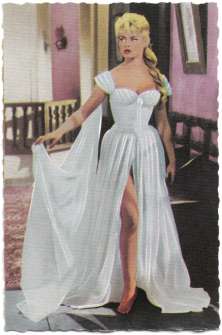
Brigitte Bardot in La mariée est trop belle (1956)
West German collector card by Druckerei Hanns Uhrig, Frankfurt a. M. / NF Films. Photo: Pathé-Cinema. Brigitte Bardot in La mariée est trop belle / The Bride Is Much Too Beautiful (Pierre Gaspard-Huit, 1956).French actress Brigitte Bardot (1934) died on 28 December 2025, at the age of 91. In the 1950s, she was the sex kitten of the European film industry. BB starred in 48 films, performed in numerous musical shows, and recorded 80 songs. After her retirement in 1973, she became an animal rights activist. In the coming weeks, we will continue to post a BB postcard every day to remember her as she once was.Brigitte Bardot was born in Paris in 1934. Her father, Louis Bardot, had an engineering degree and worked with his father in the family business. Her mother, Ann-Marie Mucel, was 14 years younger than Brigitte's father, and they married in 1933. Brigitte's mother encouraged her daughter to take up music and dance. At the age of 13, she entered the Conservatoire Nationale de Danse to study ballet. By the time she was 15, Brigitte was trying to launch a modelling career and found herself on the cover of the French magazine Elle in May 1949. Her incredible beauty was readily apparent, and Brigitte was noticed by Roger Vadim, then an assistant to the film director Marc Allegrét. Vadim was infatuated with Bardot and encouraged her to start working as a film actress. BB was 18 when she debuted in the comedy Le Trou Normand / Crazy for Love (Jean Boyer, 1952). In the same year, she married Vadim. Brigitte wanted to marry him when she was 17, but her parents quashed any marriage plans until she turned 18. In April 1953, she attended the Cannes Film Festival, where she received massive media attention. She soon was every man's idea of the girl he'd like to meet in Paris. From 1952 to 1956, she appeared in seventeen films. Her films were generally lightweight romantic dramas in which she was cast as an ingénue or siren, often with an element of undress. In 1953, she made her first US production, Un acte d'amour / Act of Love (Anatole Litvak, 1953) with Kirk Douglas, but she continued to make films in France.Roger Vadim was not content with the light fare his wife was offered. He felt Brigitte Bardot was being undersold. Looking for something more like an art film to push her as a serious actress, he showcased her in Et Dieu créa la femme / ...And God Created Woman (Roger Vadim, 1956). This film, about an immoral teenager in a respectable small-town setting, was a smash success on both sides of the Atlantic. Craig Butler at AllMovie: "It's easy enough to say that ...And God Created Woman is much more important for its historical significance than for its actual quality as a film, and that's true to an extent. The immense popularity, due to its willingness to directly embrace an exploration of sex as well as its willingness to show a degree of nudity that was remarkably daring for its day, demonstrated that audiences were willing to view subject matter that was considered too racy for the average moviegoer. This had both positive (freedom to explore, especially for the French filmmakers of the time) and negative (freedom to exploit) consequences, but its impact is undeniable. It's also true that Woman is not a great work of art, not with a story that is ultimately rather thin, some painful dialogue, and an attitude toward its characters and their sexuality that is unclear and inconsistent. Yet Woman is still fascinating, due in no small part to the presence of Brigitte Bardot in the role that made her an international star and sex symbol. She's not demonstrating great acting here, although her performance is actually good and much better than necessary, and her legendary mambo scene at the climax is nothing short of sensational." During the filming of Et Dieu créa la femme / And God Created Woman (Roger Vadim, 1956), directed by her husband, Brigitte Bardot had an affair with her co-star, Jean-Louis Trintignant, who at the time was married to French actress Stéphane Audran. Her divorce from Vadim followed, but they remained friends and collaborated in later work.Et Dieu créa la femme / ...And God Created Woman (Roger Vadim, 1956) helped elevate Brigitte Bardot's international status. The film took the USA by storm, her explosive sexuality being unlike anything seen in the States since the days of the 'flapper' in the 1920s. It gave rise to the phrase 'sex kitten', and fascination with her in America consisted of magazine photographs and dubbed over French films - good, bad or indifferent, her films drew audiences - mainly men - into theatres like lemmings. BB appeared in light comedies like Doctor at Large (Ralph Thomas, 1957) - the third of the British 'Doctor' series starring Dirk Bogarde - and Une Parisienne / La Parisienne (Michel Boisrond, 1957), which suited her acting skills best. However, she was a sensation in the crime drama En cas de malheur / Love is My Profession (Claude Autant-Lara, 1958). Hal Erickson at AllMovie: "This Brigitte Bardot vehicle ran into stiff opposition from the Catholic Legion of Decency, severely limiting its U.S. distribution. Bardot plays a nubile small-time thief named Yvette, who becomes the mistress of influential defence attorney Andre (Jean Gabin). Though Andre can shower Yvette with jewels and furs, he cannot "buy" her heart, and thus it is that it belongs to handsome young student Mazzetti (Franco Interlenghi). Alas, Yvette is no judge of human nature: attractive though Mazzetti can be, he has a dangerous and deadly side. En Cas de Malheur contains a nude scene that has since been reprinted in freeze-frame form innumerable times by both film-history books and girlie magazines." Photographer Sam Lévin's photos contributed considerably to her image of sensuality and slight immorality. One of Lévin's pictures shows Brigitte, dressed in a white corset. It is said that around 1960, postcards with this photograph outsold in Paris those of the Eiffel Tower.Brigitte Bardot divorced Vadim in 1957, and in 1959 she married actor Jacques Charrier, with whom she starred in Babette s'en va-t-en guerre / Babette Goes to War (Christian-Jaque, 1959). The paparazzi preyed upon her marriage, while she and her husband clashed over the direction of her career
Her films became more substantial, but this brought a heavy pressure of dual celebrity as she sought critical acclaim while remaining a glamour model for most of the world. Vie privée / Private Life (1962), directed by Louis Malle, has more than an element of autobiography in it. James Travers at French Films: "Brigitte Bardot hadn’t quite reached the high point of her career when she agreed to make this film with high-profile New Wave film director Louis Malle. Even so, the pressure of being a living icon was obviously beginning to get to France’s sex goddess, and Vie privée is as much an attempt by Bardot to come to terms with her celebrity as anything else. Malle is clearly fascinated by Bardot, and the documentary approach he adopts for this film reinforces the impression that it is more a biography of the actress than a work of fiction. Of course, it’s not entirely biographical, but the story is remarkably close to Bardot’s own life and comes pretty close to predicting how her career would end." The scene in which, returning to her apartment, Bardot's character is harangued in the elevator by a middle-aged cleaning lady calling her offensive names was based on an actual incident, and is a resonant image of celebrity in the mid-20th century. Soon afterwards, Bardot withdrew to the seclusion of Southern France.Brigitte Bardot's other husbands were German millionaire Playboy Gunter Sachs and right-wing politician Bernard d'Ormale. She is reputed to have had relationships with many other men, including Samy Frey, her co-star in La Vérité / The Truth (Henri-Georges Clouzot, 1960), and musicians Serge Gainsbourg and Sacha Distel. In 1963, Brigitte Bardot starred in Jean-Luc Godard's critically acclaimed film Le Mépris / Contempt (Jean-Luc Godard, 1963) opposite Michel Piccoli. She was also featured along with such notable actors as Alain Delon in Amours célèbres / Famous Love Affairs (Michel Boisrond, 1961) and Histoires extraordinaires /Tales of Mystery (Louis Malle, 1968), Jeanne Moreau in Viva Maria! (Louis Malle, 1965), Sean Connery in Shalako (Edward Dmytryk, 1968), and Claudia Cardinale in Les Pétroleuses / Petroleum Girls (Christian-Jaque, 1971). She participated in various musical shows and recorded many popular songs in the 1960s and 1970s, mostly in collaboration with Serge Gainsbourg, Bob Zagury and Sacha Distel, including 'Harley Davidson', 'Le Soleil De Ma Vie' (the cover of Stevie Wonder's 'You Are the Sunshine of My Life') and the notorious 'Je t'aime... moi non plus'.Brigitte Bardot’s film career showed a steady decline in the late 1960s and early 1970s. In 1973, just before her fortieth birthday, she announced her retirement. She chose to use her fame to promote animal rights. In 1976, she established the Brigitte Bardot Foundation for the Welfare and Protection of Animals. She became a vegetarian and raised three million French francs to fund the foundation by auctioning off jewellery and many personal belongings. For this work, she was awarded the Légion d’honneur in 1984. During the 1990s, she was also outspoken in her criticism of immigration, interracial relationships, Islam in France and homosexuality. Her husband Bernard d'Ormal was a former adviser of the far-right Front National party. Bardot has been convicted five times for 'inciting racial hatred'. More fun is that Bardot is recognised for popularising bikini swimwear, in such early films as Manina / Woman without a Veil (Willy Rozier, 1952), in her appearances at Cannes and in many photo shoots. Bardot also brought into fashion the 'choucroute' ('Sauerkraut') hairstyle (a sort of beehive hairstyle) and gingham clothes after wearing a checkered pink dress, designed by Jacques Esterel, at her wedding to Charrier. The fashions of the 1960s looked effortlessly right and spontaneous on her. Time Magazine: "She is the princess of pout, the countess of come hither. Brigitte Bardot exuded a carefree, naïve sexuality that brought a whole new audience to French films."Sources: Denny Jackson (IMDb), Hal Erickson (AllMovie), Craig Butler (AllMovie), James Travers (French Films), French Films, Wikipedia and IMDb.And please check out our blog European Film Star Postcards.
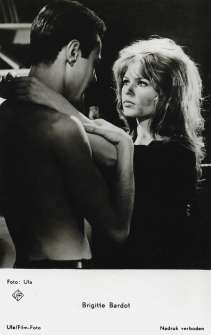
Brigitte Bardot and Michel Subor in La bride sur le cou (1961)
Dutch postcard by Gebr. Spanjersberg N.V., Rotterdam, no. 1499. Photo: Ufa. Brigitte Bardot and Michel Subor in La bride sur le cou / Please, Not Now! (Roger Vadim, 1961).French actress Brigitte Bardot (1934) died on 28 December 2025, at the age of 91. In the 1950s, she was the sex kitten of the European film industry. BB starred in 48 films, performed in numerous musical shows, and recorded 80 songs. After her retirement in 1973, she became an animal rights activist. In the coming weeks, we will continue to post a BB postcard every day to remember her as she once was.Brigitte Bardot was born in Paris in 1934. Her father, Louis Bardot, had an engineering degree and worked with his father in the family business. Her mother, Ann-Marie Mucel, was 14 years younger than Brigitte's father, and they married in 1933. Brigitte's mother encouraged her daughter to take up music and dance. At the age of 13, she entered the Conservatoire Nationale de Danse to study ballet. By the time she was 15, Brigitte was trying to launch a modelling career and found herself on the cover of the French magazine Elle in May 1949. Her incredible beauty was readily apparent, and Brigitte was noticed by Roger Vadim, then an assistant to the film director Marc Allegrét. Vadim was infatuated with Bardot and encouraged her to start working as a film actress. BB was 18 when she debuted in the comedy Le Trou Normand / Crazy for Love (Jean Boyer, 1952). In the same year, she married Vadim. Brigitte wanted to marry him when she was 17, but her parents quashed any marriage plans until she turned 18. In April 1953, she attended the Cannes Film Festival, where she received massive media attention. She soon was every man's idea of the girl he'd like to meet in Paris. From 1952 to 1956, she appeared in seventeen films. Her films were generally lightweight romantic dramas in which she was cast as an ingénue or siren, often with an element of undress. In 1953, she made her first US production, Un acte d'amour / Act of Love (Anatole Litvak, 1953) with Kirk Douglas, but she continued to make films in France.Roger Vadim was not content with the light fare his wife was offered. He felt Brigitte Bardot was being undersold. Looking for something more like an art film to push her as a serious actress, he showcased her in Et Dieu créa la femme / ...And God Created Woman (Roger Vadim, 1956). This film, about an immoral teenager in a respectable small-town setting, was a smash success on both sides of the Atlantic. Craig Butler at AllMovie: "It's easy enough to say that ...And God Created Woman is much more important for its historical significance than for its actual quality as a film, and that's true to an extent. The immense popularity, due to its willingness to directly embrace an exploration of sex as well as its willingness to show a degree of nudity that was remarkably daring for its day, demonstrated that audiences were willing to view subject matter that was considered too racy for the average moviegoer. This had both positive (freedom to explore, especially for the French filmmakers of the time) and negative (freedom to exploit) consequences, but its impact is undeniable. It's also true that Woman is not a great work of art, not with a story that is ultimately rather thin, some painful dialogue, and an attitude toward its characters and their sexuality that is unclear and inconsistent. Yet Woman is still fascinating, due in no small part to the presence of Brigitte Bardot in the role that made her an international star and sex symbol. She's not demonstrating great acting here, although her performance is actually good and much better than necessary, and her legendary mambo scene at the climax is nothing short of sensational." During the filming of Et Dieu créa la femme / And God Created Woman (Roger Vadim, 1956), directed by her husband, Brigitte Bardot had an affair with her co-star, Jean-Louis Trintignant, who at the time was married to French actress Stéphane Audran. Her divorce from Vadim followed, but they remained friends and collaborated in later work.Et Dieu créa la femme / ...And God Created Woman (Roger Vadim, 1956) helped elevate Brigitte Bardot's international status. The film took the USA by storm, her explosive sexuality being unlike anything seen in the States since the days of the 'flapper' in the 1920s. It gave rise to the phrase 'sex kitten', and fascination with her in America consisted of magazine photographs and dubbed over French films - good, bad or indifferent, her films drew audiences - mainly men - into theatres like lemmings. BB appeared in light comedies like Doctor at Large (Ralph Thomas, 1957) - the third of the British 'Doctor' series starring Dirk Bogarde - and Une Parisienne / La Parisienne (Michel Boisrond, 1957), which suited her acting skills best. However, she was a sensation in the crime drama En cas de malheur / Love is My Profession (Claude Autant-Lara, 1958). Hal Erickson at AllMovie: "This Brigitte Bardot vehicle ran into stiff opposition from the Catholic Legion of Decency, severely limiting its U.S. distribution. Bardot plays a nubile small-time thief named Yvette, who becomes the mistress of influential defence attorney Andre (Jean Gabin). Though Andre can shower Yvette with jewels and furs, he cannot "buy" her heart, and thus it is that it belongs to handsome young student Mazzetti (Franco Interlenghi). Alas, Yvette is no judge of human nature: attractive though Mazzetti can be, he has a dangerous and deadly side. En Cas de Malheur contains a nude scene that has since been reprinted in freeze-frame form innumerable times by both film-history books and girlie magazines." Photographer Sam Lévin's photos contributed considerably to her image of sensuality and slight immorality. One of Lévin's pictures shows Brigitte, dressed in a white corset. It is said that around 1960, postcards with this photograph outsold in Paris those of the Eiffel Tower.Brigitte Bardot divorced Vadim in 1957, and in 1959 she married actor Jacques Charrier, with whom she starred in Babette s'en va-t-en guerre / Babette Goes to War (Christian-Jaque, 1959). The paparazzi preyed upon her marriage, while she and her husband clashed over the direction of her career
Her films became more substantial, but this brought a heavy pressure of dual celebrity as she sought critical acclaim while remaining a glamour model for most of the world. Vie privée / Private Life (1962), directed by Louis Malle, has more than an element of autobiography in it. James Travers at French Films: "Brigitte Bardot hadn’t quite reached the high point of her career when she agreed to make this film with high-profile New Wave film director Louis Malle. Even so, the pressure of being a living icon was obviously beginning to get to France’s sex goddess, and Vie privée is as much an attempt by Bardot to come to terms with her celebrity as anything else. Malle is clearly fascinated by Bardot, and the documentary approach he adopts for this film reinforces the impression that it is more a biography of the actress than a work of fiction. Of course, it’s not entirely biographical, but the story is remarkably close to Bardot’s own life and comes pretty close to predicting how her career would end." The scene in which, returning to her apartment, Bardot's character is harangued in the elevator by a middle-aged cleaning lady calling her offensive names was based on an actual incident, and is a resonant image of celebrity in the mid-20th century. Soon afterwards, Bardot withdrew to the seclusion of Southern France.Brigitte Bardot's other husbands were German millionaire Playboy Gunter Sachs and right-wing politician Bernard d'Ormale. She is reputed to have had relationships with many other men, including Samy Frey, her co-star in La Vérité / The Truth (Henri-Georges Clouzot, 1960), and musicians Serge Gainsbourg and Sacha Distel. In 1963, Brigitte Bardot starred in Jean-Luc Godard's critically acclaimed film Le Mépris / Contempt (Jean-Luc Godard, 1963) opposite Michel Piccoli. She was also featured along with such notable actors as Alain Delon in Amours célèbres / Famous Love Affairs (Michel Boisrond, 1961) and Histoires extraordinaires /Tales of Mystery (Louis Malle, 1968), Jeanne Moreau in Viva Maria! (Louis Malle, 1965), Sean Connery in Shalako (Edward Dmytryk, 1968), and Claudia Cardinale in Les Pétroleuses / Petroleum Girls (Christian-Jaque, 1971). She participated in various musical shows and recorded many popular songs in the 1960s and 1970s, mostly in collaboration with Serge Gainsbourg, Bob Zagury and Sacha Distel, including 'Harley Davidson', 'Le Soleil De Ma Vie' (the cover of Stevie Wonder's 'You Are the Sunshine of My Life') and the notorious 'Je t'aime... moi non plus'.Brigitte Bardot’s film career showed a steady decline in the late 1960s and early 1970s. In 1973, just before her fortieth birthday, she announced her retirement. She chose to use her fame to promote animal rights. In 1976, she established the Brigitte Bardot Foundation for the Welfare and Protection of Animals. She became a vegetarian and raised three million French francs to fund the foundation by auctioning off jewellery and many personal belongings. For this work, she was awarded the Légion d’honneur in 1984. During the 1990s, she was also outspoken in her criticism of immigration, interracial relationships, Islam in France and homosexuality. Her husband Bernard d'Ormal was a former adviser of the far-right Front National party. Bardot has been convicted five times for 'inciting racial hatred'. More fun is that Bardot is recognised for popularising bikini swimwear, in such early films as Manina / Woman without a Veil (Willy Rozier, 1952), in her appearances at Cannes and in many photo shoots. Bardot also brought into fashion the 'choucroute' ('Sauerkraut') hairstyle (a sort of beehive hairstyle) and gingham clothes after wearing a checkered pink dress, designed by Jacques Esterel, at her wedding to Charrier. The fashions of the 1960s looked effortlessly right and spontaneous on her. Time Magazine: "She is the princess of pout, the countess of come hither. Brigitte Bardot exuded a carefree, naïve sexuality that brought a whole new audience to French films."Sources: Denny Jackson (IMDb), Hal Erickson (AllMovie), Craig Butler (AllMovie), James Travers (French Films), French Films, Wikipedia and IMDb.And please check out our blog European Film Star Postcards.
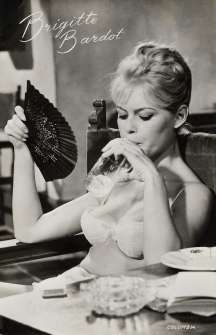
Brigitte Bardot in Les bijoutiers du clair de lune (1958)
Dutch postcard by Uitg. Takken, Utrecht, no. AX 3657. Photo: Columbia. Brigitte Bardot in Les bijoutiers du clair de lune / The Night Heaven Fell (Roger Vadim, 1958).French actress Brigitte Bardot (1934) died on 28 December 2025, at the age of 91. In the 1950s, she was the sex kitten of the European film industry. BB starred in 48 films, performed in numerous musical shows, and recorded 80 songs. After her retirement in 1973, she became an animal rights activist. In the coming weeks, we will continue to post a BB postcard every day to remember her as she once was.Brigitte Bardot was born in Paris in 1934. Her father, Louis Bardot, had an engineering degree and worked with his father in the family business. Her mother, Ann-Marie Mucel, was 14 years younger than Brigitte's father, and they married in 1933. Brigitte's mother encouraged her daughter to take up music and dance. At the age of 13, she entered the Conservatoire Nationale de Danse to study ballet. By the time she was 15, Brigitte was trying to launch a modelling career and found herself on the cover of the French magazine Elle in May 1949. Her incredible beauty was readily apparent, and Brigitte was noticed by Roger Vadim, then an assistant to the film director Marc Allegrét. Vadim was infatuated with Bardot and encouraged her to start working as a film actress. BB was 18 when she debuted in the comedy Le Trou Normand / Crazy for Love (Jean Boyer, 1952). In the same year, she married Vadim. Brigitte wanted to marry him when she was 17, but her parents quashed any marriage plans until she turned 18. In April 1953, she attended the Cannes Film Festival, where she received massive media attention. She soon was every man's idea of the girl he'd like to meet in Paris. From 1952 to 1956, she appeared in seventeen films. Her films were generally lightweight romantic dramas in which she was cast as an ingénue or siren, often with an element of undress. In 1953, she made her first US production, Un acte d'amour / Act of Love (Anatole Litvak, 1953) with Kirk Douglas, but she continued to make films in France.Roger Vadim was not content with the light fare his wife was offered. He felt Brigitte Bardot was being undersold. Looking for something more like an art film to push her as a serious actress, he showcased her in Et Dieu créa la femme / ...And God Created Woman (Roger Vadim, 1956). This film, about an immoral teenager in a respectable small-town setting, was a smash success on both sides of the Atlantic. Craig Butler at AllMovie: "It's easy enough to say that ...And God Created Woman is much more important for its historical significance than for its actual quality as a film, and that's true to an extent. The immense popularity, due to its willingness to directly embrace an exploration of sex as well as its willingness to show a degree of nudity that was remarkably daring for its day, demonstrated that audiences were willing to view subject matter that was considered too racy for the average moviegoer. This had both positive (freedom to explore, especially for the French filmmakers of the time) and negative (freedom to exploit) consequences, but its impact is undeniable. It's also true that Woman is not a great work of art, not with a story that is ultimately rather thin, some painful dialogue, and an attitude toward its characters and their sexuality that is unclear and inconsistent. Yet Woman is still fascinating, due in no small part to the presence of Brigitte Bardot in the role that made her an international star and sex symbol. She's not demonstrating great acting here, although her performance is actually good and much better than necessary, and her legendary mambo scene at the climax is nothing short of sensational." During the filming of Et Dieu créa la femme / And God Created Woman (Roger Vadim, 1956), directed by her husband, Brigitte Bardot had an affair with her co-star, Jean-Louis Trintignant, who at the time was married to French actress Stéphane Audran. Her divorce from Vadim followed, but they remained friends and collaborated in later work.Et Dieu créa la femme / ...And God Created Woman (Roger Vadim, 1956) helped elevate Brigitte Bardot's international status. The film took the USA by storm, her explosive sexuality being unlike anything seen in the States since the days of the 'flapper' in the 1920s. It gave rise to the phrase 'sex kitten', and fascination with her in America consisted of magazine photographs and dubbed over French films - good, bad or indifferent, her films drew audiences - mainly men - into theatres like lemmings. BB appeared in light comedies like Doctor at Large (Ralph Thomas, 1957) - the third of the British 'Doctor' series starring Dirk Bogarde - and Une Parisienne / La Parisienne (Michel Boisrond, 1957), which suited her acting skills best. However, she was a sensation in the crime drama En cas de malheur / Love is My Profession (Claude Autant-Lara, 1958). Hal Erickson at AllMovie: "This Brigitte Bardot vehicle ran into stiff opposition from the Catholic Legion of Decency, severely limiting its U.S. distribution. Bardot plays a nubile small-time thief named Yvette, who becomes the mistress of influential defence attorney Andre (Jean Gabin). Though Andre can shower Yvette with jewels and furs, he cannot "buy" her heart, and thus it is that it belongs to handsome young student Mazzetti (Franco Interlenghi). Alas, Yvette is no judge of human nature: attractive though Mazzetti can be, he has a dangerous and deadly side. En Cas de Malheur contains a nude scene that has since been reprinted in freeze-frame form innumerable times by both film-history books and girlie magazines." Photographer Sam Lévin's photos contributed considerably to her image of sensuality and slight immorality. One of Lévin's pictures shows Brigitte, dressed in a white corset. It is said that around 1960, postcards with this photograph outsold in Paris those of the Eiffel Tower.Brigitte Bardot divorced Vadim in 1957, and in 1959 she married actor Jacques Charrier, with whom she starred in Babette s'en va-t-en guerre / Babette Goes to War (Christian-Jaque, 1959). The paparazzi preyed upon her marriage, while she and her husband clashed over the direction of her career
Her films became more substantial, but this brought a heavy pressure of dual celebrity as she sought critical acclaim while remaining a glamour model for most of the world. Vie privée / Private Life (1962), directed by Louis Malle, has more than an element of autobiography in it. James Travers at French Films: "Brigitte Bardot hadn’t quite reached the high point of her career when she agreed to make this film with high-profile New Wave film director Louis Malle. Even so, the pressure of being a living icon was obviously beginning to get to France’s sex goddess, and Vie privée is as much an attempt by Bardot to come to terms with her celebrity as anything else. Malle is clearly fascinated by Bardot, and the documentary approach he adopts for this film reinforces the impression that it is more a biography of the actress than a work of fiction. Of course, it’s not entirely biographical, but the story is remarkably close to Bardot’s own life and comes pretty close to predicting how her career would end." The scene in which, returning to her apartment, Bardot's character is harangued in the elevator by a middle-aged cleaning lady calling her offensive names was based on an actual incident, and is a resonant image of celebrity in the mid-20th century. Soon afterwards, Bardot withdrew to the seclusion of Southern France.Brigitte Bardot's other husbands were German millionaire Playboy Gunter Sachs and right-wing politician Bernard d'Ormale. She is reputed to have had relationships with many other men, including Samy Frey, her co-star in La Vérité / The Truth (Henri-Georges Clouzot, 1960), and musicians Serge Gainsbourg and Sacha Distel. In 1963, Brigitte Bardot starred in Jean-Luc Godard's critically acclaimed film Le Mépris / Contempt (Jean-Luc Godard, 1963) opposite Michel Piccoli. She was also featured along with such notable actors as Alain Delon in Amours célèbres / Famous Love Affairs (Michel Boisrond, 1961) and Histoires extraordinaires /Tales of Mystery (Louis Malle, 1968), Jeanne Moreau in Viva Maria! (Louis Malle, 1965), Sean Connery in Shalako (Edward Dmytryk, 1968), and Claudia Cardinale in Les Pétroleuses / Petroleum Girls (Christian-Jaque, 1971). She participated in various musical shows and recorded many popular songs in the 1960s and 1970s, mostly in collaboration with Serge Gainsbourg, Bob Zagury and Sacha Distel, including 'Harley Davidson', 'Le Soleil De Ma Vie' (the cover of Stevie Wonder's 'You Are the Sunshine of My Life') and the notorious 'Je t'aime... moi non plus'.Brigitte Bardot’s film career showed a steady decline in the late 1960s and early 1970s. In 1973, just before her fortieth birthday, she announced her retirement. She chose to use her fame to promote animal rights. In 1976, she established the Brigitte Bardot Foundation for the Welfare and Protection of Animals. She became a vegetarian and raised three million French francs to fund the foundation by auctioning off jewellery and many personal belongings. For this work, she was awarded the Légion d’honneur in 1984. During the 1990s, she was also outspoken in her criticism of immigration, interracial relationships, Islam in France and homosexuality. Her husband Bernard d'Ormal was a former adviser of the far-right Front National party. Bardot has been convicted five times for 'inciting racial hatred'. More fun is that Bardot is recognised for popularising bikini swimwear, in such early films as Manina / Woman without a Veil (Willy Rozier, 1952), in her appearances at Cannes and in many photo shoots. Bardot also brought into fashion the 'choucroute' ('Sauerkraut') hairstyle (a sort of beehive hairstyle) and gingham clothes after wearing a checkered pink dress, designed by Jacques Esterel, at her wedding to Charrier. The fashions of the 1960s looked effortlessly right and spontaneous on her. Time Magazine: "She is the princess of pout, the countess of come hither. Brigitte Bardot exuded a carefree, naïve sexuality that brought a whole new audience to French films."Sources: Denny Jackson (IMDb), Hal Erickson (AllMovie), Craig Butler (AllMovie), James Travers (French Films), French Films, Wikipedia and IMDb.And please check out our blog European Film Star Postcards.
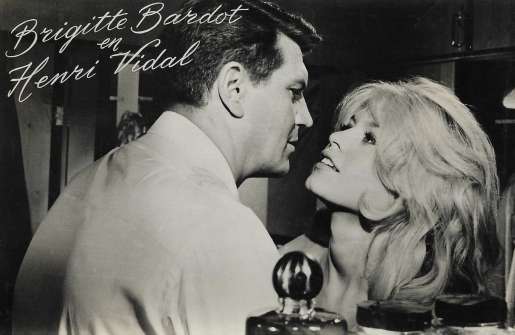
Brigitte Bardot and Henri Vidal in Voulez-vous danser avec moi (1959)
Dutch postcard by Uitg. Takken, Utrecht, no. AX 4284. Photo: N.V. City Film, Den Haag. Brigitte Bardot and Henri Vidal in Voulez-vous danser avec moi / Come Dance With Me! (Michel Boisrond, 1959).French actress Brigitte Bardot (1934) died on 28 December 2025, at the age of 91. In the 1950s, she was the sex kitten of the European film industry. BB starred in 48 films, performed in numerous musical shows, and recorded 80 songs. After her retirement in 1973, she became an animal rights activist. In the coming weeks, we will continue to post a BB postcard every day to remember her as she once was.Brigitte Bardot was born in Paris in 1934. Her father, Louis Bardot, had an engineering degree and worked with his father in the family business. Her mother, Ann-Marie Mucel, was 14 years younger than Brigitte's father, and they married in 1933. Brigitte's mother encouraged her daughter to take up music and dance. At the age of 13, she entered the Conservatoire Nationale de Danse to study ballet. By the time she was 15, Brigitte was trying to launch a modelling career and found herself on the cover of the French magazine Elle in May 1949. Her incredible beauty was readily apparent, and Brigitte was noticed by Roger Vadim, then an assistant to the film director Marc Allegrét. Vadim was infatuated with Bardot and encouraged her to start working as a film actress. BB was 18 when she debuted in the comedy Le Trou Normand / Crazy for Love (Jean Boyer, 1952). In the same year, she married Vadim. Brigitte wanted to marry him when she was 17, but her parents quashed any marriage plans until she turned 18. In April 1953, she attended the Cannes Film Festival, where she received massive media attention. She soon was every man's idea of the girl he'd like to meet in Paris. From 1952 to 1956, she appeared in seventeen films. Her films were generally lightweight romantic dramas in which she was cast as an ingénue or siren, often with an element of undress. In 1953, she made her first US production, Un acte d'amour / Act of Love (Anatole Litvak, 1953) with Kirk Douglas, but she continued to make films in France.Roger Vadim was not content with the light fare his wife was offered. He felt Brigitte Bardot was being undersold. Looking for something more like an art film to push her as a serious actress, he showcased her in Et Dieu créa la femme / ...And God Created Woman (Roger Vadim, 1956). This film, about an immoral teenager in a respectable small-town setting, was a smash success on both sides of the Atlantic. Craig Butler at AllMovie: "It's easy enough to say that ...And God Created Woman is much more important for its historical significance than for its actual quality as a film, and that's true to an extent. The immense popularity, due to its willingness to directly embrace an exploration of sex as well as its willingness to show a degree of nudity that was remarkably daring for its day, demonstrated that audiences were willing to view subject matter that was considered too racy for the average moviegoer. This had both positive (freedom to explore, especially for the French filmmakers of the time) and negative (freedom to exploit) consequences, but its impact is undeniable. It's also true that Woman is not a great work of art, not with a story that is ultimately rather thin, some painful dialogue, and an attitude toward its characters and their sexuality that is unclear and inconsistent. Yet Woman is still fascinating, due in no small part to the presence of Brigitte Bardot in the role that made her an international star and sex symbol. She's not demonstrating great acting here, although her performance is actually good and much better than necessary, and her legendary mambo scene at the climax is nothing short of sensational." During the filming of Et Dieu créa la femme / And God Created Woman (Roger Vadim, 1956), directed by her husband, Brigitte Bardot had an affair with her co-star, Jean-Louis Trintignant, who at the time was married to French actress Stéphane Audran. Her divorce from Vadim followed, but they remained friends and collaborated in later work.Et Dieu créa la femme / ...And God Created Woman (Roger Vadim, 1956) helped elevate Brigitte Bardot's international status. The film took the USA by storm, her explosive sexuality being unlike anything seen in the States since the days of the 'flapper' in the 1920s. It gave rise to the phrase 'sex kitten', and fascination with her in America consisted of magazine photographs and dubbed over French films - good, bad or indifferent, her films drew audiences - mainly men - into theatres like lemmings. BB appeared in light comedies like Doctor at Large (Ralph Thomas, 1957) - the third of the British 'Doctor' series starring Dirk Bogarde - and Une Parisienne / La Parisienne (Michel Boisrond, 1957), which suited her acting skills best. However, she was a sensation in the crime drama En cas de malheur / Love is My Profession (Claude Autant-Lara, 1958). Hal Erickson at AllMovie: "This Brigitte Bardot vehicle ran into stiff opposition from the Catholic Legion of Decency, severely limiting its U.S. distribution. Bardot plays a nubile small-time thief named Yvette, who becomes the mistress of influential defence attorney Andre (Jean Gabin). Though Andre can shower Yvette with jewels and furs, he cannot "buy" her heart, and thus it is that it belongs to handsome young student Mazzetti (Franco Interlenghi). Alas, Yvette is no judge of human nature: attractive though Mazzetti can be, he has a dangerous and deadly side. En Cas de Malheur contains a nude scene that has since been reprinted in freeze-frame form innumerable times by both film-history books and girlie magazines." Photographer Sam Lévin's photos contributed considerably to her image of sensuality and slight immorality. One of Lévin's pictures shows Brigitte, dressed in a white corset. It is said that around 1960, postcards with this photograph outsold in Paris those of the Eiffel Tower.Brigitte Bardot divorced Vadim in 1957, and in 1959 she married actor Jacques Charrier, with whom she starred in Babette s'en va-t-en guerre / Babette Goes to War (Christian-Jaque, 1959). The paparazzi preyed upon her marriage, while she and her husband clashed over the direction of her career
Her films became more substantial, but this brought a heavy pressure of dual celebrity as she sought critical acclaim while remaining a glamour model for most of the world. Vie privée / Private Life (1962), directed by Louis Malle, has more than an element of autobiography in it. James Travers at French Films: "Brigitte Bardot hadn’t quite reached the high point of her career when she agreed to make this film with high-profile New Wave film director Louis Malle. Even so, the pressure of being a living icon was obviously beginning to get to France’s sex goddess, and Vie privée is as much an attempt by Bardot to come to terms with her celebrity as anything else. Malle is clearly fascinated by Bardot, and the documentary approach he adopts for this film reinforces the impression that it is more a biography of the actress than a work of fiction. Of course, it’s not entirely biographical, but the story is remarkably close to Bardot’s own life and comes pretty close to predicting how her career would end." The scene in which, returning to her apartment, Bardot's character is harangued in the elevator by a middle-aged cleaning lady calling her offensive names was based on an actual incident, and is a resonant image of celebrity in the mid-20th century. Soon afterwards, Bardot withdrew to the seclusion of Southern France.Brigitte Bardot's other husbands were German millionaire Playboy Gunter Sachs and right-wing politician Bernard d'Ormale. She is reputed to have had relationships with many other men, including Samy Frey, her co-star in La Vérité / The Truth (Henri-Georges Clouzot, 1960), and musicians Serge Gainsbourg and Sacha Distel. In 1963, Brigitte Bardot starred in Jean-Luc Godard's critically acclaimed film Le Mépris / Contempt (Jean-Luc Godard, 1963) opposite Michel Piccoli. She was also featured along with such notable actors as Alain Delon in Amours célèbres / Famous Love Affairs (Michel Boisrond, 1961) and Histoires extraordinaires /Tales of Mystery (Louis Malle, 1968), Jeanne Moreau in Viva Maria! (Louis Malle, 1965), Sean Connery in Shalako (Edward Dmytryk, 1968), and Claudia Cardinale in Les Pétroleuses / Petroleum Girls (Christian-Jaque, 1971). She participated in various musical shows and recorded many popular songs in the 1960s and 1970s, mostly in collaboration with Serge Gainsbourg, Bob Zagury and Sacha Distel, including 'Harley Davidson', 'Le Soleil De Ma Vie' (the cover of Stevie Wonder's 'You Are the Sunshine of My Life') and the notorious 'Je t'aime... moi non plus'.Brigitte Bardot’s film career showed a steady decline in the late 1960s and early 1970s. In 1973, just before her fortieth birthday, she announced her retirement. She chose to use her fame to promote animal rights. In 1976, she established the Brigitte Bardot Foundation for the Welfare and Protection of Animals. She became a vegetarian and raised three million French francs to fund the foundation by auctioning off jewellery and many personal belongings. For this work, she was awarded the Légion d’honneur in 1984. During the 1990s, she was also outspoken in her criticism of immigration, interracial relationships, Islam in France and homosexuality. Her husband Bernard d'Ormal was a former adviser of the far-right Front National party. Bardot has been convicted five times for 'inciting racial hatred'. More fun is that Bardot is recognised for popularising bikini swimwear, in such early films as Manina / Woman without a Veil (Willy Rozier, 1952), in her appearances at Cannes and in many photo shoots. Bardot also brought into fashion the 'choucroute' ('Sauerkraut') hairstyle (a sort of beehive hairstyle) and gingham clothes after wearing a checkered pink dress, designed by Jacques Esterel, at her wedding to Charrier. The fashions of the 1960s looked effortlessly right and spontaneous on her. Time Magazine: "She is the princess of pout, the countess of come hither. Brigitte Bardot exuded a carefree, naïve sexuality that brought a whole new audience to French films."Sources: Denny Jackson (IMDb), Hal Erickson (AllMovie), Craig Butler (AllMovie), James Travers (French Films), French Films, Wikipedia and IMDb.And please check out our blog European Film Star Postcards.
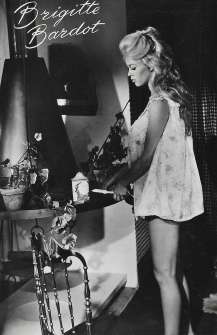
Brigitte Bardot in Voulez-vous danser avec moi (1959)
Dutch postcard by Uitg. Takken, Utrecht, no. AX 4322. Photo: N.V. City Film, Den Haag / Francofilm. Brigitte Bardot in Voulez-vous danser avec moi / Come Dance With Me! (Michel Boisrond, 1959).French actress Brigitte Bardot (1934) died on 28 December 2025, at the age of 91. In the 1950s, she was the sex kitten of the European film industry. BB starred in 48 films, performed in numerous musical shows, and recorded 80 songs. After her retirement in 1973, she became an animal rights activist. In the coming weeks, we will continue to post a BB postcard every day to remember her as she once was.Brigitte Bardot was born in Paris in 1934. Her father, Louis Bardot, had an engineering degree and worked with his father in the family business. Her mother, Ann-Marie Mucel, was 14 years younger than Brigitte's father, and they married in 1933. Brigitte's mother encouraged her daughter to take up music and dance. At the age of 13, she entered the Conservatoire Nationale de Danse to study ballet. By the time she was 15, Brigitte was trying to launch a modelling career and found herself on the cover of the French magazine Elle in May 1949. Her incredible beauty was readily apparent, and Brigitte was noticed by Roger Vadim, then an assistant to the film director Marc Allegrét. Vadim was infatuated with Bardot and encouraged her to start working as a film actress. BB was 18 when she debuted in the comedy Le Trou Normand / Crazy for Love (Jean Boyer, 1952). In the same year, she married Vadim. Brigitte wanted to marry him when she was 17, but her parents quashed any marriage plans until she turned 18. In April 1953, she attended the Cannes Film Festival, where she received massive media attention. She soon was every man's idea of the girl he'd like to meet in Paris. From 1952 to 1956, she appeared in seventeen films. Her films were generally lightweight romantic dramas in which she was cast as an ingénue or siren, often with an element of undress. In 1953, she made her first US production, Un acte d'amour / Act of Love (Anatole Litvak, 1953) with Kirk Douglas, but she continued to make films in France.Roger Vadim was not content with the light fare his wife was offered. He felt Brigitte Bardot was being undersold. Looking for something more like an art film to push her as a serious actress, he showcased her in Et Dieu créa la femme / ...And God Created Woman (Roger Vadim, 1956). This film, about an immoral teenager in a respectable small-town setting, was a smash success on both sides of the Atlantic. Craig Butler at AllMovie: "It's easy enough to say that ...And God Created Woman is much more important for its historical significance than for its actual quality as a film, and that's true to an extent. The immense popularity, due to its willingness to directly embrace an exploration of sex as well as its willingness to show a degree of nudity that was remarkably daring for its day, demonstrated that audiences were willing to view subject matter that was considered too racy for the average moviegoer. This had both positive (freedom to explore, especially for the French filmmakers of the time) and negative (freedom to exploit) consequences, but its impact is undeniable. It's also true that Woman is not a great work of art, not with a story that is ultimately rather thin, some painful dialogue, and an attitude toward its characters and their sexuality that is unclear and inconsistent. Yet Woman is still fascinating, due in no small part to the presence of Brigitte Bardot in the role that made her an international star and sex symbol. She's not demonstrating great acting here, although her performance is actually good and much better than necessary, and her legendary mambo scene at the climax is nothing short of sensational." During the filming of Et Dieu créa la femme / And God Created Woman (Roger Vadim, 1956), directed by her husband, Brigitte Bardot had an affair with her co-star, Jean-Louis Trintignant, who at the time was married to French actress Stéphane Audran. Her divorce from Vadim followed, but they remained friends and collaborated in later work.Et Dieu créa la femme / ...And God Created Woman (Roger Vadim, 1956) helped elevate Brigitte Bardot's international status. The film took the USA by storm, her explosive sexuality being unlike anything seen in the States since the days of the 'flapper' in the 1920s. It gave rise to the phrase 'sex kitten', and fascination with her in America consisted of magazine photographs and dubbed over French films - good, bad or indifferent, her films drew audiences - mainly men - into theatres like lemmings. BB appeared in light comedies like Doctor at Large (Ralph Thomas, 1957) - the third of the British 'Doctor' series starring Dirk Bogarde - and Une Parisienne / La Parisienne (Michel Boisrond, 1957), which suited her acting skills best. However, she was a sensation in the crime drama En cas de malheur / Love is My Profession (Claude Autant-Lara, 1958). Hal Erickson at AllMovie: "This Brigitte Bardot vehicle ran into stiff opposition from the Catholic Legion of Decency, severely limiting its U.S. distribution. Bardot plays a nubile small-time thief named Yvette, who becomes the mistress of influential defence attorney Andre (Jean Gabin). Though Andre can shower Yvette with jewels and furs, he cannot "buy" her heart, and thus it is that it belongs to handsome young student Mazzetti (Franco Interlenghi). Alas, Yvette is no judge of human nature: attractive though Mazzetti can be, he has a dangerous and deadly side. En Cas de Malheur contains a nude scene that has since been reprinted in freeze-frame form innumerable times by both film-history books and girlie magazines." Photographer Sam Lévin's photos contributed considerably to her image of sensuality and slight immorality. One of Lévin's pictures shows Brigitte, dressed in a white corset. It is said that around 1960, postcards with this photograph outsold in Paris those of the Eiffel Tower.Brigitte Bardot divorced Vadim in 1957, and in 1959 she married actor Jacques Charrier, with whom she starred in Babette s'en va-t-en guerre / Babette Goes to War (Christian-Jaque, 1959). The paparazzi preyed upon her marriage, while she and her husband clashed over the direction of her career
Her films became more substantial, but this brought a heavy pressure of dual celebrity as she sought critical acclaim while remaining a glamour model for most of the world. Vie privée / Private Life (1962), directed by Louis Malle, has more than an element of autobiography in it. James Travers at French Films: "Brigitte Bardot hadn’t quite reached the high point of her career when she agreed to make this film with high-profile New Wave film director Louis Malle. Even so, the pressure of being a living icon was obviously beginning to get to France’s sex goddess, and Vie privée is as much an attempt by Bardot to come to terms with her celebrity as anything else. Malle is clearly fascinated by Bardot, and the documentary approach he adopts for this film reinforces the impression that it is more a biography of the actress than a work of fiction. Of course, it’s not entirely biographical, but the story is remarkably close to Bardot’s own life and comes pretty close to predicting how her career would end." The scene in which, returning to her apartment, Bardot's character is harangued in the elevator by a middle-aged cleaning lady calling her offensive names was based on an actual incident, and is a resonant image of celebrity in the mid-20th century. Soon afterwards, Bardot withdrew to the seclusion of Southern France.Brigitte Bardot's other husbands were German millionaire Playboy Gunter Sachs and right-wing politician Bernard d'Ormale. She is reputed to have had relationships with many other men, including Samy Frey, her co-star in La Vérité / The Truth (Henri-Georges Clouzot, 1960), and musicians Serge Gainsbourg and Sacha Distel. In 1963, Brigitte Bardot starred in Jean-Luc Godard's critically acclaimed film Le Mépris / Contempt (Jean-Luc Godard, 1963) opposite Michel Piccoli. She was also featured along with such notable actors as Alain Delon in Amours célèbres / Famous Love Affairs (Michel Boisrond, 1961) and Histoires extraordinaires /Tales of Mystery (Louis Malle, 1968), Jeanne Moreau in Viva Maria! (Louis Malle, 1965), Sean Connery in Shalako (Edward Dmytryk, 1968), and Claudia Cardinale in Les Pétroleuses / Petroleum Girls (Christian-Jaque, 1971). She participated in various musical shows and recorded many popular songs in the 1960s and 1970s, mostly in collaboration with Serge Gainsbourg, Bob Zagury and Sacha Distel, including 'Harley Davidson', 'Le Soleil De Ma Vie' (the cover of Stevie Wonder's 'You Are the Sunshine of My Life') and the notorious 'Je t'aime... moi non plus'.Brigitte Bardot’s film career showed a steady decline in the late 1960s and early 1970s. In 1973, just before her fortieth birthday, she announced her retirement. She chose to use her fame to promote animal rights. In 1976, she established the Brigitte Bardot Foundation for the Welfare and Protection of Animals. She became a vegetarian and raised three million French francs to fund the foundation by auctioning off jewellery and many personal belongings. For this work, she was awarded the Légion d’honneur in 1984. During the 1990s, she was also outspoken in her criticism of immigration, interracial relationships, Islam in France and homosexuality. Her husband Bernard d'Ormal was a former adviser of the far-right Front National party. Bardot has been convicted five times for 'inciting racial hatred'. More fun is that Bardot is recognised for popularising bikini swimwear, in such early films as Manina / Woman without a Veil (Willy Rozier, 1952), in her appearances at Cannes and in many photo shoots. Bardot also brought into fashion the 'choucroute' ('Sauerkraut') hairstyle (a sort of beehive hairstyle) and gingham clothes after wearing a checkered pink dress, designed by Jacques Esterel, at her wedding to Charrier. The fashions of the 1960s looked effortlessly right and spontaneous on her. Time Magazine: "She is the princess of pout, the countess of come hither. Brigitte Bardot exuded a carefree, naïve sexuality that brought a whole new audience to French films."Sources: Denny Jackson (IMDb), Hal Erickson (AllMovie), Craig Butler (AllMovie), James Travers (French Films), French Films, Wikipedia and IMDb.And please check out our blog European Film Star Postcards.
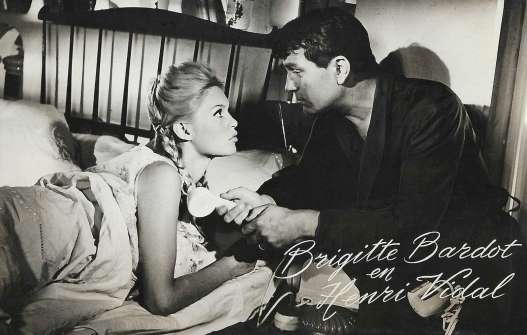
Brigitte Bardot and Henri Vidal in Voulez-vous danser avec moi (1959)
Dutch postcard by Uitg. Takken, Utrecht, no. AX 4282. Photo: N.V. City Film, Den Haag. Brigitte Bardot and Henri Vidal in Voulez-vous danser avec moi / Come Dance With Me! (Michel Boisrond, 1959).French actress Brigitte Bardot (1934) died on 28 December 2025, at the age of 91. In the 1950s, she was the sex kitten of the European film industry. BB starred in 48 films, performed in numerous musical shows, and recorded 80 songs. After her retirement in 1973, she became an animal rights activist. In the coming weeks, we will continue to post a BB postcard every day to remember her as she once was.Brigitte Bardot was born in Paris in 1934. Her father, Louis Bardot, had an engineering degree and worked with his father in the family business. Her mother, Ann-Marie Mucel, was 14 years younger than Brigitte's father, and they married in 1933. Brigitte's mother encouraged her daughter to take up music and dance. At the age of 13, she entered the Conservatoire Nationale de Danse to study ballet. By the time she was 15, Brigitte was trying to launch a modelling career and found herself on the cover of the French magazine Elle in May 1949. Her incredible beauty was readily apparent, and Brigitte was noticed by Roger Vadim, then an assistant to the film director Marc Allegrét. Vadim was infatuated with Bardot and encouraged her to start working as a film actress. BB was 18 when she debuted in the comedy Le Trou Normand / Crazy for Love (Jean Boyer, 1952). In the same year, she married Vadim. Brigitte wanted to marry him when she was 17, but her parents quashed any marriage plans until she turned 18. In April 1953, she attended the Cannes Film Festival, where she received massive media attention. She soon was every man's idea of the girl he'd like to meet in Paris. From 1952 to 1956, she appeared in seventeen films. Her films were generally lightweight romantic dramas in which she was cast as an ingénue or siren, often with an element of undress. In 1953, she made her first US production, Un acte d'amour / Act of Love (Anatole Litvak, 1953) with Kirk Douglas, but she continued to make films in France.Roger Vadim was not content with the light fare his wife was offered. He felt Brigitte Bardot was being undersold. Looking for something more like an art film to push her as a serious actress, he showcased her in Et Dieu créa la femme / ...And God Created Woman (Roger Vadim, 1956). This film, about an immoral teenager in a respectable small-town setting, was a smash success on both sides of the Atlantic. Craig Butler at AllMovie: "It's easy enough to say that ...And God Created Woman is much more important for its historical significance than for its actual quality as a film, and that's true to an extent. The immense popularity, due to its willingness to directly embrace an exploration of sex as well as its willingness to show a degree of nudity that was remarkably daring for its day, demonstrated that audiences were willing to view subject matter that was considered too racy for the average moviegoer. This had both positive (freedom to explore, especially for the French filmmakers of the time) and negative (freedom to exploit) consequences, but its impact is undeniable. It's also true that Woman is not a great work of art, not with a story that is ultimately rather thin, some painful dialogue, and an attitude toward its characters and their sexuality that is unclear and inconsistent. Yet Woman is still fascinating, due in no small part to the presence of Brigitte Bardot in the role that made her an international star and sex symbol. She's not demonstrating great acting here, although her performance is actually good and much better than necessary, and her legendary mambo scene at the climax is nothing short of sensational." During the filming of Et Dieu créa la femme / And God Created Woman (Roger Vadim, 1956), directed by her husband, Brigitte Bardot had an affair with her co-star, Jean-Louis Trintignant, who at the time was married to French actress Stéphane Audran. Her divorce from Vadim followed, but they remained friends and collaborated in later work.Et Dieu créa la femme / ...And God Created Woman (Roger Vadim, 1956) helped elevate Brigitte Bardot's international status. The film took the USA by storm, her explosive sexuality being unlike anything seen in the States since the days of the 'flapper' in the 1920s. It gave rise to the phrase 'sex kitten', and fascination with her in America consisted of magazine photographs and dubbed over French films - good, bad or indifferent, her films drew audiences - mainly men - into theatres like lemmings. BB appeared in light comedies like Doctor at Large (Ralph Thomas, 1957) - the third of the British 'Doctor' series starring Dirk Bogarde - and Une Parisienne / La Parisienne (Michel Boisrond, 1957), which suited her acting skills best. However, she was a sensation in the crime drama En cas de malheur / Love is My Profession (Claude Autant-Lara, 1958). Hal Erickson at AllMovie: "This Brigitte Bardot vehicle ran into stiff opposition from the Catholic Legion of Decency, severely limiting its U.S. distribution. Bardot plays a nubile small-time thief named Yvette, who becomes the mistress of influential defence attorney Andre (Jean Gabin). Though Andre can shower Yvette with jewels and furs, he cannot "buy" her heart, and thus it is that it belongs to handsome young student Mazzetti (Franco Interlenghi). Alas, Yvette is no judge of human nature: attractive though Mazzetti can be, he has a dangerous and deadly side. En Cas de Malheur contains a nude scene that has since been reprinted in freeze-frame form innumerable times by both film-history books and girlie magazines." Photographer Sam Lévin's photos contributed considerably to her image of sensuality and slight immorality. One of Lévin's pictures shows Brigitte, dressed in a white corset. It is said that around 1960, postcards with this photograph outsold in Paris those of the Eiffel Tower.Brigitte Bardot divorced Vadim in 1957, and in 1959 she married actor Jacques Charrier, with whom she starred in Babette s'en va-t-en guerre / Babette Goes to War (Christian-Jaque, 1959). The paparazzi preyed upon her marriage, while she and her husband clashed over the direction of her career
Her films became more substantial, but this brought a heavy pressure of dual celebrity as she sought critical acclaim while remaining a glamour model for most of the world. Vie privée / Private Life (1962), directed by Louis Malle, has more than an element of autobiography in it. James Travers at French Films: "Brigitte Bardot hadn’t quite reached the high point of her career when she agreed to make this film with high-profile New Wave film director Louis Malle. Even so, the pressure of being a living icon was obviously beginning to get to France’s sex goddess, and Vie privée is as much an attempt by Bardot to come to terms with her celebrity as anything else. Malle is clearly fascinated by Bardot, and the documentary approach he adopts for this film reinforces the impression that it is more a biography of the actress than a work of fiction. Of course, it’s not entirely biographical, but the story is remarkably close to Bardot’s own life and comes pretty close to predicting how her career would end." The scene in which, returning to her apartment, Bardot's character is harangued in the elevator by a middle-aged cleaning lady calling her offensive names was based on an actual incident, and is a resonant image of celebrity in the mid-20th century. Soon afterwards, Bardot withdrew to the seclusion of Southern France.Brigitte Bardot's other husbands were German millionaire Playboy Gunter Sachs and right-wing politician Bernard d'Ormale. She is reputed to have had relationships with many other men, including Samy Frey, her co-star in La Vérité / The Truth (Henri-Georges Clouzot, 1960), and musicians Serge Gainsbourg and Sacha Distel. In 1963, Brigitte Bardot starred in Jean-Luc Godard's critically acclaimed film Le Mépris / Contempt (Jean-Luc Godard, 1963) opposite Michel Piccoli. She was also featured along with such notable actors as Alain Delon in Amours célèbres / Famous Love Affairs (Michel Boisrond, 1961) and Histoires extraordinaires /Tales of Mystery (Louis Malle, 1968), Jeanne Moreau in Viva Maria! (Louis Malle, 1965), Sean Connery in Shalako (Edward Dmytryk, 1968), and Claudia Cardinale in Les Pétroleuses / Petroleum Girls (Christian-Jaque, 1971). She participated in various musical shows and recorded many popular songs in the 1960s and 1970s, mostly in collaboration with Serge Gainsbourg, Bob Zagury and Sacha Distel, including 'Harley Davidson', 'Le Soleil De Ma Vie' (the cover of Stevie Wonder's 'You Are the Sunshine of My Life') and the notorious 'Je t'aime... moi non plus'.Brigitte Bardot’s film career showed a steady decline in the late 1960s and early 1970s. In 1973, just before her fortieth birthday, she announced her retirement. She chose to use her fame to promote animal rights. In 1976, she established the Brigitte Bardot Foundation for the Welfare and Protection of Animals. She became a vegetarian and raised three million French francs to fund the foundation by auctioning off jewellery and many personal belongings. For this work, she was awarded the Légion d’honneur in 1984. During the 1990s, she was also outspoken in her criticism of immigration, interracial relationships, Islam in France and homosexuality. Her husband Bernard d'Ormal was a former adviser of the far-right Front National party. Bardot has been convicted five times for 'inciting racial hatred'. More fun is that Bardot is recognised for popularising bikini swimwear, in such early films as Manina / Woman without a Veil (Willy Rozier, 1952), in her appearances at Cannes and in many photo shoots. Bardot also brought into fashion the 'choucroute' ('Sauerkraut') hairstyle (a sort of beehive hairstyle) and gingham clothes after wearing a checkered pink dress, designed by Jacques Esterel, at her wedding to Charrier. The fashions of the 1960s looked effortlessly right and spontaneous on her. Time Magazine: "She is the princess of pout, the countess of come hither. Brigitte Bardot exuded a carefree, naïve sexuality that brought a whole new audience to French films."Sources: Denny Jackson (IMDb), Hal Erickson (AllMovie), Craig Butler (AllMovie), James Travers (French Films), French Films, Wikipedia and IMDb.And please check out our blog European Film Star Postcards.
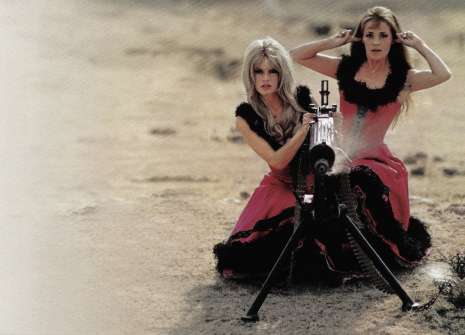
Brigitte Bardot and Jeanne Moreau in Viva Maria (1965)
French postcard by Festival Lumière, Lyon. Photo: Malavida / Gaumont. Brigitte Bardot and Jeanne Moreau in Viva Maria (Louis Malle, 1965).French actress Brigitte Bardot (1934-2025) died on 28 December 2025 at the age of 91. In the 1950s, she was the sex kitten of the European film industry. BB starred in 48 films, performed in numerous musical shows, and recorded 80 songs. After her retirement in 1973, she became an animal rights activist. In the coming weeks, we will continue to post a BB postcard every day to remember her as she once was.French actress Jeanne Moreau (1928-2017) was one of the biggest stars of European cinema and the personification of French womanhood and sensuality. Moreau had a diverse career: she was a magnificent stage and film actress, a producer, screenwriter and film director, a successful singer with a substantial recording career, and a theatre and opera director. She combined off-kilter beauty with strong character in Nouvelle Vague classics such as Ascenseur pour l'échafaud (1958) and Les amants (1959). Her role as the flamboyant, free-spirited Catherine with her devil-may-care sensuality in Jules et Jim (1962) is one of the greatest performances in the history of the cinema. Throughout her long career with more than 130 films, Jeanne Moreau worked with some of the most notable film directors ever.And please check out our blog European Film Star Postcards.
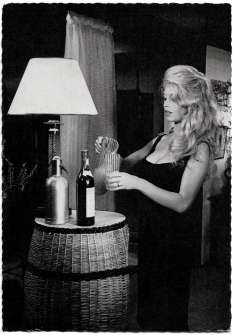
Brigitte Bardot
West German postcard by Filmbilder-Vertrieb Ernst Freihoff, Essen, no. 900.French actress Brigitte Bardot (1934) died on 28 December 2025 at the age of 91. In the 1950s, she was the sex kitten of the European film industry. BB starred in 48 films, performed in numerous musical shows, and recorded 80 songs. After her retirement in 1973, she became an animal rights activist. In the coming weeks, we will continue to post a BB postcard every day to remember her as she once was.Brigitte Bardot was born in Paris in 1934. Her father, Louis Bardot, had an engineering degree and worked with his father in the family business. Her mother, Ann-Marie Mucel, was 14 years younger than Brigitte's father, and they married in 1933. Brigitte's mother encouraged her daughter to take up music and dance. At the age of 13, she entered the Conservatoire Nationale de Danse to study ballet. By the time she was 15, Brigitte was trying to launch a modelling career and found herself on the cover of the French magazine Elle in May 1949. Her incredible beauty was readily apparent, and Brigitte was noticed by Roger Vadim, then an assistant to the film director Marc Allegrét. Vadim was infatuated with Bardot and encouraged her to start working as a film actress. BB was 18 when she debuted in the comedy Le Trou Normand / Crazy for Love (Jean Boyer, 1952). In the same year, she married Vadim. Brigitte wanted to marry him when she was 17, but her parents quashed any marriage plans until she turned 18. In April 1953, she attended the Cannes Film Festival, where she received massive media attention. She soon was every man's idea of the girl he'd like to meet in Paris. From 1952 to 1956, she appeared in seventeen films. Her films were generally lightweight romantic dramas in which she was cast as an ingénue or siren, often with an element of undress. In 1953, she made her first US production, Un acte d'amour / Act of Love (Anatole Litvak, 1953) with Kirk Douglas, but she continued to make films in France.Roger Vadim was not content with the light fare his wife was offered. He felt Brigitte Bardot was being undersold. Looking for something more like an art film to push her as a serious actress, he showcased her in Et Dieu créa la femme / ...And God Created Woman (Roger Vadim, 1956). This film, about an immoral teenager in a respectable small-town setting, was a smash success on both sides of the Atlantic. Craig Butler at AllMovie: "It's easy enough to say that ...And God Created Woman is much more important for its historical significance than for its actual quality as a film, and that's true to an extent. The immense popularity, due to its willingness to directly embrace an exploration of sex as well as its willingness to show a degree of nudity that was remarkably daring for its day, demonstrated that audiences were willing to view subject matter that was considered too racy for the average moviegoer. This had both positive (freedom to explore, especially for the French filmmakers of the time) and negative (freedom to exploit) consequences, but its impact is undeniable. It's also true that Woman is not a great work of art, not with a story that is ultimately rather thin, some painful dialogue, and an attitude toward its characters and their sexuality that is unclear and inconsistent. Yet Woman is still fascinating, due in no small part to the presence of Brigitte Bardot in the role that made her an international star and sex symbol. She's not demonstrating great acting here, although her performance is actually good and much better than necessary, and her legendary mambo scene at the climax is nothing short of sensational." During the filming of Et Dieu créa la femme / And God Created Woman (Roger Vadim, 1956), directed by her husband, Brigitte Bardot had an affair with her co-star, Jean-Louis Trintignant, who at the time was married to French actress Stéphane Audran. Her divorce from Vadim followed, but they remained friends and collaborated in later work.Et Dieu créa la femme / ...And God Created Woman (Roger Vadim, 1956) helped Brigitte Bardot's international status. The film took the USA by storm, her explosive sexuality being unlike anything seen in the States since the days of the 'flapper' in the 1920s. It gave rise to the phrase 'sex kitten', and fascination with her in America consisted of magazine photographs and dubbed over French films - good, bad or indifferent, her films drew audiences - mainly men - into theatres like lemmings. BB appeared in light comedies like Doctor at Large (Ralph Thomas, 1957) - the third of the British 'Doctor' series starring Dirk Bogarde - and Une Parisienne / La Parisienne (Michel Boisrond, 1957), which suited her acting skills best. However, she was a sensation in the crime drama En cas de malheur / Love is My Profession (Claude Autant-Lara, 1958). Hal Erickson at AllMovie: "This Brigitte Bardot vehicle ran into stiff opposition from the Catholic Legion of Decency, severely limiting its U.S. distribution. Bardot plays a nubile small-time thief named Yvette, who becomes the mistress of influential defence attorney Andre (Jean Gabin). Though Andre can shower Yvette with jewels and furs, he cannot "buy" her heart, and thus it is that it belongs to handsome young student Mazzetti (Franco Interlenghi). Alas, Yvette is no judge of human nature: attractive though Mazzetti can be, he has a dangerous and deadly side. En Cas de Malheur contains a nude scene that has since been reprinted in freeze-frame form innumerable times by both film-history books and girlie magazines." Photographer Sam Lévin's photos contributed considerably to her image of sensuality and slight immorality. One of Lévin's pictures shows Brigitte, dressed in a white corset. It is said that around 1960, postcards with this photograph outsold in Paris those of the Eiffel Tower.Brigitte Bardot divorced Vadim in 1957, and in 1959 she married actor Jacques Charrier, with whom she starred in Babette s'en va-t-en guerre / Babette Goes to War (Christian-Jaque, 1959). The paparazzi preyed upon her marriage, while she and her husband clashed over the direction of her career
Her films became more substantial, but this brought a heavy pressure of dual celebrity as she sought critical acclaim while remaining a glamour model for most of the world. Vie privée / Private Life (1962), directed by Louis Malle, has more than an element of autobiography in it. James Travers at French Films: "Brigitte Bardot hadn’t quite reached the high point of her career when she agreed to make this film with high-profile New Wave film director Louis Malle. Even so, the pressure of being a living icon was obviously beginning to get to France’s sex goddess, and Vie privée is as much an attempt by Bardot to come to terms with her celebrity as anything else. Malle is clearly fascinated by Bardot, and the documentary approach he adopts for this film reinforces the impression that it is more a biography of the actress than a work of fiction. Of course, it’s not entirely biographical, but the story is remarkably close to Bardot’s own life and comes pretty close to predicting how her career would end." The scene in which, returning to her apartment, Bardot's character is harangued in the elevator by a middle-aged cleaning lady calling her offensive names was based on an actual incident, and is a resonant image of celebrity in the mid-20th century. Soon afterwards, Bardot withdrew to the seclusion of Southern France.Brigitte Bardot's other husbands were German millionaire Playboy Gunter Sachs and right-wing politician Bernard d'Ormale. She is reputed to have had relationships with many other men, including Samy Frey, her co-star in La Vérité / The Truth (Henri-Georges Clouzot, 1960), and musicians Serge Gainsbourg and Sacha Distel. In 1963, Brigitte Bardot starred in Jean-Luc Godard's critically acclaimed film Le Mépris / Contempt (Jean-Luc Godard, 1963) opposite Michel Piccoli. She was also featured along with such notable actors as Alain Delon in Amours célèbres / Famous Love Affairs (Michel Boisrond, 1961) and Histoires extraordinaires /Tales of Mystery (Louis Malle, 1968), Jeanne Moreau in Viva Maria! (Louis Malle, 1965), Sean Connery in Shalako (Edward Dmytryk, 1968), and Claudia Cardinale in Les Pétroleuses / Petroleum Girls (Christian-Jaque, 1971). She participated in various musical shows and recorded many popular songs in the 1960s and 1970s, mostly in collaboration with Serge Gainsbourg, Bob Zagury and Sacha Distel, including 'Harley Davidson', 'Le Soleil De Ma Vie' (the cover of Stevie Wonder's 'You Are the Sunshine of My Life') and the notorious 'Je t'aime... moi non plus'.Brigitte Bardot’s film career showed a steady decline in the late 1960s and early 1970s. In 1973, just before her fortieth birthday, she announced her retirement. She chose to use her fame to promote animal rights. In 1976, she established the Brigitte Bardot Foundation for the Welfare and Protection of Animals. She became a vegetarian and raised three million French francs to fund the foundation by auctioning off jewellery and many personal belongings. For this work, she was awarded the Légion d’honneur in 1984. During the 1990s, she was also outspoken in her criticism of immigration, interracial relationships, Islam in France and homosexuality. Her husband Bernard d'Ormal was a former adviser of the far-right Front National party. Bardot has been convicted five times for 'inciting racial hatred'. More fun is that Bardot is recognised for popularising bikini swimwear, in such early films as Manina / Woman without a Veil (Willy Rozier, 1952), in her appearances at Cannes and in many photo shoots. Bardot also brought into fashion the 'choucroute' ('Sauerkraut') hairstyle (a sort of beehive hairstyle) and gingham clothes after wearing a checkered pink dress, designed by Jacques Esterel, at her wedding to Charrier. The fashions of the 1960s looked effortlessly right and spontaneous on her. Time Magazine: "She is the princess of pout, the countess of come hither. Brigitte Bardot exuded a carefree, naïve sexuality that brought a whole new audience to French films."Sources: Denny Jackson (IMDb), Hal Erickson (AllMovie), Craig Butler (AllMovie), James Travers (French Films), French Films, Wikipedia and IMDb.And please check out our blog European Film Star Postcards.
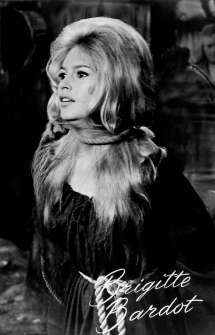
Brigitte Bardot in Amours célèbres (1961)
Dutch postcard by Uitg. Takken, Utrecht, no. AX 4805. Photo: City-Film. Brigitte Bardot in Amours célèbres / Famous Love Affairs (Michel Boisrond, 1961).French actress Brigitte Bardot (1934) died on 28 December 2025, at the age of 91. In the 1950s, she was the sex kitten of the European film industry. BB starred in 48 films, performed in numerous musical shows, and recorded 80 songs. After her retirement in 1973, she became an animal rights activist. In the coming weeks, we will continue to post a BB postcard every day to remember her as she once was.Brigitte Bardot was born in Paris in 1934. Her father, Louis Bardot, had an engineering degree and worked with his father in the family business. Her mother, Ann-Marie Mucel, was 14 years younger than Brigitte's father, and they married in 1933. Brigitte's mother encouraged her daughter to take up music and dance. At the age of 13, she entered the Conservatoire Nationale de Danse to study ballet. By the time she was 15, Brigitte was trying to launch a modelling career and found herself on the cover of the French magazine Elle in May 1949. Her incredible beauty was readily apparent, and Brigitte was noticed by Roger Vadim, then an assistant to the film director Marc Allegrét. Vadim was infatuated with Bardot and encouraged her to start working as a film actress. BB was 18 when she debuted in the comedy Le Trou Normand / Crazy for Love (Jean Boyer, 1952). In the same year, she married Vadim. Brigitte wanted to marry him when she was 17, but her parents quashed any marriage plans until she turned 18. In April 1953, she attended the Cannes Film Festival, where she received massive media attention. She soon was every man's idea of the girl he'd like to meet in Paris. From 1952 to 1956, she appeared in seventeen films. Her films were generally lightweight romantic dramas in which she was cast as an ingénue or siren, often with an element of undress. In 1953, she made her first US production, Un acte d'amour / Act of Love (Anatole Litvak, 1953) with Kirk Douglas, but she continued to make films in France.Roger Vadim was not content with the light fare his wife was offered. He felt Brigitte Bardot was being undersold. Looking for something more like an art film to push her as a serious actress, he showcased her in Et Dieu créa la femme / ...And God Created Woman (Roger Vadim, 1956). This film, about an immoral teenager in a respectable small-town setting, was a smash success on both sides of the Atlantic. Craig Butler at AllMovie: "It's easy enough to say that ...And God Created Woman is much more important for its historical significance than for its actual quality as a film, and that's true to an extent. The immense popularity, due to its willingness to directly embrace an exploration of sex as well as its willingness to show a degree of nudity that was remarkably daring for its day, demonstrated that audiences were willing to view subject matter that was considered too racy for the average moviegoer. This had both positive (freedom to explore, especially for the French filmmakers of the time) and negative (freedom to exploit) consequences, but its impact is undeniable. It's also true that Woman is not a great work of art, not with a story that is ultimately rather thin, some painful dialogue, and an attitude toward its characters and their sexuality that is unclear and inconsistent. Yet Woman is still fascinating, due in no small part to the presence of Brigitte Bardot in the role that made her an international star and sex symbol. She's not demonstrating great acting here, although her performance is actually good and much better than necessary, and her legendary mambo scene at the climax is nothing short of sensational." During the filming of Et Dieu créa la femme / And God Created Woman (Roger Vadim, 1956), directed by her husband, Brigitte Bardot had an affair with her co-star, Jean-Louis Trintignant, who at the time was married to French actress Stéphane Audran. Her divorce from Vadim followed, but they remained friends and collaborated in later work.Et Dieu créa la femme / ...And God Created Woman (Roger Vadim, 1956) helped Brigitte Bardot's international status. The film took the USA by storm, her explosive sexuality being unlike anything seen in the States since the days of the 'flapper' in the 1920s. It gave rise to the phrase 'sex kitten', and fascination with her in America consisted of magazine photographs and dubbed over French films - good, bad or indifferent, her films drew audiences - mainly men - into theatres like lemmings. BB appeared in light comedies like Doctor at Large (Ralph Thomas, 1957) - the third of the British 'Doctor' series starring Dirk Bogarde - and Une Parisienne / La Parisienne (Michel Boisrond, 1957), which suited her acting skills best. However, she was a sensation in the crime drama En cas de malheur / Love is My Profession (Claude Autant-Lara, 1958). Hal Erickson at AllMovie: "This Brigitte Bardot vehicle ran into stiff opposition from the Catholic Legion of Decency, severely limiting its U.S. distribution. Bardot plays a nubile small-time thief named Yvette, who becomes the mistress of influential defence attorney Andre (Jean Gabin). Though Andre can shower Yvette with jewels and furs, he cannot "buy" her heart, and thus it is that it belongs to handsome young student Mazzetti (Franco Interlenghi). Alas, Yvette is no judge of human nature: attractive though Mazzetti can be, he has a dangerous and deadly side. En Cas de Malheur contains a nude scene that has since been reprinted in freeze-frame form innumerable times by both film-history books and girlie magazines." Photographer Sam Lévin's photos contributed considerably to her image of sensuality and slight immorality. One of Lévin's pictures shows Brigitte, dressed in a white corset. It is said that around 1960, postcards with this photograph outsold in Paris those of the Eiffel Tower.Brigitte Bardot divorced Vadim in 1957, and in 1959 she married actor Jacques Charrier, with whom she starred in Babette s'en va-t-en guerre / Babette Goes to War (Christian-Jaque, 1959). The paparazzi preyed upon her marriage, while she and her husband clashed over the direction of her career
Her films became more substantial, but this brought a heavy pressure of dual celebrity as she sought critical acclaim while remaining a glamour model for most of the world. Vie privée / Private Life (1962), directed by Louis Malle, has more than an element of autobiography in it. James Travers at French Films: "Brigitte Bardot hadn’t quite reached the high point of her career when she agreed to make this film with high-profile New Wave film director Louis Malle. Even so, the pressure of being a living icon was obviously beginning to get to France’s sex goddess, and Vie privée is as much an attempt by Bardot to come to terms with her celebrity as anything else. Malle is clearly fascinated by Bardot, and the documentary approach he adopts for this film reinforces the impression that it is more a biography of the actress than a work of fiction. Of course, it’s not entirely biographical, but the story is remarkably close to Bardot’s own life and comes pretty close to predicting how her career would end." The scene in which, returning to her apartment, Bardot's character is harangued in the elevator by a middle-aged cleaning lady calling her offensive names was based on an actual incident, and is a resonant image of celebrity in the mid-20th century. Soon afterwards, Bardot withdrew to the seclusion of Southern France.Brigitte Bardot's other husbands were German millionaire Playboy Gunter Sachs and right-wing politician Bernard d'Ormale. She is reputed to have had relationships with many other men, including Samy Frey, her co-star in La Vérité / The Truth (Henri-Georges Clouzot, 1960), and musicians Serge Gainsbourg and Sacha Distel. In 1963, Brigitte Bardot starred in Jean-Luc Godard's critically acclaimed film Le Mépris / Contempt (Jean-Luc Godard, 1963) opposite Michel Piccoli. She was also featured along with such notable actors as Alain Delon in Amours célèbres / Famous Love Affairs (Michel Boisrond, 1961) and Histoires extraordinaires /Tales of Mystery (Louis Malle, 1968), Jeanne Moreau in Viva Maria! (Louis Malle, 1965), Sean Connery in Shalako (Edward Dmytryk, 1968), and Claudia Cardinale in Les Pétroleuses / Petroleum Girls (Christian-Jaque, 1971). She participated in various musical shows and recorded many popular songs in the 1960s and 1970s, mostly in collaboration with Serge Gainsbourg, Bob Zagury and Sacha Distel, including 'Harley Davidson', 'Le Soleil De Ma Vie' (the cover of Stevie Wonder's 'You Are the Sunshine of My Life') and the notorious 'Je t'aime... moi non plus'.Brigitte Bardot’s film career showed a steady decline in the late 1960s and early 1970s. In 1973, just before her fortieth birthday, she announced her retirement. She chose to use her fame to promote animal rights. In 1976, she established the Brigitte Bardot Foundation for the Welfare and Protection of Animals. She became a vegetarian and raised three million French francs to fund the foundation by auctioning off jewellery and many personal belongings. For this work, she was awarded the Légion d’honneur in 1984. During the 1990s, she was also outspoken in her criticism of immigration, interracial relationships, Islam in France and homosexuality. Her husband Bernard d'Ormal was a former adviser of the far-right Front National party. Bardot has been convicted five times for 'inciting racial hatred'. More fun is that Bardot is recognised for popularising bikini swimwear, in such early films as Manina / Woman without a Veil (Willy Rozier, 1952), in her appearances at Cannes and in many photo shoots. Bardot also brought into fashion the 'choucroute' ('Sauerkraut') hairstyle (a sort of beehive hairstyle) and gingham clothes after wearing a checkered pink dress, designed by Jacques Esterel, at her wedding to Charrier. The fashions of the 1960s looked effortlessly right and spontaneous on her. Time Magazine: "She is the princess of pout, the countess of come hither. Brigitte Bardot exuded a carefree, naïve sexuality that brought a whole new audience to French films."Sources: Denny Jackson (IMDb), Hal Erickson (AllMovie), Craig Butler (AllMovie), James Travers (French Films), French Films, Wikipedia and IMDb.And please check out our blog European Film Star Postcards.
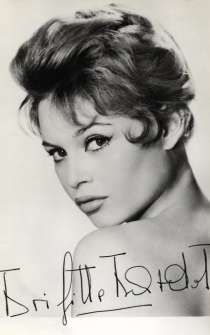
Brigitte Bardot
British promotion postcard. Caption: "I'm a woman from a man's point of view', says Bardot. ...If you want to find out why, read 'The Secrets of A Sex Kitten', with Bardot's own intimate pictures only in Sunday's Empire News.French actress Brigitte Bardot (1934) died on 28 December 2025, at the age of 91. In the 1950s, she was the sex kitten of the European film industry. BB starred in 48 films, performed in numerous musical shows, and recorded 80 songs. After her retirement in 1973, she became an animal rights activist. In the coming weeks, we will continue to post a BB postcard every day to remember her as she once was.Brigitte Bardot was born in Paris in 1934. Her father, Louis Bardot, had an engineering degree and worked with his father in the family business. Her mother, Ann-Marie Mucel, was 14 years younger than Brigitte's father, and they married in 1933. Brigitte's mother encouraged her daughter to take up music and dance. At the age of 13, she entered the Conservatoire Nationale de Danse to study ballet. By the time she was 15, Brigitte was trying to launch a modelling career and found herself on the cover of the French magazine Elle in May 1949. Her incredible beauty was readily apparent, and Brigitte was noticed by Roger Vadim, then an assistant to the film director Marc Allegrét. Vadim was infatuated with Bardot and encouraged her to start working as a film actress. BB was 18 when she debuted in the comedy Le Trou Normand / Crazy for Love (Jean Boyer, 1952). In the same year, she married Vadim. Brigitte wanted to marry him when she was 17, but her parents quashed any marriage plans until she turned 18. In April 1953, she attended the Cannes Film Festival, where she received massive media attention. She soon was every man's idea of the girl he'd like to meet in Paris. From 1952 to 1956, she appeared in seventeen films. Her films were generally lightweight romantic dramas in which she was cast as an ingénue or siren, often with an element of undress. In 1953, she made her first US production, Un acte d'amour / Act of Love (Anatole Litvak, 1953) with Kirk Douglas, but she continued to make films in France.Roger Vadim was not content with the light fare his wife was offered. He felt Brigitte Bardot was being undersold. Looking for something more like an art film to push her as a serious actress, he showcased her in Et Dieu créa la femme / ...And God Created Woman (Roger Vadim, 1956). This film, about an immoral teenager in a respectable small-town setting, was a smash success on both sides of the Atlantic. Craig Butler at AllMovie: "It's easy enough to say that ...And God Created Woman is much more important for its historical significance than for its actual quality as a film, and that's true to an extent. The immense popularity, due to its willingness to directly embrace an exploration of sex as well as its willingness to show a degree of nudity that was remarkably daring for its day, demonstrated that audiences were willing to view subject matter that was considered too racy for the average moviegoer. This had both positive (freedom to explore, especially for the French filmmakers of the time) and negative (freedom to exploit) consequences, but its impact is undeniable. It's also true that Woman is not a great work of art, not with a story that is ultimately rather thin, some painful dialogue, and an attitude toward its characters and their sexuality that is unclear and inconsistent. Yet Woman is still fascinating, due in no small part to the presence of Brigitte Bardot in the role that made her an international star and sex symbol. She's not demonstrating great acting here, although her performance is actually good and much better than necessary, and her legendary mambo scene at the climax is nothing short of sensational." During the filming of Et Dieu créa la femme / And God Created Woman (Roger Vadim, 1956), directed by her husband, Brigitte Bardot had an affair with her co-star, Jean-Louis Trintignant, who at the time was married to French actress Stéphane Audran. Her divorce from Vadim followed, but they remained friends and collaborated in later work.Et Dieu créa la femme / ...And God Created Woman (Roger Vadim, 1956) helped Brigitte Bardot's international status. The film took the USA by storm, her explosive sexuality being unlike anything seen in the States since the days of the 'flapper' in the 1920s. It gave rise to the phrase 'sex kitten', and fascination with her in America consisted of magazine photographs and dubbed over French films - good, bad or indifferent, her films drew audiences - mainly men - into theatres like lemmings. BB appeared in light comedies like Doctor at Large (Ralph Thomas, 1957) - the third of the British 'Doctor' series starring Dirk Bogarde - and Une Parisienne / La Parisienne (Michel Boisrond, 1957), which suited her acting skills best. However, she was a sensation in the crime drama En cas de malheur / Love is My Profession (Claude Autant-Lara, 1958). Hal Erickson at AllMovie: "This Brigitte Bardot vehicle ran into stiff opposition from the Catholic Legion of Decency, severely limiting its U.S. distribution. Bardot plays a nubile small-time thief named Yvette, who becomes the mistress of influential defence attorney Andre (Jean Gabin). Though Andre can shower Yvette with jewels and furs, he cannot "buy" her heart, and thus it is that it belongs to handsome young student Mazzetti (Franco Interlenghi). Alas, Yvette is no judge of human nature: attractive though Mazzetti can be, he has a dangerous and deadly side. En Cas de Malheur contains a nude scene that has since been reprinted in freeze-frame form innumerable times by both film-history books and girlie magazines." Photographer Sam Lévin's photos contributed considerably to her image of sensuality and slight immorality. One of Lévin's pictures shows Brigitte, dressed in a white corset. It is said that around 1960, postcards with this photograph outsold in Paris those of the Eiffel Tower.Brigitte Bardot divorced Vadim in 1957, and in 1959 she married actor Jacques Charrier, with whom she starred in Babette s'en va-t-en guerre / Babette Goes to War (Christian-Jaque, 1959). The paparazzi preyed upon her marriage, while she and her husband clashed over the direction of her career
Her films became more substantial, but this brought a heavy pressure of dual celebrity as she sought critical acclaim while remaining a glamour model for most of the world. Vie privée / Private Life (1962), directed by Louis Malle, has more than an element of autobiography in it. James Travers at French Films: "Brigitte Bardot hadn’t quite reached the high point of her career when she agreed to make this film with high-profile New Wave film director Louis Malle. Even so, the pressure of being a living icon was obviously beginning to get to France’s sex goddess, and Vie privée is as much an attempt by Bardot to come to terms with her celebrity as anything else. Malle is clearly fascinated by Bardot, and the documentary approach he adopts for this film reinforces the impression that it is more a biography of the actress than a work of fiction. Of course, it’s not entirely biographical, but the story is remarkably close to Bardot’s own life and comes pretty close to predicting how her career would end." The scene in which, returning to her apartment, Bardot's character is harangued in the elevator by a middle-aged cleaning lady calling her offensive names was based on an actual incident, and is a resonant image of celebrity in the mid-20th century. Soon afterwards, Bardot withdrew to the seclusion of Southern France.Brigitte Bardot's other husbands were German millionaire Playboy Gunter Sachs and right-wing politician Bernard d'Ormale. She is reputed to have had relationships with many other men, including Samy Frey, her co-star in La Vérité / The Truth (Henri-Georges Clouzot, 1960), and musicians Serge Gainsbourg and Sacha Distel. In 1963, Brigitte Bardot starred in Jean-Luc Godard's critically acclaimed film Le Mépris / Contempt (Jean-Luc Godard, 1963) opposite Michel Piccoli. She was also featured along with such notable actors as Alain Delon in Amours célèbres / Famous Love Affairs (Michel Boisrond, 1961) and Histoires extraordinaires /Tales of Mystery (Louis Malle, 1968), Jeanne Moreau in Viva Maria! (Louis Malle, 1965), Sean Connery in Shalako (Edward Dmytryk, 1968), and Claudia Cardinale in Les Pétroleuses / Petroleum Girls (Christian-Jaque, 1971). She participated in various musical shows and recorded many popular songs in the 1960s and 1970s, mostly in collaboration with Serge Gainsbourg, Bob Zagury and Sacha Distel, including 'Harley Davidson', 'Le Soleil De Ma Vie' (the cover of Stevie Wonder's 'You Are the Sunshine of My Life') and the notorious 'Je t'aime... moi non plus'.Brigitte Bardot’s film career showed a steady decline in the late 1960s and early 1970s. In 1973, just before her fortieth birthday, she announced her retirement. She chose to use her fame to promote animal rights. In 1976, she established the Brigitte Bardot Foundation for the Welfare and Protection of Animals. She became a vegetarian and raised three million French francs to fund the foundation by auctioning off jewellery and many personal belongings. For this work, she was awarded the Légion d’honneur in 1984. During the 1990s, she was also outspoken in her criticism of immigration, interracial relationships, Islam in France and homosexuality. Her husband Bernard d'Ormal was a former adviser of the far-right Front National party. Bardot has been convicted five times for 'inciting racial hatred'. More fun is that Bardot is recognised for popularising bikini swimwear, in such early films as Manina / Woman without a Veil (Willy Rozier, 1952), in her appearances at Cannes and in many photo shoots. Bardot also brought into fashion the 'choucroute' ('Sauerkraut') hairstyle (a sort of beehive hairstyle) and gingham clothes after wearing a checkered pink dress, designed by Jacques Esterel, at her wedding to Charrier. The fashions of the 1960s looked effortlessly right and spontaneous on her. Time Magazine: "She is the princess of pout, the countess of come hither. Brigitte Bardot exuded a carefree, naïve sexuality that brought a whole new audience to French films."Sources: Denny Jackson (IMDb), Hal Erickson (AllMovie), Craig Butler (AllMovie), James Travers (French Films), French Films, Wikipedia and IMDb.And please check out our blog European Film Star Postcards.
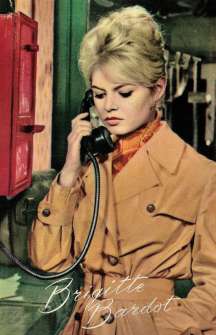
Brigitte Bardot
Vintage postcard.French actress Brigitte Bardot (1934) died on 28 December 2025, at the age of 91. In the 1950s, she was the sex kitten of the European film industry. BB starred in 48 films, performed in numerous musical shows, and recorded 80 songs. After her retirement in 1973, she became an animal rights activist. In the coming weeks, we will continue to post a BB postcard every day to remember her as she once was.Brigitte Bardot was born in Paris in 1934. Her father, Louis Bardot, had an engineering degree and worked with his father in the family business. Her mother, Ann-Marie Mucel, was 14 years younger than Brigitte's father, and they married in 1933. Brigitte's mother encouraged her daughter to take up music and dance. At the age of 13, she entered the Conservatoire Nationale de Danse to study ballet. By the time she was 15, Brigitte was trying to launch a modelling career and found herself on the cover of the French magazine Elle in May 1949. Her incredible beauty was readily apparent, and Brigitte was noticed by Roger Vadim, then an assistant to the film director Marc Allegrét. Vadim was infatuated with Bardot and encouraged her to start working as a film actress. BB was 18 when she debuted in the comedy Le Trou Normand / Crazy for Love (Jean Boyer, 1952). In the same year, she married Vadim. Brigitte wanted to marry him when she was 17, but her parents quashed any marriage plans until she turned 18. In April 1953, she attended the Cannes Film Festival, where she received massive media attention. She soon was every man's idea of the girl he'd like to meet in Paris. From 1952 to 1956, she appeared in seventeen films. Her films were generally lightweight romantic dramas in which she was cast as an ingénue or siren, often with an element of undress. In 1953, she made her first US production, Un acte d'amour / Act of Love (Anatole Litvak, 1953) with Kirk Douglas, but she continued to make films in France.Roger Vadim was not content with the light fare his wife was offered. He felt Brigitte Bardot was being undersold. Looking for something more like an art film to push her as a serious actress, he showcased her in Et Dieu créa la femme / ...And God Created Woman (Roger Vadim, 1956). This film, about an immoral teenager in a respectable small-town setting, was a smash success on both sides of the Atlantic. Craig Butler at AllMovie: "It's easy enough to say that ...And God Created Woman is much more important for its historical significance than for its actual quality as a film, and that's true to an extent. The immense popularity, due to its willingness to directly embrace an exploration of sex as well as its willingness to show a degree of nudity that was remarkably daring for its day, demonstrated that audiences were willing to view subject matter that was considered too racy for the average moviegoer. This had both positive (freedom to explore, especially for the French filmmakers of the time) and negative (freedom to exploit) consequences, but its impact is undeniable. It's also true that Woman is not a great work of art, not with a story that is ultimately rather thin, some painful dialogue, and an attitude toward its characters and their sexuality that is unclear and inconsistent. Yet Woman is still fascinating, due in no small part to the presence of Brigitte Bardot in the role that made her an international star and sex symbol. She's not demonstrating great acting here, although her performance is actually good and much better than necessary, and her legendary mambo scene at the climax is nothing short of sensational." During the filming of Et Dieu créa la femme / And God Created Woman (Roger Vadim, 1956), directed by her husband, Brigitte Bardot had an affair with her co-star, Jean-Louis Trintignant, who at the time was married to French actress Stéphane Audran. Her divorce from Vadim followed, but they remained friends and collaborated in later work.Et Dieu créa la femme / ...And God Created Woman (Roger Vadim, 1956) helped Brigitte Bardot's international status. The film took the USA by storm, her explosive sexuality being unlike anything seen in the States since the days of the 'flapper' in the 1920s. It gave rise to the phrase 'sex kitten', and fascination with her in America consisted of magazine photographs and dubbed over French films - good, bad or indifferent, her films drew audiences - mainly men - into theatres like lemmings. BB appeared in light comedies like Doctor at Large (Ralph Thomas, 1957) - the third of the British 'Doctor' series starring Dirk Bogarde - and Une Parisienne / La Parisienne (Michel Boisrond, 1957), which suited her acting skills best. However, she was a sensation in the crime drama En cas de malheur / Love is My Profession (Claude Autant-Lara, 1958). Hal Erickson at AllMovie: "This Brigitte Bardot vehicle ran into stiff opposition from the Catholic Legion of Decency, severely limiting its U.S. distribution. Bardot plays a nubile small-time thief named Yvette, who becomes the mistress of influential defence attorney Andre (Jean Gabin). Though Andre can shower Yvette with jewels and furs, he cannot "buy" her heart, and thus it is that it belongs to handsome young student Mazzetti (Franco Interlenghi). Alas, Yvette is no judge of human nature: attractive though Mazzetti can be, he has a dangerous and deadly side. En Cas de Malheur contains a nude scene that has since been reprinted in freeze-frame form innumerable times by both film-history books and girlie magazines." Photographer Sam Lévin's photos contributed considerably to her image of sensuality and slight immorality. One of Lévin's pictures shows Brigitte, dressed in a white corset. It is said that around 1960, postcards with this photograph outsold in Paris those of the Eiffel Tower.Brigitte Bardot divorced Vadim in 1957, and in 1959 she married actor Jacques Charrier, with whom she starred in Babette s'en va-t-en guerre / Babette Goes to War (Christian-Jaque, 1959). The paparazzi preyed upon her marriage, while she and her husband clashed over the direction of her career
Her films became more substantial, but this brought a heavy pressure of dual celebrity as she sought critical acclaim while remaining a glamour model for most of the world. Vie privée / Private Life (1962), directed by Louis Malle, has more than an element of autobiography in it. James Travers at French Films: "Brigitte Bardot hadn’t quite reached the high point of her career when she agreed to make this film with high-profile New Wave film director Louis Malle. Even so, the pressure of being a living icon was obviously beginning to get to France’s sex goddess, and Vie privée is as much an attempt by Bardot to come to terms with her celebrity as anything else. Malle is clearly fascinated by Bardot, and the documentary approach he adopts for this film reinforces the impression that it is more a biography of the actress than a work of fiction. Of course, it’s not entirely biographical, but the story is remarkably close to Bardot’s own life and comes pretty close to predicting how her career would end." The scene in which, returning to her apartment, Bardot's character is harangued in the elevator by a middle-aged cleaning lady calling her offensive names was based on an actual incident, and is a resonant image of celebrity in the mid-20th century. Soon afterwards, Bardot withdrew to the seclusion of Southern France.Brigitte Bardot's other husbands were German millionaire Playboy Gunter Sachs and right-wing politician Bernard d'Ormale. She is reputed to have had relationships with many other men, including Samy Frey, her co-star in La Vérité / The Truth (Henri-Georges Clouzot, 1960), and musicians Serge Gainsbourg and Sacha Distel. In 1963, Brigitte Bardot starred in Jean-Luc Godard's critically acclaimed film Le Mépris / Contempt (Jean-Luc Godard, 1963) opposite Michel Piccoli. She was also featured along with such notable actors as Alain Delon in Amours célèbres / Famous Love Affairs (Michel Boisrond, 1961) and Histoires extraordinaires /Tales of Mystery (Louis Malle, 1968), Jeanne Moreau in Viva Maria! (Louis Malle, 1965), Sean Connery in Shalako (Edward Dmytryk, 1968), and Claudia Cardinale in Les Pétroleuses / Petroleum Girls (Christian-Jaque, 1971). She participated in various musical shows and recorded many popular songs in the 1960s and 1970s, mostly in collaboration with Serge Gainsbourg, Bob Zagury and Sacha Distel, including 'Harley Davidson', 'Le Soleil De Ma Vie' (the cover of Stevie Wonder's 'You Are the Sunshine of My Life') and the notorious 'Je t'aime... moi non plus'.Brigitte Bardot’s film career showed a steady decline in the late 1960s and early 1970s. In 1973, just before her fortieth birthday, she announced her retirement. She chose to use her fame to promote animal rights. In 1976, she established the Brigitte Bardot Foundation for the Welfare and Protection of Animals. She became a vegetarian and raised three million French francs to fund the foundation by auctioning off jewellery and many personal belongings. For this work, she was awarded the Légion d’honneur in 1984. During the 1990s, she was also outspoken in her criticism of immigration, interracial relationships, Islam in France and homosexuality. Her husband Bernard d'Ormal was a former adviser of the far-right Front National party. Bardot has been convicted five times for 'inciting racial hatred'. More fun is that Bardot is recognised for popularising bikini swimwear, in such early films as Manina / Woman without a Veil (Willy Rozier, 1952), in her appearances at Cannes and in many photo shoots. Bardot also brought into fashion the 'choucroute' ('Sauerkraut') hairstyle (a sort of beehive hairstyle) and gingham clothes after wearing a checkered pink dress, designed by Jacques Esterel, at her wedding to Charrier. The fashions of the 1960s looked effortlessly right and spontaneous on her. Time Magazine: "She is the princess of pout, the countess of come hither. Brigitte Bardot exuded a carefree, naïve sexuality that brought a whole new audience to French films."Sources: Denny Jackson (IMDb), Hal Erickson (AllMovie), Craig Butler (AllMovie), James Travers (French Films), French Films, Wikipedia and IMDb.And please check out our blog European Film Star Postcards.
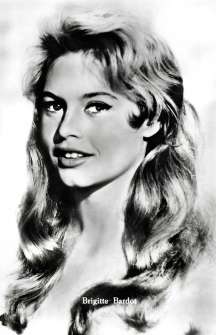
Brigitte Bardot
Dutch postcard by Gebr. Spanjersberg N.V., Rotterdam (SPARO), no. b 78.French actress Brigitte Bardot (1934) died on 28 December 2025, at the age of 91. In the 1950s, she was the sex kitten of the European film industry. BB starred in 48 films, performed in numerous musical shows, and recorded 80 songs. After her retirement in 1973, she became an animal rights activist. In the coming weeks, we will continue to post a BB postcard every day to remember her as she once was.Brigitte Bardot was born in Paris in 1934. Her father, Louis Bardot, had an engineering degree and worked with his father in the family business. Her mother, Ann-Marie Mucel, was 14 years younger than Brigitte's father, and they married in 1933. Brigitte's mother encouraged her daughter to take up music and dance. At the age of 13, she entered the Conservatoire Nationale de Danse to study ballet. By the time she was 15, Brigitte was trying to launch a modelling career and found herself on the cover of the French magazine Elle in May 1949. Her incredible beauty was readily apparent, and Brigitte was noticed by Roger Vadim, then an assistant to the film director Marc Allegrét. Vadim was infatuated with Bardot and encouraged her to start working as a film actress. BB was 18 when she debuted in the comedy Le Trou Normand / Crazy for Love (Jean Boyer, 1952). In the same year, she married Vadim. Brigitte wanted to marry him when she was 17, but her parents quashed any marriage plans until she turned 18. In April 1953, she attended the Cannes Film Festival, where she received massive media attention. She soon was every man's idea of the girl he'd like to meet in Paris. From 1952 to 1956, she appeared in seventeen films. Her films were generally lightweight romantic dramas in which she was cast as an ingénue or siren, often with an element of undress. In 1953, she made her first US production, Un acte d'amour / Act of Love (Anatole Litvak, 1953) with Kirk Douglas, but she continued to make films in France.Roger Vadim was not content with the light fare his wife was offered. He felt Brigitte Bardot was being undersold. Looking for something more like an art film to push her as a serious actress, he showcased her in Et Dieu créa la femme / ...And God Created Woman (Roger Vadim, 1956). This film, about an immoral teenager in a respectable small-town setting, was a smash success on both sides of the Atlantic. Craig Butler at AllMovie: "It's easy enough to say that ...And God Created Woman is much more important for its historical significance than for its actual quality as a film, and that's true to an extent. The immense popularity, due to its willingness to directly embrace an exploration of sex as well as its willingness to show a degree of nudity that was remarkably daring for its day, demonstrated that audiences were willing to view subject matter that was considered too racy for the average moviegoer. This had both positive (freedom to explore, especially for the French filmmakers of the time) and negative (freedom to exploit) consequences, but its impact is undeniable. It's also true that Woman is not a great work of art, not with a story that is ultimately rather thin, some painful dialogue, and an attitude toward its characters and their sexuality that is unclear and inconsistent. Yet Woman is still fascinating, due in no small part to the presence of Brigitte Bardot in the role that made her an international star and sex symbol. She's not demonstrating great acting here, although her performance is actually good and much better than necessary, and her legendary mambo scene at the climax is nothing short of sensational." During the filming of Et Dieu créa la femme / And God Created Woman (Roger Vadim, 1956), directed by her husband, Brigitte Bardot had an affair with her co-star, Jean-Louis Trintignant, who at the time was married to French actress Stéphane Audran. Her divorce from Vadim followed, but they remained friends and collaborated in later work.Et Dieu créa la femme / ...And God Created Woman (Roger Vadim, 1956) helped Brigitte Bardot's international status. The film took the USA by storm, her explosive sexuality being unlike anything seen in the States since the days of the 'flapper' in the 1920s. It gave rise to the phrase 'sex kitten', and fascination with her in America consisted of magazine photographs and dubbed over French films - good, bad or indifferent, her films drew audiences - mainly men - into theatres like lemmings. BB appeared in light comedies like Doctor at Large (Ralph Thomas, 1957) - the third of the British 'Doctor' series starring Dirk Bogarde - and Une Parisienne / La Parisienne (Michel Boisrond, 1957), which suited her acting skills best. However, she was a sensation in the crime drama En cas de malheur / Love is My Profession (Claude Autant-Lara, 1958). Hal Erickson at AllMovie: "This Brigitte Bardot vehicle ran into stiff opposition from the Catholic Legion of Decency, severely limiting its U.S. distribution. Bardot plays a nubile small-time thief named Yvette, who becomes the mistress of influential defence attorney Andre (Jean Gabin). Though Andre can shower Yvette with jewels and furs, he cannot "buy" her heart, and thus it is that it belongs to handsome young student Mazzetti (Franco Interlenghi). Alas, Yvette is no judge of human nature: attractive though Mazzetti can be, he has a dangerous and deadly side. En Cas de Malheur contains a nude scene that has since been reprinted in freeze-frame form innumerable times by both film-history books and girlie magazines." Photographer Sam Lévin's photos contributed considerably to her image of sensuality and slight immorality. One of Lévin's pictures shows Brigitte, dressed in a white corset. It is said that around 1960, postcards with this photograph outsold in Paris those of the Eiffel Tower.Brigitte Bardot divorced Vadim in 1957, and in 1959 she married actor Jacques Charrier, with whom she starred in Babette s'en va-t-en guerre / Babette Goes to War (Christian-Jaque, 1959). The paparazzi preyed upon her marriage, while she and her husband clashed over the direction of her career
Her films became more substantial, but this brought a heavy pressure of dual celebrity as she sought critical acclaim while remaining a glamour model for most of the world. Vie privée / Private Life (1962), directed by Louis Malle, has more than an element of autobiography in it. James Travers at French Films: "Brigitte Bardot hadn’t quite reached the high point of her career when she agreed to make this film with high-profile New Wave film director Louis Malle. Even so, the pressure of being a living icon was obviously beginning to get to France’s sex goddess, and Vie privée is as much an attempt by Bardot to come to terms with her celebrity as anything else. Malle is clearly fascinated by Bardot, and the documentary approach he adopts for this film reinforces the impression that it is more a biography of the actress than a work of fiction. Of course, it’s not entirely biographical, but the story is remarkably close to Bardot’s own life and comes pretty close to predicting how her career would end." The scene in which, returning to her apartment, Bardot's character is harangued in the elevator by a middle-aged cleaning lady calling her offensive names was based on an actual incident, and is a resonant image of celebrity in the mid-20th century. Soon afterwards, Bardot withdrew to the seclusion of Southern France.Brigitte Bardot's other husbands were German millionaire Playboy Gunter Sachs and right-wing politician Bernard d'Ormale. She is reputed to have had relationships with many other men, including Samy Frey, her co-star in La Vérité / The Truth (Henri-Georges Clouzot, 1960), and musicians Serge Gainsbourg and Sacha Distel. In 1963, Brigitte Bardot starred in Jean-Luc Godard's critically acclaimed film Le Mépris / Contempt (Jean-Luc Godard, 1963) opposite Michel Piccoli. She was also featured along with such notable actors as Alain Delon in Amours célèbres / Famous Love Affairs (Michel Boisrond, 1961) and Histoires extraordinaires /Tales of Mystery (Louis Malle, 1968), Jeanne Moreau in Viva Maria! (Louis Malle, 1965), Sean Connery in Shalako (Edward Dmytryk, 1968), and Claudia Cardinale in Les Pétroleuses / Petroleum Girls (Christian-Jaque, 1971). She participated in various musical shows and recorded many popular songs in the 1960s and 1970s, mostly in collaboration with Serge Gainsbourg, Bob Zagury and Sacha Distel, including 'Harley Davidson', 'Le Soleil De Ma Vie' (the cover of Stevie Wonder's 'You Are the Sunshine of My Life') and the notorious 'Je t'aime... moi non plus'.Brigitte Bardot’s film career showed a steady decline in the late 1960s and early 1970s. In 1973, just before her fortieth birthday, she announced her retirement. She chose to use her fame to promote animal rights. In 1976, she established the Brigitte Bardot Foundation for the Welfare and Protection of Animals. She became a vegetarian and raised three million French francs to fund the foundation by auctioning off jewellery and many personal belongings. For this work, she was awarded the Légion d’honneur in 1984. During the 1990s, she was also outspoken in her criticism of immigration, interracial relationships, Islam in France and homosexuality. Her husband Bernard d'Ormal was a former adviser of the far-right Front National party. Bardot has been convicted five times for 'inciting racial hatred'. More fun is that Bardot is recognised for popularising bikini swimwear, in such early films as Manina / Woman without a Veil (Willy Rozier, 1952), in her appearances at Cannes and in many photo shoots. Bardot also brought into fashion the 'choucroute' ('Sauerkraut') hairstyle (a sort of beehive hairstyle) and gingham clothes after wearing a checkered pink dress, designed by Jacques Esterel, at her wedding to Charrier. The fashions of the 1960s looked effortlessly right and spontaneous on her. Time Magazine: "She is the princess of pout, the countess of come hither. Brigitte Bardot exuded a carefree, naïve sexuality that brought a whole new audience to French films."Sources: Denny Jackson (IMDb), Hal Erickson (AllMovie), Craig Butler (AllMovie), James Travers (French Films), French Films, Wikipedia and IMDb.And please check out our blog European Film Star Postcards.
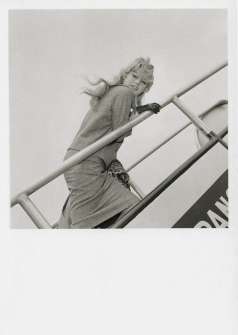
Brigitte Bardot
French postcard by Editions F. Nugeron, no. Star 138. Photo: Air France / Distribution VU. Caption: Brigitte Bardot, 6 April 1958..French actress Brigitte Bardot (1934) died on 28 December 2025, at the age of 91. In the 1950s, she was the sex kitten of the European film industry. BB starred in 48 films, performed in numerous musical shows, and recorded 80 songs. After her retirement in 1973, she became an animal rights activist. In the coming weeks, we will continue to post a BB postcard every day to remember her as she once was.Brigitte Bardot was born in Paris in 1934. Her father, Louis Bardot, had an engineering degree and worked with his father in the family business. Her mother, Ann-Marie Mucel, was 14 years younger than Brigitte's father, and they married in 1933. Brigitte's mother encouraged her daughter to take up music and dance. At the age of 13, she entered the Conservatoire Nationale de Danse to study ballet. By the time she was 15, Brigitte was trying to launch a modelling career and found herself on the cover of the French magazine Elle in May 1949. Her incredible beauty was readily apparent, and Brigitte was noticed by Roger Vadim, then an assistant to the film director Marc Allegrét. Vadim was infatuated with Bardot and encouraged her to start working as a film actress. BB was 18 when she debuted in the comedy Le Trou Normand / Crazy for Love (Jean Boyer, 1952). In the same year, she married Vadim. Brigitte wanted to marry him when she was 17, but her parents quashed any marriage plans until she turned 18. In April 1953, she attended the Cannes Film Festival, where she received massive media attention. She soon was every man's idea of the girl he'd like to meet in Paris. From 1952 to 1956, she appeared in seventeen films. Her films were generally lightweight romantic dramas in which she was cast as an ingénue or siren, often with an element of undress. In 1953, she made her first US production, Un acte d'amour / Act of Love (Anatole Litvak, 1953) with Kirk Douglas, but she continued to make films in France.Roger Vadim was not content with the light fare his wife was offered. He felt Brigitte Bardot was being undersold. Looking for something more like an art film to push her as a serious actress, he showcased her in Et Dieu créa la femme / ...And God Created Woman (Roger Vadim, 1956). This film, about an immoral teenager in a respectable small-town setting, was a smash success on both sides of the Atlantic. Craig Butler at AllMovie: "It's easy enough to say that ...And God Created Woman is much more important for its historical significance than for its actual quality as a film, and that's true to an extent. The immense popularity, due to its willingness to directly embrace an exploration of sex as well as its willingness to show a degree of nudity that was remarkably daring for its day, demonstrated that audiences were willing to view subject matter that was considered too racy for the average moviegoer. This had both positive (freedom to explore, especially for the French filmmakers of the time) and negative (freedom to exploit) consequences, but its impact is undeniable. It's also true that Woman is not a great work of art, not with a story that is ultimately rather thin, some painful dialogue, and an attitude toward its characters and their sexuality that is unclear and inconsistent. Yet Woman is still fascinating, due in no small part to the presence of Brigitte Bardot in the role that made her an international star and sex symbol. She's not demonstrating great acting here, although her performance is actually good and much better than necessary, and her legendary mambo scene at the climax is nothing short of sensational." During the filming of Et Dieu créa la femme / And God Created Woman (Roger Vadim, 1956), directed by her husband, Brigitte Bardot had an affair with her co-star, Jean-Louis Trintignant, who at the time was married to French actress Stéphane Audran. Her divorce from Vadim followed, but they remained friends and collaborated in later work.Et Dieu créa la femme / ...And God Created Woman (Roger Vadim, 1956) helped Brigitte Bardot's international status. The film took the USA by storm, her explosive sexuality being unlike anything seen in the States since the days of the 'flapper' in the 1920s. It gave rise to the phrase 'sex kitten', and fascination with her in America consisted of magazine photographs and dubbed over French films - good, bad or indifferent, her films drew audiences - mainly men - into theatres like lemmings. BB appeared in light comedies like Doctor at Large (Ralph Thomas, 1957) - the third of the British 'Doctor' series starring Dirk Bogarde - and Une Parisienne / La Parisienne (Michel Boisrond, 1957), which suited her acting skills best. However, she was a sensation in the crime drama En cas de malheur / Love is My Profession (Claude Autant-Lara, 1958). Hal Erickson at AllMovie: "This Brigitte Bardot vehicle ran into stiff opposition from the Catholic Legion of Decency, severely limiting its U.S. distribution. Bardot plays a nubile small-time thief named Yvette, who becomes the mistress of influential defence attorney Andre (Jean Gabin). Though Andre can shower Yvette with jewels and furs, he cannot "buy" her heart, and thus it is that it belongs to handsome young student Mazzetti (Franco Interlenghi). Alas, Yvette is no judge of human nature: attractive though Mazzetti can be, he has a dangerous and deadly side. En Cas de Malheur contains a nude scene that has since been reprinted in freeze-frame form innumerable times by both film-history books and girlie magazines." Photographer Sam Lévin's photos contributed considerably to her image of sensuality and slight immorality. One of Lévin's pictures shows Brigitte, dressed in a white corset. It is said that around 1960, postcards with this photograph outsold in Paris those of the Eiffel Tower.Brigitte Bardot divorced Vadim in 1957, and in 1959 she married actor Jacques Charrier, with whom she starred in Babette s'en va-t-en guerre / Babette Goes to War (Christian-Jaque, 1959). The paparazzi preyed upon her marriage, while she and her husband clashed over the direction of her career
Her films became more substantial, but this brought a heavy pressure of dual celebrity as she sought critical acclaim while remaining a glamour model for most of the world. Vie privée / Private Life (1962), directed by Louis Malle, has more than an element of autobiography in it. James Travers at French Films: "Brigitte Bardot hadn’t quite reached the high point of her career when she agreed to make this film with high-profile New Wave film director Louis Malle. Even so, the pressure of being a living icon was obviously beginning to get to France’s sex goddess, and Vie privée is as much an attempt by Bardot to come to terms with her celebrity as anything else. Malle is clearly fascinated by Bardot, and the documentary approach he adopts for this film reinforces the impression that it is more a biography of the actress than a work of fiction. Of course, it’s not entirely biographical, but the story is remarkably close to Bardot’s own life and comes pretty close to predicting how her career would end." The scene in which, returning to her apartment, Bardot's character is harangued in the elevator by a middle-aged cleaning lady calling her offensive names was based on an actual incident, and is a resonant image of celebrity in the mid-20th century. Soon afterwards, Bardot withdrew to the seclusion of Southern France.Brigitte Bardot's other husbands were German millionaire Playboy Gunter Sachs and right-wing politician Bernard d'Ormale. She is reputed to have had relationships with many other men, including Samy Frey, her co-star in La Vérité / The Truth (Henri-Georges Clouzot, 1960), and musicians Serge Gainsbourg and Sacha Distel. In 1963, Brigitte Bardot starred in Jean-Luc Godard's critically acclaimed film Le Mépris / Contempt (Jean-Luc Godard, 1963) opposite Michel Piccoli. She was also featured along with such notable actors as Alain Delon in Amours célèbres / Famous Love Affairs (Michel Boisrond, 1961) and Histoires extraordinaires /Tales of Mystery (Louis Malle, 1968), Jeanne Moreau in Viva Maria! (Louis Malle, 1965), Sean Connery in Shalako (Edward Dmytryk, 1968), and Claudia Cardinale in Les Pétroleuses / Petroleum Girls (Christian-Jaque, 1971). She participated in various musical shows and recorded many popular songs in the 1960s and 1970s, mostly in collaboration with Serge Gainsbourg, Bob Zagury and Sacha Distel, including 'Harley Davidson', 'Le Soleil De Ma Vie' (the cover of Stevie Wonder's 'You Are the Sunshine of My Life') and the notorious 'Je t'aime... moi non plus'.Brigitte Bardot’s film career showed a steady decline in the late 1960s and early 1970s. In 1973, just before her fortieth birthday, she announced her retirement. She chose to use her fame to promote animal rights. In 1976, she established the Brigitte Bardot Foundation for the Welfare and Protection of Animals. She became a vegetarian and raised three million French francs to fund the foundation by auctioning off jewellery and many personal belongings. For this work, she was awarded the Légion d’honneur in 1984. During the 1990s, she was also outspoken in her criticism of immigration, interracial relationships, Islam in France and homosexuality. Her husband Bernard d'Ormal was a former adviser of the far-right Front National party. Bardot has been convicted five times for 'inciting racial hatred'. More fun is that Bardot is recognised for popularising bikini swimwear, in such early films as Manina / Woman without a Veil (Willy Rozier, 1952), in her appearances at Cannes and in many photo shoots. Bardot also brought into fashion the 'choucroute' ('Sauerkraut') hairstyle (a sort of beehive hairstyle) and gingham clothes after wearing a checkered pink dress, designed by Jacques Esterel, at her wedding to Charrier. The fashions of the 1960s looked effortlessly right and spontaneous on her. Time Magazine: "She is the princess of pout, the countess of come hither. Brigitte Bardot exuded a carefree, naïve sexuality that brought a whole new audience to French films."Sources: Denny Jackson (IMDb), Hal Erickson (AllMovie), Craig Butler (AllMovie), James Travers (French Films), French Films, Wikipedia and IMDb.And please check out our blog European Film Star Postcards.
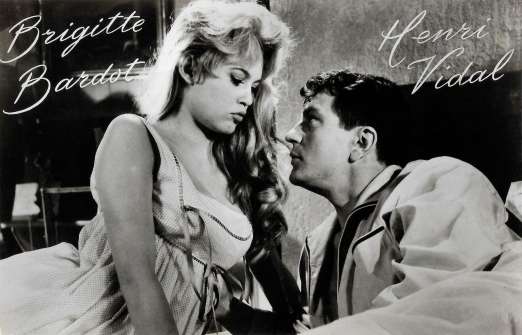
Brigitte Bardot and Henri Vidal, Une Parisienne (1957)
Dutch postcard by Uitg. Takken, Utrecht, no. AX 4002. Photo: N.V. City Film, Den Haag. Brigitte Bardot and Henri Vidal in Une Parisienne/ La Parisienne (Michel Boisrond, 1957).French actress Brigitte Bardot (1934) died on 28 December 2025, at the age of 91. In the 1950s, she was the sex kitten of the European film industry. BB starred in 48 films, performed in numerous musical shows, and recorded 80 songs. After her retirement in 1973, she became an animal rights activist. In the coming weeks, we will continue to post a BB postcard every day to remember her as she once was.Brigitte Bardot was born in Paris in 1934. Her father, Louis Bardot, had an engineering degree and worked with his father in the family business. Her mother, Ann-Marie Mucel, was 14 years younger than Brigitte's father, and they married in 1933. Brigitte's mother encouraged her daughter to take up music and dance. At the age of 13, she entered the Conservatoire Nationale de Danse to study ballet. By the time she was 15, Brigitte was trying to launch a modelling career and found herself on the cover of the French magazine Elle in May 1949. Her incredible beauty was readily apparent, and Brigitte was noticed by Roger Vadim, then an assistant to the film director Marc Allegrét. Vadim was infatuated with Bardot and encouraged her to start working as a film actress. BB was 18 when she debuted in the comedy Le Trou Normand / Crazy for Love (Jean Boyer, 1952). In the same year, she married Vadim. Brigitte wanted to marry him when she was 17, but her parents quashed any marriage plans until she turned 18. In April 1953, she attended the Cannes Film Festival, where she received massive media attention. She soon was every man's idea of the girl he'd like to meet in Paris. From 1952 to 1956, she appeared in seventeen films. Her films were generally lightweight romantic dramas in which she was cast as an ingénue or siren, often with an element of undress. In 1953, she made her first US production, Un acte d'amour / Act of Love (Anatole Litvak, 1953) with Kirk Douglas, but she continued to make films in France.Roger Vadim was not content with the light fare his wife was offered. He felt Brigitte Bardot was being undersold. Looking for something more like an art film to push her as a serious actress, he showcased her in Et Dieu créa la femme / ...And God Created Woman (Roger Vadim, 1956). This film, about an immoral teenager in a respectable small-town setting, was a smash success on both sides of the Atlantic. Craig Butler at AllMovie: "It's easy enough to say that ...And God Created Woman is much more important for its historical significance than for its actual quality as a film, and that's true to an extent. The immense popularity, due to its willingness to directly embrace an exploration of sex as well as its willingness to show a degree of nudity that was remarkably daring for its day, demonstrated that audiences were willing to view subject matter that was considered too racy for the average moviegoer. This had both positive (freedom to explore, especially for the French filmmakers of the time) and negative (freedom to exploit) consequences, but its impact is undeniable. It's also true that Woman is not a great work of art, not with a story that is ultimately rather thin, some painful dialogue, and an attitude toward its characters and their sexuality that is unclear and inconsistent. Yet Woman is still fascinating, due in no small part to the presence of Brigitte Bardot in the role that made her an international star and sex symbol. She's not demonstrating great acting here, although her performance is actually good and much better than necessary, and her legendary mambo scene at the climax is nothing short of sensational." During the filming of Et Dieu créa la femme / And God Created Woman (Roger Vadim, 1956), directed by her husband, Brigitte Bardot had an affair with her co-star, Jean-Louis Trintignant, who at the time was married to French actress Stéphane Audran. Her divorce from Vadim followed, but they remained friends and collaborated in later work.Et Dieu créa la femme / ...And God Created Woman (Roger Vadim, 1956) helped Brigitte Bardot's international status. The film took the USA by storm, her explosive sexuality being unlike anything seen in the States since the days of the 'flapper' in the 1920s. It gave rise to the phrase 'sex kitten', and fascination with her in America consisted of magazine photographs and dubbed over French films - good, bad or indifferent, her films drew audiences - mainly men - into theatres like lemmings. BB appeared in light comedies like Doctor at Large (Ralph Thomas, 1957) - the third of the British 'Doctor' series starring Dirk Bogarde - and Une Parisienne / La Parisienne (Michel Boisrond, 1957), which suited her acting skills best. However, she was a sensation in the crime drama En cas de malheur / Love is My Profession (Claude Autant-Lara, 1958). Hal Erickson at AllMovie: "This Brigitte Bardot vehicle ran into stiff opposition from the Catholic Legion of Decency, severely limiting its U.S. distribution. Bardot plays a nubile small-time thief named Yvette, who becomes the mistress of influential defence attorney Andre (Jean Gabin). Though Andre can shower Yvette with jewels and furs, he cannot "buy" her heart, and thus it is that it belongs to handsome young student Mazzetti (Franco Interlenghi). Alas, Yvette is no judge of human nature: attractive though Mazzetti can be, he has a dangerous and deadly side. En Cas de Malheur contains a nude scene that has since been reprinted in freeze-frame form innumerable times by both film-history books and girlie magazines." Photographer Sam Lévin's photos contributed considerably to her image of sensuality and slight immorality. One of Lévin's pictures shows Brigitte, dressed in a white corset. It is said that around 1960, postcards with this photograph outsold in Paris those of the Eiffel Tower.Brigitte Bardot divorced Vadim in 1957, and in 1959 she married actor Jacques Charrier, with whom she starred in Babette s'en va-t-en guerre / Babette Goes to War (Christian-Jaque, 1959). The paparazzi preyed upon her marriage, while she and her husband clashed over the direction of her career
Her films became more substantial, but this brought a heavy pressure of dual celebrity as she sought critical acclaim while remaining a glamour model for most of the world. Vie privée / Private Life (1962), directed by Louis Malle, has more than an element of autobiography in it. James Travers at French Films: "Brigitte Bardot hadn’t quite reached the high point of her career when she agreed to make this film with high-profile New Wave film director Louis Malle. Even so, the pressure of being a living icon was obviously beginning to get to France’s sex goddess, and Vie privée is as much an attempt by Bardot to come to terms with her celebrity as anything else. Malle is clearly fascinated by Bardot, and the documentary approach he adopts for this film reinforces the impression that it is more a biography of the actress than a work of fiction. Of course, it’s not entirely biographical, but the story is remarkably close to Bardot’s own life and comes pretty close to predicting how her career would end." The scene in which, returning to her apartment, Bardot's character is harangued in the elevator by a middle-aged cleaning lady calling her offensive names was based on an actual incident, and is a resonant image of celebrity in the mid-20th century. Soon afterwards, Bardot withdrew to the seclusion of Southern France.Brigitte Bardot's other husbands were German millionaire Playboy Gunter Sachs and right-wing politician Bernard d'Ormale. She is reputed to have had relationships with many other men, including Samy Frey, her co-star in La Vérité / The Truth (Henri-Georges Clouzot, 1960), and musicians Serge Gainsbourg and Sacha Distel. In 1963, Brigitte Bardot starred in Jean-Luc Godard's critically acclaimed film Le Mépris / Contempt (Jean-Luc Godard, 1963) opposite Michel Piccoli. She was also featured along with such notable actors as Alain Delon in Amours célèbres / Famous Love Affairs (Michel Boisrond, 1961) and Histoires extraordinaires /Tales of Mystery (Louis Malle, 1968), Jeanne Moreau in Viva Maria! (Louis Malle, 1965), Sean Connery in Shalako (Edward Dmytryk, 1968), and Claudia Cardinale in Les Pétroleuses / Petroleum Girls (Christian-Jaque, 1971). She participated in various musical shows and recorded many popular songs in the 1960s and 1970s, mostly in collaboration with Serge Gainsbourg, Bob Zagury and Sacha Distel, including 'Harley Davidson', 'Le Soleil De Ma Vie' (the cover of Stevie Wonder's 'You Are the Sunshine of My Life') and the notorious 'Je t'aime... moi non plus'.Brigitte Bardot’s film career showed a steady decline in the late 1960s and early 1970s. In 1973, just before her fortieth birthday, she announced her retirement. She chose to use her fame to promote animal rights. In 1976, she established the Brigitte Bardot Foundation for the Welfare and Protection of Animals. She became a vegetarian and raised three million French francs to fund the foundation by auctioning off jewellery and many personal belongings. For this work, she was awarded the Légion d’honneur in 1984. During the 1990s, she was also outspoken in her criticism of immigration, interracial relationships, Islam in France and homosexuality. Her husband Bernard d'Ormal was a former adviser of the far-right Front National party. Bardot has been convicted five times for 'inciting racial hatred'. More fun is that Bardot is recognised for popularising bikini swimwear, in such early films as Manina / Woman without a Veil (Willy Rozier, 1952), in her appearances at Cannes and in many photo shoots. Bardot also brought into fashion the 'choucroute' ('Sauerkraut') hairstyle (a sort of beehive hairstyle) and gingham clothes after wearing a checkered pink dress, designed by Jacques Esterel, at her wedding to Charrier. The fashions of the 1960s looked effortlessly right and spontaneous on her. Time Magazine: "She is the princess of pout, the countess of come hither. Brigitte Bardot exuded a carefree, naïve sexuality that brought a whole new audience to French films."Sources: Denny Jackson (IMDb), Hal Erickson (AllMovie), Craig Butler (AllMovie), James Travers (French Films), French Films, Wikipedia and IMDb.And please check out our blog European Film Star Postcards.
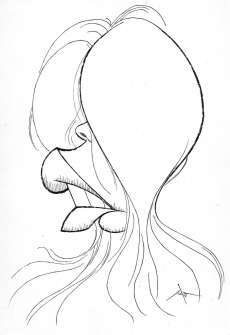
Brigitte Bardot
French postcard in the series 'Les acteurs Français vus par Solo' by Carterie Occitane, Toulouse, no. 7. Illustration: Solo.French actress Brigitte Bardot (1934) died on 28 December 2025, at the age of 91. In the 1950s, she was the sex kitten of the European film industry. BB starred in 48 films, performed in numerous musical shows, and recorded 80 songs. After her retirement in 1973, she became an animal rights activist. In the coming weeks, we will continue to post a BB postcard every day to remember her as she once was.Brigitte Bardot was born in Paris in 1934. Her father, Louis Bardot, had an engineering degree and worked with his father in the family business. Her mother, Ann-Marie Mucel, was 14 years younger than Brigitte's father, and they married in 1933. Brigitte's mother encouraged her daughter to take up music and dance. At the age of 13, she entered the Conservatoire Nationale de Danse to study ballet. By the time she was 15, Brigitte was trying to launch a modelling career and found herself on the cover of the French magazine Elle in May 1949. Her incredible beauty was readily apparent, and Brigitte was noticed by Roger Vadim, then an assistant to the film director Marc Allegrét. Vadim was infatuated with Bardot and encouraged her to start working as a film actress. BB was 18 when she debuted in the comedy Le Trou Normand / Crazy for Love (Jean Boyer, 1952). In the same year, she married Vadim. Brigitte wanted to marry him when she was 17, but her parents quashed any marriage plans until she turned 18. In April 1953, she attended the Cannes Film Festival, where she received massive media attention. She soon was every man's idea of the girl he'd like to meet in Paris. From 1952 to 1956, she appeared in seventeen films. Her films were generally lightweight romantic dramas in which she was cast as an ingénue or siren, often with an element of undress. In 1953, she made her first US production, Un acte d'amour / Act of Love (Anatole Litvak, 1953) with Kirk Douglas, but she continued to make films in France.Roger Vadim was not content with the light fare his wife was offered. He felt Brigitte Bardot was being undersold. Looking for something more like an art film to push her as a serious actress, he showcased her in Et Dieu créa la femme / ...And God Created Woman (Roger Vadim, 1956). This film, about an immoral teenager in a respectable small-town setting, was a smash success on both sides of the Atlantic. Craig Butler at AllMovie: "It's easy enough to say that ...And God Created Woman is much more important for its historical significance than for its actual quality as a film, and that's true to an extent. The immense popularity, due to its willingness to directly embrace an exploration of sex as well as its willingness to show a degree of nudity that was remarkably daring for its day, demonstrated that audiences were willing to view subject matter that was considered too racy for the average moviegoer. This had both positive (freedom to explore, especially for the French filmmakers of the time) and negative (freedom to exploit) consequences, but its impact is undeniable. It's also true that Woman is not a great work of art, not with a story that is ultimately rather thin, some painful dialogue, and an attitude toward its characters and their sexuality that is unclear and inconsistent. Yet Woman is still fascinating, due in no small part to the presence of Brigitte Bardot in the role that made her an international star and sex symbol. She's not demonstrating great acting here, although her performance is actually good and much better than necessary, and her legendary mambo scene at the climax is nothing short of sensational." During the filming of Et Dieu créa la femme / And God Created Woman (Roger Vadim, 1956), directed by her husband, Brigitte Bardot had an affair with her co-star, Jean-Louis Trintignant, who at the time was married to French actress Stéphane Audran. Her divorce from Vadim followed, but they remained friends and collaborated in later work.Et Dieu créa la femme / ...And God Created Woman (Roger Vadim, 1956) helped Brigitte Bardot's international status. The film took the USA by storm, her explosive sexuality being unlike anything seen in the States since the days of the 'flapper' in the 1920s. It gave rise to the phrase 'sex kitten', and fascination with her in America consisted of magazine photographs and dubbed over French films - good, bad or indifferent, her films drew audiences - mainly men - into theatres like lemmings. BB appeared in light comedies like Doctor at Large (Ralph Thomas, 1957) - the third of the British 'Doctor' series starring Dirk Bogarde - and Une Parisienne / La Parisienne (Michel Boisrond, 1957), which suited her acting skills best. However, she was a sensation in the crime drama En cas de malheur / Love is My Profession (Claude Autant-Lara, 1958). Hal Erickson at AllMovie: "This Brigitte Bardot vehicle ran into stiff opposition from the Catholic Legion of Decency, severely limiting its U.S. distribution. Bardot plays a nubile small-time thief named Yvette, who becomes the mistress of influential defence attorney Andre (Jean Gabin). Though Andre can shower Yvette with jewels and furs, he cannot "buy" her heart, and thus it is that it belongs to handsome young student Mazzetti (Franco Interlenghi). Alas, Yvette is no judge of human nature: attractive though Mazzetti can be, he has a dangerous and deadly side. En Cas de Malheur contains a nude scene that has since been reprinted in freeze-frame form innumerable times by both film-history books and girlie magazines." Photographer Sam Lévin's photos contributed considerably to her image of sensuality and slight immorality. One of Lévin's pictures shows Brigitte, dressed in a white corset. It is said that around 1960, postcards with this photograph outsold in Paris those of the Eiffel Tower.Brigitte Bardot divorced Vadim in 1957, and in 1959 she married actor Jacques Charrier, with whom she starred in Babette s'en va-t-en guerre / Babette Goes to War (Christian-Jaque, 1959). The paparazzi preyed upon her marriage, while she and her husband clashed over the direction of her career
Her films became more substantial, but this brought a heavy pressure of dual celebrity as she sought critical acclaim while remaining a glamour model for most of the world. Vie privée / Private Life (1962), directed by Louis Malle, has more than an element of autobiography in it. James Travers at French Films: "Brigitte Bardot hadn’t quite reached the high point of her career when she agreed to make this film with high-profile New Wave film director Louis Malle. Even so, the pressure of being a living icon was obviously beginning to get to France’s sex goddess, and Vie privée is as much an attempt by Bardot to come to terms with her celebrity as anything else. Malle is clearly fascinated by Bardot, and the documentary approach he adopts for this film reinforces the impression that it is more a biography of the actress than a work of fiction. Of course, it’s not entirely biographical, but the story is remarkably close to Bardot’s own life and comes pretty close to predicting how her career would end." The scene in which, returning to her apartment, Bardot's character is harangued in the elevator by a middle-aged cleaning lady calling her offensive names was based on an actual incident, and is a resonant image of celebrity in the mid-20th century. Soon afterwards, Bardot withdrew to the seclusion of Southern France.Brigitte Bardot's other husbands were German millionaire Playboy Gunter Sachs and right-wing politician Bernard d'Ormale. She is reputed to have had relationships with many other men, including Samy Frey, her co-star in La Vérité / The Truth (Henri-Georges Clouzot, 1960), and musicians Serge Gainsbourg and Sacha Distel. In 1963, Brigitte Bardot starred in Jean-Luc Godard's critically acclaimed film Le Mépris / Contempt (Jean-Luc Godard, 1963) opposite Michel Piccoli. She was also featured along with such notable actors as Alain Delon in Amours célèbres / Famous Love Affairs (Michel Boisrond, 1961) and Histoires extraordinaires /Tales of Mystery (Louis Malle, 1968), Jeanne Moreau in Viva Maria! (Louis Malle, 1965), Sean Connery in Shalako (Edward Dmytryk, 1968), and Claudia Cardinale in Les Pétroleuses / Petroleum Girls (Christian-Jaque, 1971). She participated in various musical shows and recorded many popular songs in the 1960s and 1970s, mostly in collaboration with Serge Gainsbourg, Bob Zagury and Sacha Distel, including 'Harley Davidson', 'Le Soleil De Ma Vie' (the cover of Stevie Wonder's 'You Are the Sunshine of My Life') and the notorious 'Je t'aime... moi non plus'.Brigitte Bardot’s film career showed a steady decline in the late 1960s and early 1970s. In 1973, just before her fortieth birthday, she announced her retirement. She chose to use her fame to promote animal rights. In 1976, she established the Brigitte Bardot Foundation for the Welfare and Protection of Animals. She became a vegetarian and raised three million French francs to fund the foundation by auctioning off jewellery and many personal belongings. For this work, she was awarded the Légion d’honneur in 1984. During the 1990s, she was also outspoken in her criticism of immigration, interracial relationships, Islam in France and homosexuality. Her husband Bernard d'Ormal was a former adviser of the far-right Front National party. Bardot has been convicted five times for 'inciting racial hatred'. More fun is that Bardot is recognised for popularising bikini swimwear, in such early films as Manina / Woman without a Veil (Willy Rozier, 1952), in her appearances at Cannes and in many photo shoots. Bardot also brought into fashion the 'choucroute' ('Sauerkraut') hairstyle (a sort of beehive hairstyle) and gingham clothes after wearing a checkered pink dress, designed by Jacques Esterel, at her wedding to Charrier. The fashions of the 1960s looked effortlessly right and spontaneous on her. Time Magazine: "She is the princess of pout, the countess of come hither. Brigitte Bardot exuded a carefree, naïve sexuality that brought a whole new audience to French films."Sources: Denny Jackson (IMDb), Hal Erickson (AllMovie), Craig Butler (AllMovie), James Travers (French Films), French Films, Wikipedia and IMDb.And please check out our blog European Film Star Postcards.
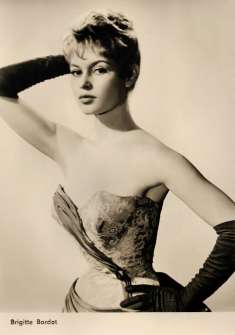
Brigitte Bardot in En effeuillant la marguerite (1956)
East German postcard by VEB Progress Film-Vertrieb, no. 2105, 1964. Brigitte Bardot in En effeuillant la marguerite / Plucking the Daisy (Marc Allégret, 1956).French actress Brigitte Bardot (1934) died on 28 December 2025, at the age of 91. In the 1950s, she was the sex kitten of the European film industry. BB starred in 48 films, performed in numerous musical shows, and recorded 80 songs. After her retirement in 1973, she became an animal rights activist. In the coming weeks, we will continue to post a BB postcard every day to remember her as she once was.Brigitte Bardot was born in Paris in 1934. Her father, Louis Bardot, had an engineering degree and worked with his father in the family business. Her mother, Ann-Marie Mucel, was 14 years younger than Brigitte's father, and they married in 1933. Brigitte's mother encouraged her daughter to take up music and dance. At the age of 13, she entered the Conservatoire Nationale de Danse to study ballet. By the time she was 15, Brigitte was trying to launch a modelling career and found herself on the cover of the French magazine Elle in May 1949. Her incredible beauty was readily apparent, and Brigitte was noticed by Roger Vadim, then an assistant to the film director Marc Allegrét. Vadim was infatuated with Bardot and encouraged her to start working as a film actress. BB was 18 when she debuted in the comedy Le Trou Normand / Crazy for Love (Jean Boyer, 1952). In the same year, she married Vadim. Brigitte wanted to marry him when she was 17, but her parents quashed any marriage plans until she turned 18. In April 1953, she attended the Cannes Film Festival, where she received massive media attention. She soon was every man's idea of the girl he'd like to meet in Paris. From 1952 to 1956, she appeared in seventeen films. Her films were generally lightweight romantic dramas in which she was cast as an ingénue or siren, often with an element of undress. In 1953, she made her first US production, Un acte d'amour / Act of Love (Anatole Litvak, 1953) with Kirk Douglas, but she continued to make films in France.Roger Vadim was not content with the light fare his wife was offered. He felt Brigitte Bardot was being undersold. Looking for something more like an art film to push her as a serious actress, he showcased her in Et Dieu créa la femme / ...And God Created Woman (Roger Vadim, 1956). This film, about an immoral teenager in a respectable small-town setting, was a smash success on both sides of the Atlantic. Craig Butler at AllMovie: "It's easy enough to say that ...And God Created Woman is much more important for its historical significance than for its actual quality as a film, and that's true to an extent. The immense popularity, due to its willingness to directly embrace an exploration of sex as well as its willingness to show a degree of nudity that was remarkably daring for its day, demonstrated that audiences were willing to view subject matter that was considered too racy for the average moviegoer. This had both positive (freedom to explore, especially for the French filmmakers of the time) and negative (freedom to exploit) consequences, but its impact is undeniable. It's also true that Woman is not a great work of art, not with a story that is ultimately rather thin, some painful dialogue, and an attitude toward its characters and their sexuality that is unclear and inconsistent. Yet Woman is still fascinating, due in no small part to the presence of Brigitte Bardot in the role that made her an international star and sex symbol. She's not demonstrating great acting here, although her performance is actually good and much better than necessary, and her legendary mambo scene at the climax is nothing short of sensational." During the filming of Et Dieu créa la femme / And God Created Woman (Roger Vadim, 1956), directed by her husband, Brigitte Bardot had an affair with her co-star, Jean-Louis Trintignant, who at the time was married to French actress Stéphane Audran. Her divorce from Vadim followed, but they remained friends and collaborated in later work.Et Dieu créa la femme / ...And God Created Woman (Roger Vadim, 1956) helped Brigitte Bardot's international status. The film took the USA by storm, her explosive sexuality being unlike anything seen in the States since the days of the 'flapper' in the 1920s. It gave rise to the phrase 'sex kitten', and fascination with her in America consisted of magazine photographs and dubbed over French films - good, bad or indifferent, her films drew audiences - mainly men - into theatres like lemmings. BB appeared in light comedies like Doctor at Large (Ralph Thomas, 1957) - the third of the British 'Doctor' series starring Dirk Bogarde - and Une Parisienne / La Parisienne (Michel Boisrond, 1957), which suited her acting skills best. However, she was a sensation in the crime drama En cas de malheur / Love is My Profession (Claude Autant-Lara, 1958). Hal Erickson at AllMovie: "This Brigitte Bardot vehicle ran into stiff opposition from the Catholic Legion of Decency, severely limiting its U.S. distribution. Bardot plays a nubile small-time thief named Yvette, who becomes the mistress of influential defence attorney Andre (Jean Gabin). Though Andre can shower Yvette with jewels and furs, he cannot "buy" her heart, and thus it is that it belongs to handsome young student Mazzetti (Franco Interlenghi). Alas, Yvette is no judge of human nature: attractive though Mazzetti can be, he has a dangerous and deadly side. En Cas de Malheur contains a nude scene that has since been reprinted in freeze-frame form innumerable times by both film-history books and girlie magazines." Photographer Sam Lévin's photos contributed considerably to her image of sensuality and slight immorality. One of Lévin's pictures shows Brigitte, dressed in a white corset. It is said that around 1960, postcards with this photograph outsold in Paris those of the Eiffel Tower.Brigitte Bardot divorced Vadim in 1957, and in 1959 she married actor Jacques Charrier, with whom she starred in Babette s'en va-t-en guerre / Babette Goes to War (Christian-Jaque, 1959). The paparazzi preyed upon her marriage, while she and her husband clashed over the direction of her career
Her films became more substantial, but this brought a heavy pressure of dual celebrity as she sought critical acclaim while remaining a glamour model for most of the world. Vie privée / Private Life (1962), directed by Louis Malle, has more than an element of autobiography in it. James Travers at French Films: "Brigitte Bardot hadn’t quite reached the high point of her career when she agreed to make this film with high-profile New Wave film director Louis Malle. Even so, the pressure of being a living icon was obviously beginning to get to France’s sex goddess, and Vie privée is as much an attempt by Bardot to come to terms with her celebrity as anything else. Malle is clearly fascinated by Bardot, and the documentary approach he adopts for this film reinforces the impression that it is more a biography of the actress than a work of fiction. Of course, it’s not entirely biographical, but the story is remarkably close to Bardot’s own life and comes pretty close to predicting how her career would end." The scene in which, returning to her apartment, Bardot's character is harangued in the elevator by a middle-aged cleaning lady calling her offensive names was based on an actual incident, and is a resonant image of celebrity in the mid-20th century. Soon afterwards, Bardot withdrew to the seclusion of Southern France.Brigitte Bardot's other husbands were German millionaire Playboy Gunter Sachs and right-wing politician Bernard d'Ormale. She is reputed to have had relationships with many other men, including Samy Frey, her co-star in La Vérité / The Truth (Henri-Georges Clouzot, 1960), and musicians Serge Gainsbourg and Sacha Distel. In 1963, Brigitte Bardot starred in Jean-Luc Godard's critically acclaimed film Le Mépris / Contempt (Jean-Luc Godard, 1963) opposite Michel Piccoli. She was also featured along with such notable actors as Alain Delon in Amours célèbres / Famous Love Affairs (Michel Boisrond, 1961) and Histoires extraordinaires /Tales of Mystery (Louis Malle, 1968), Jeanne Moreau in Viva Maria! (Louis Malle, 1965), Sean Connery in Shalako (Edward Dmytryk, 1968), and Claudia Cardinale in Les Pétroleuses / Petroleum Girls (Christian-Jaque, 1971). She participated in various musical shows and recorded many popular songs in the 1960s and 1970s, mostly in collaboration with Serge Gainsbourg, Bob Zagury and Sacha Distel, including 'Harley Davidson', 'Le Soleil De Ma Vie' (the cover of Stevie Wonder's 'You Are the Sunshine of My Life') and the notorious 'Je t'aime... moi non plus'.Brigitte Bardot’s film career showed a steady decline in the late 1960s and early 1970s. In 1973, just before her fortieth birthday, she announced her retirement. She chose to use her fame to promote animal rights. In 1976, she established the Brigitte Bardot Foundation for the Welfare and Protection of Animals. She became a vegetarian and raised three million French francs to fund the foundation by auctioning off jewellery and many personal belongings. For this work, she was awarded the Légion d’honneur in 1984. During the 1990s, she was also outspoken in her criticism of immigration, interracial relationships, Islam in France and homosexuality. Her husband Bernard d'Ormal was a former adviser of the far-right Front National party. Bardot has been convicted five times for 'inciting racial hatred'. More fun is that Bardot is recognised for popularising bikini swimwear, in such early films as Manina / Woman without a Veil (Willy Rozier, 1952), in her appearances at Cannes and in many photo shoots. Bardot also brought into fashion the 'choucroute' ('Sauerkraut') hairstyle (a sort of beehive hairstyle) and gingham clothes after wearing a checkered pink dress, designed by Jacques Esterel, at her wedding to Charrier. The fashions of the 1960s looked effortlessly right and spontaneous on her. Time Magazine: "She is the princess of pout, the countess of come hither. Brigitte Bardot exuded a carefree, naïve sexuality that brought a whole new audience to French films."Sources: Denny Jackson (IMDb), Hal Erickson (AllMovie), Craig Butler (AllMovie), James Travers (French Films), French Films, Wikipedia and IMDb.And please check out our blog European Film Star Postcards.
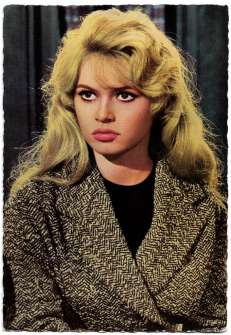
Brigitte Bardot in En cas de malheur (1958)
West German postcard. Brigitte Bardot in En cas de malheur / Love is My Profession (Claude Autant-Lara, 1958).French actress Brigitte Bardot (1934) died on 28 December 2025, at the age of 91. In the 1950s, she was the sex kitten of the European film industry. BB starred in 48 films, performed in numerous musical shows, and recorded 80 songs. After her retirement in 1973, she became an animal rights activist. In the coming weeks, we will continue to post a BB postcard every day to remember her as she once was.Brigitte Bardot was born in Paris in 1934. Her father, Louis Bardot, had an engineering degree and worked with his father in the family business. Her mother, Ann-Marie Mucel, was 14 years younger than Brigitte's father, and they married in 1933. Brigitte's mother encouraged her daughter to take up music and dance. At the age of 13, she entered the Conservatoire Nationale de Danse to study ballet. By the time she was 15, Brigitte was trying to launch a modelling career and found herself on the cover of the French magazine Elle in May 1949. Her incredible beauty was readily apparent, and Brigitte was noticed by Roger Vadim, then an assistant to the film director Marc Allegrét. Vadim was infatuated with Bardot and encouraged her to start working as a film actress. BB was 18 when she debuted in the comedy Le Trou Normand / Crazy for Love (Jean Boyer, 1952). In the same year, she married Vadim. Brigitte wanted to marry him when she was 17, but her parents quashed any marriage plans until she turned 18. In April 1953, she attended the Cannes Film Festival, where she received massive media attention. She soon was every man's idea of the girl he'd like to meet in Paris. From 1952 to 1956, she appeared in seventeen films. Her films were generally lightweight romantic dramas in which she was cast as an ingénue or siren, often with an element of undress. In 1953, she made her first US production, Un acte d'amour / Act of Love (Anatole Litvak, 1953) with Kirk Douglas, but she continued to make films in France.Roger Vadim was not content with the light fare his wife was offered. He felt Brigitte Bardot was being undersold. Looking for something more like an art film to push her as a serious actress, he showcased her in Et Dieu créa la femme / ...And God Created Woman (Roger Vadim, 1956). This film, about an immoral teenager in a respectable small-town setting, was a smash success on both sides of the Atlantic. Craig Butler at AllMovie: "It's easy enough to say that ...And God Created Woman is much more important for its historical significance than for its actual quality as a film, and that's true to an extent. The immense popularity, due to its willingness to directly embrace an exploration of sex as well as its willingness to show a degree of nudity that was remarkably daring for its day, demonstrated that audiences were willing to view subject matter that was considered too racy for the average moviegoer. This had both positive (freedom to explore, especially for the French filmmakers of the time) and negative (freedom to exploit) consequences, but its impact is undeniable. It's also true that Woman is not a great work of art, not with a story that is ultimately rather thin, some painful dialogue, and an attitude toward its characters and their sexuality that is unclear and inconsistent. Yet Woman is still fascinating, due in no small part to the presence of Brigitte Bardot in the role that made her an international star and sex symbol. She's not demonstrating great acting here, although her performance is actually good and much better than necessary, and her legendary mambo scene at the climax is nothing short of sensational." During the filming of Et Dieu créa la femme / And God Created Woman (Roger Vadim, 1956), directed by her husband, Brigitte Bardot had an affair with her co-star, Jean-Louis Trintignant, who at the time was married to French actress Stéphane Audran. Her divorce from Vadim followed, but they remained friends and collaborated in later work.Et Dieu créa la femme / ...And God Created Woman (Roger Vadim, 1956) helped Brigitte Bardot's international status. The film took the USA by storm, her explosive sexuality being unlike anything seen in the States since the days of the 'flapper' in the 1920s. It gave rise to the phrase 'sex kitten', and fascination with her in America consisted of magazine photographs and dubbed over French films - good, bad or indifferent, her films drew audiences - mainly men - into theatres like lemmings. BB appeared in light comedies like Doctor at Large (Ralph Thomas, 1957) - the third of the British 'Doctor' series starring Dirk Bogarde - and Une Parisienne / La Parisienne (Michel Boisrond, 1957), which suited her acting skills best. However, she was a sensation in the crime drama En cas de malheur / Love is My Profession (Claude Autant-Lara, 1958). Hal Erickson at AllMovie: "This Brigitte Bardot vehicle ran into stiff opposition from the Catholic Legion of Decency, severely limiting its U.S. distribution. Bardot plays a nubile small-time thief named Yvette, who becomes the mistress of influential defence attorney Andre (Jean Gabin). Though Andre can shower Yvette with jewels and furs, he cannot "buy" her heart, and thus it is that it belongs to handsome young student Mazzetti (Franco Interlenghi). Alas, Yvette is no judge of human nature: attractive though Mazzetti can be, he has a dangerous and deadly side. En Cas de Malheur contains a nude scene that has since been reprinted in freeze-frame form innumerable times by both film-history books and girlie magazines." Photographer Sam Lévin's photos contributed considerably to her image of sensuality and slight immorality. One of Lévin's pictures shows Brigitte, dressed in a white corset. It is said that around 1960, postcards with this photograph outsold in Paris those of the Eiffel Tower.Brigitte Bardot divorced Vadim in 1957, and in 1959 she married actor Jacques Charrier, with whom she starred in Babette s'en va-t-en guerre / Babette Goes to War (Christian-Jaque, 1959). The paparazzi preyed upon her marriage, while she and her husband clashed over the direction of her career
Her films became more substantial, but this brought a heavy pressure of dual celebrity as she sought critical acclaim while remaining a glamour model for most of the world. Vie privée / Private Life (1962), directed by Louis Malle, has more than an element of autobiography in it. James Travers at French Films: "Brigitte Bardot hadn’t quite reached the high point of her career when she agreed to make this film with high-profile New Wave film director Louis Malle. Even so, the pressure of being a living icon was obviously beginning to get to France’s sex goddess, and Vie privée is as much an attempt by Bardot to come to terms with her celebrity as anything else. Malle is clearly fascinated by Bardot, and the documentary approach he adopts for this film reinforces the impression that it is more a biography of the actress than a work of fiction. Of course, it’s not entirely biographical, but the story is remarkably close to Bardot’s own life and comes pretty close to predicting how her career would end." The scene in which, returning to her apartment, Bardot's character is harangued in the elevator by a middle-aged cleaning lady calling her offensive names was based on an actual incident, and is a resonant image of celebrity in the mid-20th century. Soon afterwards, Bardot withdrew to the seclusion of Southern France.Brigitte Bardot's other husbands were German millionaire Playboy Gunter Sachs and right-wing politician Bernard d'Ormale. She is reputed to have had relationships with many other men, including Samy Frey, her co-star in La Vérité / The Truth (Henri-Georges Clouzot, 1960), and musicians Serge Gainsbourg and Sacha Distel. In 1963, Brigitte Bardot starred in Jean-Luc Godard's critically acclaimed film Le Mépris / Contempt (Jean-Luc Godard, 1963) opposite Michel Piccoli. She was also featured along with such notable actors as Alain Delon in Amours célèbres / Famous Love Affairs (Michel Boisrond, 1961) and Histoires extraordinaires /Tales of Mystery (Louis Malle, 1968), Jeanne Moreau in Viva Maria! (Louis Malle, 1965), Sean Connery in Shalako (Edward Dmytryk, 1968), and Claudia Cardinale in Les Pétroleuses / Petroleum Girls (Christian-Jaque, 1971). She participated in various musical shows and recorded many popular songs in the 1960s and 1970s, mostly in collaboration with Serge Gainsbourg, Bob Zagury and Sacha Distel, including 'Harley Davidson', 'Le Soleil De Ma Vie' (the cover of Stevie Wonder's 'You Are the Sunshine of My Life') and the notorious 'Je t'aime... moi non plus'.Brigitte Bardot’s film career showed a steady decline in the late 1960s and early 1970s. In 1973, just before her fortieth birthday, she announced her retirement. She chose to use her fame to promote animal rights. In 1976, she established the Brigitte Bardot Foundation for the Welfare and Protection of Animals. She became a vegetarian and raised three million French francs to fund the foundation by auctioning off jewellery and many personal belongings. For this work, she was awarded the Légion d’honneur in 1984. During the 1990s, she was also outspoken in her criticism of immigration, interracial relationships, Islam in France and homosexuality. Her husband Bernard d'Ormal was a former adviser of the far-right Front National party. Bardot has been convicted five times for 'inciting racial hatred'. More fun is that Bardot is recognised for popularising bikini swimwear, in such early films as Manina / Woman without a Veil (Willy Rozier, 1952), in her appearances at Cannes and in many photo shoots. Bardot also brought into fashion the 'choucroute' ('Sauerkraut') hairstyle (a sort of beehive hairstyle) and gingham clothes after wearing a checkered pink dress, designed by Jacques Esterel, at her wedding to Charrier. The fashions of the 1960s looked effortlessly right and spontaneous on her. Time Magazine: "She is the princess of pout, the countess of come hither. Brigitte Bardot exuded a carefree, naïve sexuality that brought a whole new audience to French films."Sources: Denny Jackson (IMDb), Hal Erickson (AllMovie), Craig Butler (AllMovie), James Travers (French Films), French Films, Wikipedia and IMDb.And please check out our blog European Film Star Postcards.
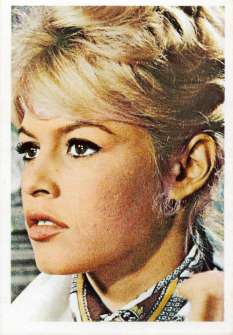
Brigitte Bardot
West German collector card, no. 98.French actress Brigitte Bardot (1934) died on 28 December 2025, at the age of 91. In the 1950s, she was the sex kitten of the European film industry. BB starred in 48 films, performed in numerous musical shows, and recorded 80 songs. After her retirement in 1973, she became an animal rights activist. In the coming weeks, we will continue to post a BB postcard every day to remember her as she once was.Brigitte Bardot was born in Paris in 1934. Her father, Louis Bardot, had an engineering degree and worked with his father in the family business. Her mother, Ann-Marie Mucel, was 14 years younger than Brigitte's father, and they married in 1933. Brigitte's mother encouraged her daughter to take up music and dance. At the age of 13, she entered the Conservatoire Nationale de Danse to study ballet. By the time she was 15, Brigitte was trying to launch a modelling career and found herself on the cover of the French magazine Elle in May 1949. Her incredible beauty was readily apparent, and Brigitte was noticed by Roger Vadim, then an assistant to the film director Marc Allegrét. Vadim was infatuated with Bardot and encouraged her to start working as a film actress. BB was 18 when she debuted in the comedy Le Trou Normand / Crazy for Love (Jean Boyer, 1952). In the same year, she married Vadim. Brigitte wanted to marry him when she was 17, but her parents quashed any marriage plans until she turned 18. In April 1953, she attended the Cannes Film Festival, where she received massive media attention. She soon was every man's idea of the girl he'd like to meet in Paris. From 1952 to 1956, she appeared in seventeen films. Her films were generally lightweight romantic dramas in which she was cast as an ingénue or siren, often with an element of undress. In 1953, she made her first US production, Un acte d'amour / Act of Love (Anatole Litvak, 1953) with Kirk Douglas, but she continued to make films in France.Roger Vadim was not content with the light fare his wife was offered. He felt Brigitte Bardot was being undersold. Looking for something more like an art film to push her as a serious actress, he showcased her in Et Dieu créa la femme / ...And God Created Woman (Roger Vadim, 1956). This film, about an immoral teenager in a respectable small-town setting, was a smash success on both sides of the Atlantic. Craig Butler at AllMovie: "It's easy enough to say that ...And God Created Woman is much more important for its historical significance than for its actual quality as a film, and that's true to an extent. The immense popularity, due to its willingness to directly embrace an exploration of sex as well as its willingness to show a degree of nudity that was remarkably daring for its day, demonstrated that audiences were willing to view subject matter that was considered too racy for the average moviegoer. This had both positive (freedom to explore, especially for the French filmmakers of the time) and negative (freedom to exploit) consequences, but its impact is undeniable. It's also true that Woman is not a great work of art, not with a story that is ultimately rather thin, some painful dialogue, and an attitude toward its characters and their sexuality that is unclear and inconsistent. Yet Woman is still fascinating, due in no small part to the presence of Brigitte Bardot in the role that made her an international star and sex symbol. She's not demonstrating great acting here, although her performance is actually good and much better than necessary, and her legendary mambo scene at the climax is nothing short of sensational." During the filming of Et Dieu créa la femme / And God Created Woman (Roger Vadim, 1956), directed by her husband, Brigitte Bardot had an affair with her co-star, Jean-Louis Trintignant, who at the time was married to French actress Stéphane Audran. Her divorce from Vadim followed, but they remained friends and collaborated in later work.Et Dieu créa la femme / ...And God Created Woman (Roger Vadim, 1956) helped Brigitte Bardot's international status. The film took the USA by storm, her explosive sexuality being unlike anything seen in the States since the days of the 'flapper' in the 1920s. It gave rise to the phrase 'sex kitten', and fascination with her in America consisted of magazine photographs and dubbed over French films - good, bad or indifferent, her films drew audiences - mainly men - into theatres like lemmings. BB appeared in light comedies like Doctor at Large (Ralph Thomas, 1957) - the third of the British 'Doctor' series starring Dirk Bogarde - and Une Parisienne / La Parisienne (Michel Boisrond, 1957), which suited her acting skills best. However, she was a sensation in the crime drama En cas de malheur / Love is My Profession (Claude Autant-Lara, 1958). Hal Erickson at AllMovie: "This Brigitte Bardot vehicle ran into stiff opposition from the Catholic Legion of Decency, severely limiting its U.S. distribution. Bardot plays a nubile small-time thief named Yvette, who becomes the mistress of influential defence attorney Andre (Jean Gabin). Though Andre can shower Yvette with jewels and furs, he cannot "buy" her heart, and thus it is that it belongs to handsome young student Mazzetti (Franco Interlenghi). Alas, Yvette is no judge of human nature: attractive though Mazzetti can be, he has a dangerous and deadly side. En Cas de Malheur contains a nude scene that has since been reprinted in freeze-frame form innumerable times by both film-history books and girlie magazines." Photographer Sam Lévin's photos contributed considerably to her image of sensuality and slight immorality. One of Lévin's pictures shows Brigitte, dressed in a white corset. It is said that around 1960, postcards with this photograph outsold in Paris those of the Eiffel Tower.Brigitte Bardot divorced Vadim in 1957, and in 1959 she married actor Jacques Charrier, with whom she starred in Babette s'en va-t-en guerre / Babette Goes to War (Christian-Jaque, 1959). The paparazzi preyed upon her marriage, while she and her husband clashed over the direction of her career
Her films became more substantial, but this brought a heavy pressure of dual celebrity as she sought critical acclaim while remaining a glamour model for most of the world. Vie privée / Private Life (1962), directed by Louis Malle, has more than an element of autobiography in it. James Travers at French Films: "Brigitte Bardot hadn’t quite reached the high point of her career when she agreed to make this film with high-profile New Wave film director Louis Malle. Even so, the pressure of being a living icon was obviously beginning to get to France’s sex goddess, and Vie privée is as much an attempt by Bardot to come to terms with her celebrity as anything else. Malle is clearly fascinated by Bardot, and the documentary approach he adopts for this film reinforces the impression that it is more a biography of the actress than a work of fiction. Of course, it’s not entirely biographical, but the story is remarkably close to Bardot’s own life and comes pretty close to predicting how her career would end." The scene in which, returning to her apartment, Bardot's character is harangued in the elevator by a middle-aged cleaning lady calling her offensive names was based on an actual incident, and is a resonant image of celebrity in the mid-20th century. Soon afterwards, Bardot withdrew to the seclusion of Southern France.Brigitte Bardot's other husbands were German millionaire Playboy Gunter Sachs and right-wing politician Bernard d'Ormale. She is reputed to have had relationships with many other men, including Samy Frey, her co-star in La Vérité / The Truth (Henri-Georges Clouzot, 1960), and musicians Serge Gainsbourg and Sacha Distel. In 1963, Brigitte Bardot starred in Jean-Luc Godard's critically acclaimed film Le Mépris / Contempt (Jean-Luc Godard, 1963) opposite Michel Piccoli. She was also featured along with such notable actors as Alain Delon in Amours célèbres / Famous Love Affairs (Michel Boisrond, 1961) and Histoires extraordinaires /Tales of Mystery (Louis Malle, 1968), Jeanne Moreau in Viva Maria! (Louis Malle, 1965), Sean Connery in Shalako (Edward Dmytryk, 1968), and Claudia Cardinale in Les Pétroleuses / Petroleum Girls (Christian-Jaque, 1971). She participated in various musical shows and recorded many popular songs in the 1960s and 1970s, mostly in collaboration with Serge Gainsbourg, Bob Zagury and Sacha Distel, including 'Harley Davidson', 'Le Soleil De Ma Vie' (the cover of Stevie Wonder's 'You Are the Sunshine of My Life') and the notorious 'Je t'aime... moi non plus'.Brigitte Bardot’s film career showed a steady decline in the late 1960s and early 1970s. In 1973, just before her fortieth birthday, she announced her retirement. She chose to use her fame to promote animal rights. In 1976, she established the Brigitte Bardot Foundation for the Welfare and Protection of Animals. She became a vegetarian and raised three million French francs to fund the foundation by auctioning off jewellery and many personal belongings. For this work, she was awarded the Légion d’honneur in 1984. During the 1990s, she was also outspoken in her criticism of immigration, interracial relationships, Islam in France and homosexuality. Her husband Bernard d'Ormal was a former adviser of the far-right Front National party. Bardot has been convicted five times for 'inciting racial hatred'. More fun is that Bardot is recognised for popularising bikini swimwear, in such early films as Manina / Woman without a Veil (Willy Rozier, 1952), in her appearances at Cannes and in many photo shoots. Bardot also brought into fashion the 'choucroute' ('Sauerkraut') hairstyle (a sort of beehive hairstyle) and gingham clothes after wearing a checkered pink dress, designed by Jacques Esterel, at her wedding to Charrier. The fashions of the 1960s looked effortlessly right and spontaneous on her. Time Magazine: "She is the princess of pout, the countess of come hither. Brigitte Bardot exuded a carefree, naïve sexuality that brought a whole new audience to French films."Sources: Denny Jackson (IMDb), Hal Erickson (AllMovie), Craig Butler (AllMovie), James Travers (French Films), French Films, Wikipedia and IMDb.And please check out our blog European Film Star Postcards.
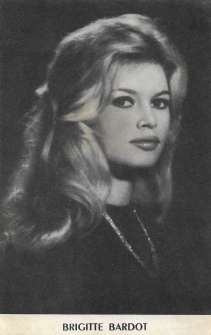
Brigitte Bardot
Vintage card.French actress Brigitte Bardot (1934) died on 28 December 2025, at the age of 91. In the 1950s, she was the sex kitten of the European film industry. BB starred in 48 films, performed in numerous musical shows, and recorded 80 songs. After her retirement in 1973, she became an animal rights activist. In the coming weeks, we will continue to post a BB postcard every day to remember her as she once was.Brigitte Bardot was born in Paris in 1934. Her father, Louis Bardot, had an engineering degree and worked with his father in the family business. Her mother, Ann-Marie Mucel, was 14 years younger than Brigitte's father, and they married in 1933. Brigitte's mother encouraged her daughter to take up music and dance. At the age of 13, she entered the Conservatoire Nationale de Danse to study ballet. By the time she was 15, Brigitte was trying to launch a modelling career and found herself on the cover of the French magazine Elle in May 1949. Her incredible beauty was readily apparent, and Brigitte was noticed by Roger Vadim, then an assistant to the film director Marc Allegrét. Vadim was infatuated with Bardot and encouraged her to start working as a film actress. BB was 18 when she debuted in the comedy Le Trou Normand / Crazy for Love (Jean Boyer, 1952). In the same year, she married Vadim. Brigitte wanted to marry him when she was 17, but her parents quashed any marriage plans until she turned 18. In April 1953, she attended the Cannes Film Festival, where she received massive media attention. She soon was every man's idea of the girl he'd like to meet in Paris. From 1952 to 1956, she appeared in seventeen films. Her films were generally lightweight romantic dramas in which she was cast as an ingénue or siren, often with an element of undress. In 1953, she made her first US production, Un acte d'amour / Act of Love (Anatole Litvak, 1953) with Kirk Douglas, but she continued to make films in France.Roger Vadim was not content with the light fare his wife was offered. He felt Brigitte Bardot was being undersold. Looking for something more like an art film to push her as a serious actress, he showcased her in Et Dieu créa la femme / ...And God Created Woman (Roger Vadim, 1956). This film, about an immoral teenager in a respectable small-town setting, was a smash success on both sides of the Atlantic. Craig Butler at AllMovie: "It's easy enough to say that ...And God Created Woman is much more important for its historical significance than for its actual quality as a film, and that's true to an extent. The immense popularity, due to its willingness to directly embrace an exploration of sex as well as its willingness to show a degree of nudity that was remarkably daring for its day, demonstrated that audiences were willing to view subject matter that was considered too racy for the average moviegoer. This had both positive (freedom to explore, especially for the French filmmakers of the time) and negative (freedom to exploit) consequences, but its impact is undeniable. It's also true that Woman is not a great work of art, not with a story that is ultimately rather thin, some painful dialogue, and an attitude toward its characters and their sexuality that is unclear and inconsistent. Yet Woman is still fascinating, due in no small part to the presence of Brigitte Bardot in the role that made her an international star and sex symbol. She's not demonstrating great acting here, although her performance is actually good and much better than necessary, and her legendary mambo scene at the climax is nothing short of sensational." During the filming of Et Dieu créa la femme / And God Created Woman (Roger Vadim, 1956), directed by her husband, Brigitte Bardot had an affair with her co-star, Jean-Louis Trintignant, who at the time was married to French actress Stéphane Audran. Her divorce from Vadim followed, but they remained friends and collaborated in later work.Et Dieu créa la femme / ...And God Created Woman (Roger Vadim, 1956) helped Brigitte Bardot's international status. The film took the USA by storm, her explosive sexuality being unlike anything seen in the States since the days of the 'flapper' in the 1920s. It gave rise to the phrase 'sex kitten', and fascination with her in America consisted of magazine photographs and dubbed over French films - good, bad or indifferent, her films drew audiences - mainly men - into theatres like lemmings. BB appeared in light comedies like Doctor at Large (Ralph Thomas, 1957) - the third of the British 'Doctor' series starring Dirk Bogarde - and Une Parisienne / La Parisienne (Michel Boisrond, 1957), which suited her acting skills best. However, she was a sensation in the crime drama En cas de malheur / Love is My Profession (Claude Autant-Lara, 1958). Hal Erickson at AllMovie: "This Brigitte Bardot vehicle ran into stiff opposition from the Catholic Legion of Decency, severely limiting its U.S. distribution. Bardot plays a nubile small-time thief named Yvette, who becomes the mistress of influential defence attorney Andre (Jean Gabin). Though Andre can shower Yvette with jewels and furs, he cannot "buy" her heart, and thus it is that it belongs to handsome young student Mazzetti (Franco Interlenghi). Alas, Yvette is no judge of human nature: attractive though Mazzetti can be, he has a dangerous and deadly side. En Cas de Malheur contains a nude scene that has since been reprinted in freeze-frame form innumerable times by both film-history books and girlie magazines." Photographer Sam Lévin's photos contributed considerably to her image of sensuality and slight immorality. One of Lévin's pictures shows Brigitte, dressed in a white corset. It is said that around 1960, postcards with this photograph outsold in Paris those of the Eiffel Tower.Brigitte Bardot divorced Vadim in 1957, and in 1959 she married actor Jacques Charrier, with whom she starred in Babette s'en va-t-en guerre / Babette Goes to War (Christian-Jaque, 1959). The paparazzi preyed upon her marriage, while she and her husband clashed over the direction of her career
Her films became more substantial, but this brought a heavy pressure of dual celebrity as she sought critical acclaim while remaining a glamour model for most of the world. Vie privée / Private Life (1962), directed by Louis Malle, has more than an element of autobiography in it. James Travers at French Films: "Brigitte Bardot hadn’t quite reached the high point of her career when she agreed to make this film with high-profile New Wave film director Louis Malle. Even so, the pressure of being a living icon was obviously beginning to get to France’s sex goddess, and Vie privée is as much an attempt by Bardot to come to terms with her celebrity as anything else. Malle is clearly fascinated by Bardot, and the documentary approach he adopts for this film reinforces the impression that it is more a biography of the actress than a work of fiction. Of course, it’s not entirely biographical, but the story is remarkably close to Bardot’s own life and comes pretty close to predicting how her career would end." The scene in which, returning to her apartment, Bardot's character is harangued in the elevator by a middle-aged cleaning lady calling her offensive names was based on an actual incident, and is a resonant image of celebrity in the mid-20th century. Soon afterwards, Bardot withdrew to the seclusion of Southern France.Brigitte Bardot's other husbands were German millionaire Playboy Gunter Sachs and right-wing politician Bernard d'Ormale. She is reputed to have had relationships with many other men, including Samy Frey, her co-star in La Vérité / The Truth (Henri-Georges Clouzot, 1960), and musicians Serge Gainsbourg and Sacha Distel. In 1963, Brigitte Bardot starred in Jean-Luc Godard's critically acclaimed film Le Mépris / Contempt (Jean-Luc Godard, 1963) opposite Michel Piccoli. She was also featured along with such notable actors as Alain Delon in Amours célèbres / Famous Love Affairs (Michel Boisrond, 1961) and Histoires extraordinaires /Tales of Mystery (Louis Malle, 1968), Jeanne Moreau in Viva Maria! (Louis Malle, 1965), Sean Connery in Shalako (Edward Dmytryk, 1968), and Claudia Cardinale in Les Pétroleuses / Petroleum Girls (Christian-Jaque, 1971). She participated in various musical shows and recorded many popular songs in the 1960s and 1970s, mostly in collaboration with Serge Gainsbourg, Bob Zagury and Sacha Distel, including 'Harley Davidson', 'Le Soleil De Ma Vie' (the cover of Stevie Wonder's 'You Are the Sunshine of My Life') and the notorious 'Je t'aime... moi non plus'.Brigitte Bardot’s film career showed a steady decline in the late 1960s and early 1970s. In 1973, just before her fortieth birthday, she announced her retirement. She chose to use her fame to promote animal rights. In 1976, she established the Brigitte Bardot Foundation for the Welfare and Protection of Animals. She became a vegetarian and raised three million French francs to fund the foundation by auctioning off jewellery and many personal belongings. For this work, she was awarded the Légion d’honneur in 1984. During the 1990s, she was also outspoken in her criticism of immigration, interracial relationships, Islam in France and homosexuality. Her husband Bernard d'Ormal was a former adviser of the far-right Front National party. Bardot has been convicted five times for 'inciting racial hatred'. More fun is that Bardot is recognised for popularising bikini swimwear, in such early films as Manina / Woman without a Veil (Willy Rozier, 1952), in her appearances at Cannes and in many photo shoots. Bardot also brought into fashion the 'choucroute' ('Sauerkraut') hairstyle (a sort of beehive hairstyle) and gingham clothes after wearing a checkered pink dress, designed by Jacques Esterel, at her wedding to Charrier. The fashions of the 1960s looked effortlessly right and spontaneous on her. Time Magazine: "She is the princess of pout, the countess of come hither. Brigitte Bardot exuded a carefree, naïve sexuality that brought a whole new audience to French films."Sources: Denny Jackson (IMDb), Hal Erickson (AllMovie), Craig Butler (AllMovie), James Travers (French Films), French Films, Wikipedia and IMDb.And please check out our blog European Film Star Postcards.
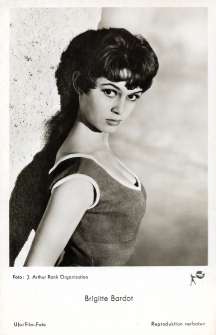
Brigitte Bardot in Doctor at Sea (1955)
West German postcard by Ufa/Film-Foto, Berlin-Tempelhof, no. FK 3320. Photo: J. Arthur Rank Organisation. Brigitte Bardot in Doctor at Sea (Ralph Thomas, 1955).French actress Brigitte Bardot (1934) died on 28 December 2025, at the age of 91. In the 1950s, she was the sex kitten of the European film industry. BB starred in 48 films, performed in numerous musical shows, and recorded 80 songs. After her retirement in 1973, she became an animal rights activist. In the coming weeks, we will continue to post a BB postcard every day to remember her as she once was.Brigitte Bardot was born in Paris in 1934. Her father, Louis Bardot, had an engineering degree and worked with his father in the family business. Her mother, Ann-Marie Mucel, was 14 years younger than Brigitte's father, and they married in 1933. Brigitte's mother encouraged her daughter to take up music and dance. At the age of 13, she entered the Conservatoire Nationale de Danse to study ballet. By the time she was 15, Brigitte was trying to launch a modelling career and found herself on the cover of the French magazine Elle in May 1949. Her incredible beauty was readily apparent, and Brigitte was noticed by Roger Vadim, then an assistant to the film director Marc Allegrét. Vadim was infatuated with Bardot and encouraged her to start working as a film actress. BB was 18 when she debuted in the comedy Le Trou Normand / Crazy for Love (Jean Boyer, 1952). In the same year, she married Vadim. Brigitte wanted to marry him when she was 17, but her parents quashed any marriage plans until she turned 18. In April 1953, she attended the Cannes Film Festival, where she received massive media attention. She soon was every man's idea of the girl he'd like to meet in Paris. From 1952 to 1956, she appeared in seventeen films. Her films were generally lightweight romantic dramas in which she was cast as an ingénue or siren, often with an element of undress. In 1953, she made her first US production, Un acte d'amour / Act of Love (Anatole Litvak, 1953) with Kirk Douglas, but she continued to make films in France.Roger Vadim was not content with the light fare his wife was offered. He felt Brigitte Bardot was being undersold. Looking for something more like an art film to push her as a serious actress, he showcased her in Et Dieu créa la femme / ...And God Created Woman (Roger Vadim, 1956). This film, about an immoral teenager in a respectable small-town setting, was a smash success on both sides of the Atlantic. Craig Butler at AllMovie: "It's easy enough to say that ...And God Created Woman is much more important for its historical significance than for its actual quality as a film, and that's true to an extent. The immense popularity, due to its willingness to directly embrace an exploration of sex as well as its willingness to show a degree of nudity that was remarkably daring for its day, demonstrated that audiences were willing to view subject matter that was considered too racy for the average moviegoer. This had both positive (freedom to explore, especially for the French filmmakers of the time) and negative (freedom to exploit) consequences, but its impact is undeniable. It's also true that Woman is not a great work of art, not with a story that is ultimately rather thin, some painful dialogue, and an attitude toward its characters and their sexuality that is unclear and inconsistent. Yet Woman is still fascinating, due in no small part to the presence of Brigitte Bardot in the role that made her an international star and sex symbol. She's not demonstrating great acting here, although her performance is actually good and much better than necessary, and her legendary mambo scene at the climax is nothing short of sensational." During the filming of Et Dieu créa la femme / And God Created Woman (Roger Vadim, 1956), directed by her husband, Brigitte Bardot had an affair with her co-star, Jean-Louis Trintignant, who at the time was married to French actress Stéphane Audran. Her divorce from Vadim followed, but they remained friends and collaborated in later work.Et Dieu créa la femme / ...And God Created Woman (Roger Vadim, 1956) helped Brigitte Bardot's international status. The film took the USA by storm, her explosive sexuality being unlike anything seen in the States since the days of the 'flapper' in the 1920s. It gave rise to the phrase 'sex kitten', and fascination with her in America consisted of magazine photographs and dubbed over French films - good, bad or indifferent, her films drew audiences - mainly men - into theatres like lemmings. BB appeared in light comedies like Doctor at Large (Ralph Thomas, 1957) - the third of the British 'Doctor' series starring Dirk Bogarde - and Une Parisienne / La Parisienne (Michel Boisrond, 1957), which suited her acting skills best. However, she was a sensation in the crime drama En cas de malheur / Love is My Profession (Claude Autant-Lara, 1958). Hal Erickson at AllMovie: "This Brigitte Bardot vehicle ran into stiff opposition from the Catholic Legion of Decency, severely limiting its U.S. distribution. Bardot plays a nubile small-time thief named Yvette, who becomes the mistress of influential defence attorney Andre (Jean Gabin). Though Andre can shower Yvette with jewels and furs, he cannot "buy" her heart, and thus it is that it belongs to handsome young student Mazzetti (Franco Interlenghi). Alas, Yvette is no judge of human nature: attractive though Mazzetti can be, he has a dangerous and deadly side. En Cas de Malheur contains a nude scene that has since been reprinted in freeze-frame form innumerable times by both film-history books and girlie magazines." Photographer Sam Lévin's photos contributed considerably to her image of sensuality and slight immorality. One of Lévin's pictures shows Brigitte, dressed in a white corset. It is said that around 1960, postcards with this photograph outsold in Paris those of the Eiffel Tower.Brigitte Bardot divorced Vadim in 1957, and in 1959 she married actor Jacques Charrier, with whom she starred in Babette s'en va-t-en guerre / Babette Goes to War (Christian-Jaque, 1959). The paparazzi preyed upon her marriage, while she and her husband clashed over the direction of her career
Her films became more substantial, but this brought a heavy pressure of dual celebrity as she sought critical acclaim while remaining a glamour model for most of the world. Vie privée / Private Life (1962), directed by Louis Malle, has more than an element of autobiography in it. James Travers at French Films: "Brigitte Bardot hadn’t quite reached the high point of her career when she agreed to make this film with high-profile New Wave film director Louis Malle. Even so, the pressure of being a living icon was obviously beginning to get to France’s sex goddess, and Vie privée is as much an attempt by Bardot to come to terms with her celebrity as anything else. Malle is clearly fascinated by Bardot, and the documentary approach he adopts for this film reinforces the impression that it is more a biography of the actress than a work of fiction. Of course, it’s not entirely biographical, but the story is remarkably close to Bardot’s own life and comes pretty close to predicting how her career would end." The scene in which, returning to her apartment, Bardot's character is harangued in the elevator by a middle-aged cleaning lady calling her offensive names was based on an actual incident, and is a resonant image of celebrity in the mid-20th century. Soon afterwards, Bardot withdrew to the seclusion of Southern France.Brigitte Bardot's other husbands were German millionaire Playboy Gunter Sachs and right-wing politician Bernard d'Ormale. She is reputed to have had relationships with many other men, including Samy Frey, her co-star in La Vérité / The Truth (Henri-Georges Clouzot, 1960), and musicians Serge Gainsbourg and Sacha Distel. In 1963, Brigitte Bardot starred in Jean-Luc Godard's critically acclaimed film Le Mépris / Contempt (Jean-Luc Godard, 1963) opposite Michel Piccoli. She was also featured along with such notable actors as Alain Delon in Amours célèbres / Famous Love Affairs (Michel Boisrond, 1961) and Histoires extraordinaires /Tales of Mystery (Louis Malle, 1968), Jeanne Moreau in Viva Maria! (Louis Malle, 1965), Sean Connery in Shalako (Edward Dmytryk, 1968), and Claudia Cardinale in Les Pétroleuses / Petroleum Girls (Christian-Jaque, 1971). She participated in various musical shows and recorded many popular songs in the 1960s and 1970s, mostly in collaboration with Serge Gainsbourg, Bob Zagury and Sacha Distel, including 'Harley Davidson', 'Le Soleil De Ma Vie' (the cover of Stevie Wonder's 'You Are the Sunshine of My Life') and the notorious 'Je t'aime... moi non plus'.Brigitte Bardot’s film career showed a steady decline in the late 1960s and early 1970s. In 1973, just before her fortieth birthday, she announced her retirement. She chose to use her fame to promote animal rights. In 1976, she established the Brigitte Bardot Foundation for the Welfare and Protection of Animals. She became a vegetarian and raised three million French francs to fund the foundation by auctioning off jewellery and many personal belongings. For this work, she was awarded the Légion d’honneur in 1984. During the 1990s, she was also outspoken in her criticism of immigration, interracial relationships, Islam in France and homosexuality. Her husband Bernard d'Ormal was a former adviser of the far-right Front National party. Bardot has been convicted five times for 'inciting racial hatred'. More fun is that Bardot is recognised for popularising bikini swimwear, in such early films as Manina / Woman without a Veil (Willy Rozier, 1952), in her appearances at Cannes and in many photo shoots. Bardot also brought into fashion the 'choucroute' ('Sauerkraut') hairstyle (a sort of beehive hairstyle) and gingham clothes after wearing a checkered pink dress, designed by Jacques Esterel, at her wedding to Charrier. The fashions of the 1960s looked effortlessly right and spontaneous on her. Time Magazine: "She is the princess of pout, the countess of come hither. Brigitte Bardot exuded a carefree, naïve sexuality that brought a whole new audience to French films."Sources: Denny Jackson (IMDb), Hal Erickson (AllMovie), Craig Butler (AllMovie), James Travers (French Films), French Films, Wikipedia and IMDb.And please check out our blog European Film Star Postcards.
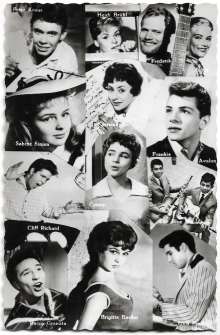
Brigitte Bardot and other stars
Dutch multi-view postcard by NV. v.h. Weenenk & Snel, Baarn, no. 662. Photos: Brigitte Bardot, mid-under. The other stars are from upper left: Peter Krauss, Heidi Brühl, Nina & Frederik, Sabine Sinjen, Caterina Valente, Frankie Avalon, Cliff Richard, Connie Froboess, The Blue Diamonds, Rocco Granata and Elvis Presley.French actress Brigitte Bardot (1934) died on 28 December 2025, at the age of 91. In the 1950s, she was the sex kitten of the European film industry. BB starred in 48 films, performed in numerous musical shows, and recorded 80 songs. After her retirement in 1973, she became an animal rights activist. In the coming weeks, we will continue to post a BB postcard every day to remember her as she once was.Brigitte Bardot was born in Paris in 1934. Her father, Louis Bardot, had an engineering degree and worked with his father in the family business. Her mother, Ann-Marie Mucel, was 14 years younger than Brigitte's father, and they married in 1933. Brigitte's mother encouraged her daughter to take up music and dance. At the age of 13, she entered the Conservatoire Nationale de Danse to study ballet. By the time she was 15, Brigitte was trying to launch a modelling career and found herself on the cover of the French magazine Elle in May 1949. Her incredible beauty was readily apparent, and Brigitte was noticed by Roger Vadim, then an assistant to the film director Marc Allegrét. Vadim was infatuated with Bardot and encouraged her to start working as a film actress. BB was 18 when she debuted in the comedy Le Trou Normand / Crazy for Love (Jean Boyer, 1952). In the same year, she married Vadim. Brigitte wanted to marry him when she was 17, but her parents quashed any marriage plans until she turned 18. In April 1953, she attended the Cannes Film Festival, where she received massive media attention. She soon was every man's idea of the girl he'd like to meet in Paris. From 1952 to 1956, she appeared in seventeen films. Her films were generally lightweight romantic dramas in which she was cast as an ingénue or siren, often with an element of undress. In 1953, she made her first US production, Un acte d'amour / Act of Love (Anatole Litvak, 1953) with Kirk Douglas, but she continued to make films in France.Roger Vadim was not content with the light fare his wife was offered. He felt Brigitte Bardot was being undersold. Looking for something more like an art film to push her as a serious actress, he showcased her in Et Dieu créa la femme / ...And God Created Woman (Roger Vadim, 1956). This film, about an immoral teenager in a respectable small-town setting, was a smash success on both sides of the Atlantic. Craig Butler at AllMovie: "It's easy enough to say that ...And God Created Woman is much more important for its historical significance than for its actual quality as a film, and that's true to an extent. The immense popularity, due to its willingness to directly embrace an exploration of sex as well as its willingness to show a degree of nudity that was remarkably daring for its day, demonstrated that audiences were willing to view subject matter that was considered too racy for the average moviegoer. This had both positive (freedom to explore, especially for the French filmmakers of the time) and negative (freedom to exploit) consequences, but its impact is undeniable. It's also true that Woman is not a great work of art, not with a story that is ultimately rather thin, some painful dialogue, and an attitude toward its characters and their sexuality that is unclear and inconsistent. Yet Woman is still fascinating, due in no small part to the presence of Brigitte Bardot in the role that made her an international star and sex symbol. She's not demonstrating great acting here, although her performance is actually good and much better than necessary, and her legendary mambo scene at the climax is nothing short of sensational." During the filming of Et Dieu créa la femme / And God Created Woman (Roger Vadim, 1956), directed by her husband, Brigitte Bardot had an affair with her co-star, Jean-Louis Trintignant, who at the time was married to French actress Stéphane Audran. Her divorce from Vadim followed, but they remained friends and collaborated in later work.Et Dieu créa la femme / ...And God Created Woman (Roger Vadim, 1956) helped Brigitte Bardot's international status. The film took the USA by storm, her explosive sexuality being unlike anything seen in the States since the days of the 'flapper' in the 1920s. It gave rise to the phrase 'sex kitten', and fascination with her in America consisted of magazine photographs and dubbed over French films - good, bad or indifferent, her films drew audiences - mainly men - into theatres like lemmings. BB appeared in light comedies like Doctor at Large (Ralph Thomas, 1957) - the third of the British 'Doctor' series starring Dirk Bogarde - and Une Parisienne / La Parisienne (Michel Boisrond, 1957), which suited her acting skills best. However, she was a sensation in the crime drama En cas de malheur / Love is My Profession (Claude Autant-Lara, 1958). Hal Erickson at AllMovie: "This Brigitte Bardot vehicle ran into stiff opposition from the Catholic Legion of Decency, severely limiting its U.S. distribution. Bardot plays a nubile small-time thief named Yvette, who becomes the mistress of influential defence attorney Andre (Jean Gabin). Though Andre can shower Yvette with jewels and furs, he cannot "buy" her heart, and thus it is that it belongs to handsome young student Mazzetti (Franco Interlenghi). Alas, Yvette is no judge of human nature: attractive though Mazzetti can be, he has a dangerous and deadly side. En Cas de Malheur contains a nude scene that has since been reprinted in freeze-frame form innumerable times by both film-history books and girlie magazines." Photographer Sam Lévin's photos contributed considerably to her image of sensuality and slight immorality. One of Lévin's pictures shows Brigitte, dressed in a white corset. It is said that around 1960, postcards with this photograph outsold in Paris those of the Eiffel Tower.Brigitte Bardot divorced Vadim in 1957, and in 1959 she married actor Jacques Charrier, with whom she starred in Babette s'en va-t-en guerre / Babette Goes to War (Christian-Jaque, 1959). The paparazzi preyed upon her marriage, while she and her husband clashed over the direction of her career
Her films became more substantial, but this brought a heavy pressure of dual celebrity as she sought critical acclaim while remaining a glamour model for most of the world. Vie privée / Private Life (1962), directed by Louis Malle, has more than an element of autobiography in it. James Travers at French Films: "Brigitte Bardot hadn’t quite reached the high point of her career when she agreed to make this film with high-profile New Wave film director Louis Malle. Even so, the pressure of being a living icon was obviously beginning to get to France’s sex goddess, and Vie privée is as much an attempt by Bardot to come to terms with her celebrity as anything else. Malle is clearly fascinated by Bardot, and the documentary approach he adopts for this film reinforces the impression that it is more a biography of the actress than a work of fiction. Of course, it’s not entirely biographical, but the story is remarkably close to Bardot’s own life and comes pretty close to predicting how her career would end." The scene in which, returning to her apartment, Bardot's character is harangued in the elevator by a middle-aged cleaning lady calling her offensive names was based on an actual incident, and is a resonant image of celebrity in the mid-20th century. Soon afterwards, Bardot withdrew to the seclusion of Southern France.Brigitte Bardot's other husbands were German millionaire Playboy Gunter Sachs and right-wing politician Bernard d'Ormale. She is reputed to have had relationships with many other men, including Samy Frey, her co-star in La Vérité / The Truth (Henri-Georges Clouzot, 1960), and musicians Serge Gainsbourg and Sacha Distel. In 1963, Brigitte Bardot starred in Jean-Luc Godard's critically acclaimed film Le Mépris / Contempt (Jean-Luc Godard, 1963) opposite Michel Piccoli. She was also featured along with such notable actors as Alain Delon in Amours célèbres / Famous Love Affairs (Michel Boisrond, 1961) and Histoires extraordinaires /Tales of Mystery (Louis Malle, 1968), Jeanne Moreau in Viva Maria! (Louis Malle, 1965), Sean Connery in Shalako (Edward Dmytryk, 1968), and Claudia Cardinale in Les Pétroleuses / Petroleum Girls (Christian-Jaque, 1971). She participated in various musical shows and recorded many popular songs in the 1960s and 1970s, mostly in collaboration with Serge Gainsbourg, Bob Zagury and Sacha Distel, including 'Harley Davidson', 'Le Soleil De Ma Vie' (the cover of Stevie Wonder's 'You Are the Sunshine of My Life') and the notorious 'Je t'aime... moi non plus'.Brigitte Bardot’s film career showed a steady decline in the late 1960s and early 1970s. In 1973, just before her fortieth birthday, she announced her retirement. She chose to use her fame to promote animal rights. In 1976, she established the Brigitte Bardot Foundation for the Welfare and Protection of Animals. She became a vegetarian and raised three million French francs to fund the foundation by auctioning off jewellery and many personal belongings. For this work, she was awarded the Légion d’honneur in 1984. During the 1990s, she was also outspoken in her criticism of immigration, interracial relationships, Islam in France and homosexuality. Her husband Bernard d'Ormal was a former adviser of the far-right Front National party. Bardot has been convicted five times for 'inciting racial hatred'. More fun is that Bardot is recognised for popularising bikini swimwear, in such early films as Manina / Woman without a Veil (Willy Rozier, 1952), in her appearances at Cannes and in many photo shoots. Bardot also brought into fashion the 'choucroute' ('Sauerkraut') hairstyle (a sort of beehive hairstyle) and gingham clothes after wearing a checkered pink dress, designed by Jacques Esterel, at her wedding to Charrier. The fashions of the 1960s looked effortlessly right and spontaneous on her. Time Magazine: "She is the princess of pout, the countess of come hither. Brigitte Bardot exuded a carefree, naïve sexuality that brought a whole new audience to French films."Sources: Denny Jackson (IMDb), Hal Erickson (AllMovie), Craig Butler (AllMovie), James Travers (French Films), French Films, Wikipedia and IMDb.And please check out our blog European Film Star Postcards.
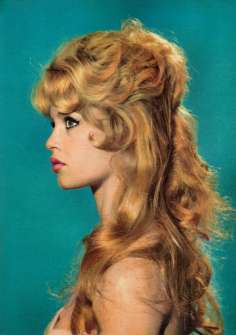
Brigitte Bardot
Italian postcard in the Rotalcolor series by Rotalfoto, Milano, no. N 47. Photo: Sam Lévin.French actress Brigitte Bardot (1934) died on 28 December 2025, at the age of 91. In the 1950s, she was the sex kitten of the European film industry. BB starred in 48 films, performed in numerous musical shows, and recorded 80 songs. After her retirement in 1973, she became an animal rights activist. In the coming weeks, we will continue to post a BB postcard every day to remember her as she once was.Brigitte Bardot was born in Paris in 1934. Her father, Louis Bardot, had an engineering degree and worked with his father in the family business. Her mother, Ann-Marie Mucel, was 14 years younger than Brigitte's father, and they married in 1933. Brigitte's mother encouraged her daughter to take up music and dance. At the age of 13, she entered the Conservatoire Nationale de Danse to study ballet. By the time she was 15, Brigitte was trying to launch a modelling career and found herself on the cover of the French magazine Elle in May 1949. Her incredible beauty was readily apparent, and Brigitte was noticed by Roger Vadim, then an assistant to the film director Marc Allegrét. Vadim was infatuated with Bardot and encouraged her to start working as a film actress. BB was 18 when she debuted in the comedy Le Trou Normand / Crazy for Love (Jean Boyer, 1952). In the same year, she married Vadim. Brigitte wanted to marry him when she was 17, but her parents quashed any marriage plans until she turned 18. In April 1953, she attended the Cannes Film Festival, where she received massive media attention. She soon was every man's idea of the girl he'd like to meet in Paris. From 1952 to 1956, she appeared in seventeen films. Her films were generally lightweight romantic dramas in which she was cast as an ingénue or siren, often with an element of undress. In 1953, she made her first US production, Un acte d'amour / Act of Love (Anatole Litvak, 1953) with Kirk Douglas, but she continued to make films in France.Roger Vadim was not content with the light fare his wife was offered. He felt Brigitte Bardot was being undersold. Looking for something more like an art film to push her as a serious actress, he showcased her in Et Dieu créa la femme / ...And God Created Woman (Roger Vadim, 1956). This film, about an immoral teenager in a respectable small-town setting, was a smash success on both sides of the Atlantic. Craig Butler at AllMovie: "It's easy enough to say that ...And God Created Woman is much more important for its historical significance than for its actual quality as a film, and that's true to an extent. The immense popularity, due to its willingness to directly embrace an exploration of sex as well as its willingness to show a degree of nudity that was remarkably daring for its day, demonstrated that audiences were willing to view subject matter that was considered too racy for the average moviegoer. This had both positive (freedom to explore, especially for the French filmmakers of the time) and negative (freedom to exploit) consequences, but its impact is undeniable. It's also true that Woman is not a great work of art, not with a story that is ultimately rather thin, some painful dialogue, and an attitude toward its characters and their sexuality that is unclear and inconsistent. Yet Woman is still fascinating, due in no small part to the presence of Brigitte Bardot in the role that made her an international star and sex symbol. She's not demonstrating great acting here, although her performance is actually good and much better than necessary, and her legendary mambo scene at the climax is nothing short of sensational." During the filming of Et Dieu créa la femme / And God Created Woman (Roger Vadim, 1956), directed by her husband, Brigitte Bardot had an affair with her co-star, Jean-Louis Trintignant, who at the time was married to French actress Stéphane Audran. Her divorce from Vadim followed, but they remained friends and collaborated in later work.Et Dieu créa la femme / ...And God Created Woman (Roger Vadim, 1956) helped Brigitte Bardot's international status. The film took the USA by storm, her explosive sexuality being unlike anything seen in the States since the days of the 'flapper' in the 1920s. It gave rise to the phrase 'sex kitten', and fascination with her in America consisted of magazine photographs and dubbed over French films - good, bad or indifferent, her films drew audiences - mainly men - into theatres like lemmings. BB appeared in light comedies like Doctor at Large (Ralph Thomas, 1957) - the third of the British 'Doctor' series starring Dirk Bogarde - and Une Parisienne / La Parisienne (Michel Boisrond, 1957), which suited her acting skills best. However, she was a sensation in the crime drama En cas de malheur / Love is My Profession (Claude Autant-Lara, 1958). Hal Erickson at AllMovie: "This Brigitte Bardot vehicle ran into stiff opposition from the Catholic Legion of Decency, severely limiting its U.S. distribution. Bardot plays a nubile small-time thief named Yvette, who becomes the mistress of influential defence attorney Andre (Jean Gabin). Though Andre can shower Yvette with jewels and furs, he cannot "buy" her heart, and thus it is that it belongs to handsome young student Mazzetti (Franco Interlenghi). Alas, Yvette is no judge of human nature: attractive though Mazzetti can be, he has a dangerous and deadly side. En Cas de Malheur contains a nude scene that has since been reprinted in freeze-frame form innumerable times by both film-history books and girlie magazines." Photographer Sam Lévin's photos contributed considerably to her image of sensuality and slight immorality. One of Lévin's pictures shows Brigitte, dressed in a white corset. It is said that around 1960, postcards with this photograph outsold in Paris those of the Eiffel Tower.Brigitte Bardot divorced Vadim in 1957, and in 1959 she married actor Jacques Charrier, with whom she starred in Babette s'en va-t-en guerre / Babette Goes to War (Christian-Jaque, 1959). The paparazzi preyed upon her marriage, while she and her husband clashed over the direction of her career
Her films became more substantial, but this brought a heavy pressure of dual celebrity as she sought critical acclaim while remaining a glamour model for most of the world. Vie privée / Private Life (1962), directed by Louis Malle, has more than an element of autobiography in it. James Travers at French Films: "Brigitte Bardot hadn’t quite reached the high point of her career when she agreed to make this film with high-profile New Wave film director Louis Malle. Even so, the pressure of being a living icon was obviously beginning to get to France’s sex goddess, and Vie privée is as much an attempt by Bardot to come to terms with her celebrity as anything else. Malle is clearly fascinated by Bardot, and the documentary approach he adopts for this film reinforces the impression that it is more a biography of the actress than a work of fiction. Of course, it’s not entirely biographical, but the story is remarkably close to Bardot’s own life and comes pretty close to predicting how her career would end." The scene in which, returning to her apartment, Bardot's character is harangued in the elevator by a middle-aged cleaning lady calling her offensive names was based on an actual incident, and is a resonant image of celebrity in the mid-20th century. Soon afterwards, Bardot withdrew to the seclusion of Southern France.Brigitte Bardot's other husbands were German millionaire Playboy Gunter Sachs and right-wing politician Bernard d'Ormale. She is reputed to have had relationships with many other men, including Samy Frey, her co-star in La Vérité / The Truth (Henri-Georges Clouzot, 1960), and musicians Serge Gainsbourg and Sacha Distel. In 1963, Brigitte Bardot starred in Jean-Luc Godard's critically acclaimed film Le Mépris / Contempt (Jean-Luc Godard, 1963) opposite Michel Piccoli. She was also featured along with such notable actors as Alain Delon in Amours célèbres / Famous Love Affairs (Michel Boisrond, 1961) and Histoires extraordinaires /Tales of Mystery (Louis Malle, 1968), Jeanne Moreau in Viva Maria! (Louis Malle, 1965), Sean Connery in Shalako (Edward Dmytryk, 1968), and Claudia Cardinale in Les Pétroleuses / Petroleum Girls (Christian-Jaque, 1971). She participated in various musical shows and recorded many popular songs in the 1960s and 1970s, mostly in collaboration with Serge Gainsbourg, Bob Zagury and Sacha Distel, including 'Harley Davidson', 'Le Soleil De Ma Vie' (the cover of Stevie Wonder's 'You Are the Sunshine of My Life') and the notorious 'Je t'aime... moi non plus'.Brigitte Bardot’s film career showed a steady decline in the late 1960s and early 1970s. In 1973, just before her fortieth birthday, she announced her retirement. She chose to use her fame to promote animal rights. In 1976, she established the Brigitte Bardot Foundation for the Welfare and Protection of Animals. She became a vegetarian and raised three million French francs to fund the foundation by auctioning off jewellery and many personal belongings. For this work, she was awarded the Légion d’honneur in 1984. During the 1990s, she was also outspoken in her criticism of immigration, interracial relationships, Islam in France and homosexuality. Her husband Bernard d'Ormal was a former adviser of the far-right Front National party. Bardot has been convicted five times for 'inciting racial hatred'. More fun is that Bardot is recognised for popularising bikini swimwear, in such early films as Manina / Woman without a Veil (Willy Rozier, 1952), in her appearances at Cannes and in many photo shoots. Bardot also brought into fashion the 'choucroute' ('Sauerkraut') hairstyle (a sort of beehive hairstyle) and gingham clothes after wearing a checkered pink dress, designed by Jacques Esterel, at her wedding to Charrier. The fashions of the 1960s looked effortlessly right and spontaneous on her. Time Magazine: "She is the princess of pout, the countess of come hither. Brigitte Bardot exuded a carefree, naïve sexuality that brought a whole new audience to French films."Sources: Denny Jackson (IMDb), Hal Erickson (AllMovie), Craig Butler (AllMovie), James Travers (French Films), French Films, Wikipedia and IMDb.And please check out our blog European Film Star Postcards.
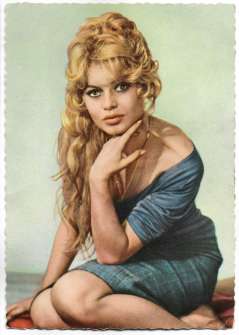
Brigitte Bardot
West German postcard by Ufa (Universum-Film Aktiengesellschaft), Berlin-Tempelhof, no. CK-192. Photo: Sam Lévin / Ufa.French actress Brigitte Bardot (1934) died on 28 December 2025, at the age of 91. In the 1950s, she was the sex kitten of the European film industry. BB starred in 48 films, performed in numerous musical shows, and recorded 80 songs. After her retirement in 1973, she became an animal rights activist. In the coming weeks, we will continue to post a BB postcard every day to remember her as she once was.Brigitte Bardot was born in Paris in 1934. Her father, Louis Bardot, had an engineering degree and worked with his father in the family business. Her mother, Ann-Marie Mucel, was 14 years younger than Brigitte's father, and they married in 1933. Brigitte's mother encouraged her daughter to take up music and dance. At the age of 13, she entered the Conservatoire Nationale de Danse to study ballet. By the time she was 15, Brigitte was trying to launch a modelling career and found herself on the cover of the French magazine Elle in May 1949. Her incredible beauty was readily apparent, and Brigitte was noticed by Roger Vadim, then an assistant to the film director Marc Allegrét. Vadim was infatuated with Bardot and encouraged her to start working as a film actress. BB was 18 when she debuted in the comedy Le Trou Normand / Crazy for Love (Jean Boyer, 1952). In the same year, she married Vadim. Brigitte wanted to marry him when she was 17, but her parents quashed any marriage plans until she turned 18. In April 1953, she attended the Cannes Film Festival, where she received massive media attention. She soon was every man's idea of the girl he'd like to meet in Paris. From 1952 to 1956, she appeared in seventeen films. Her films were generally lightweight romantic dramas in which she was cast as an ingénue or siren, often with an element of undress. In 1953, she made her first US production, Un acte d'amour / Act of Love (Anatole Litvak, 1953) with Kirk Douglas, but she continued to make films in France.Roger Vadim was not content with the light fare his wife was offered. He felt Brigitte Bardot was being undersold. Looking for something more like an art film to push her as a serious actress, he showcased her in Et Dieu créa la femme / ...And God Created Woman (Roger Vadim, 1956). This film, about an immoral teenager in a respectable small-town setting, was a smash success on both sides of the Atlantic. Craig Butler at AllMovie: "It's easy enough to say that ...And God Created Woman is much more important for its historical significance than for its actual quality as a film, and that's true to an extent. The immense popularity, due to its willingness to directly embrace an exploration of sex as well as its willingness to show a degree of nudity that was remarkably daring for its day, demonstrated that audiences were willing to view subject matter that was considered too racy for the average moviegoer. This had both positive (freedom to explore, especially for the French filmmakers of the time) and negative (freedom to exploit) consequences, but its impact is undeniable. It's also true that Woman is not a great work of art, not with a story that is ultimately rather thin, some painful dialogue, and an attitude toward its characters and their sexuality that is unclear and inconsistent. Yet Woman is still fascinating, due in no small part to the presence of Brigitte Bardot in the role that made her an international star and sex symbol. She's not demonstrating great acting here, although her performance is actually good and much better than necessary, and her legendary mambo scene at the climax is nothing short of sensational." During the filming of Et Dieu créa la femme / And God Created Woman (Roger Vadim, 1956), directed by her husband, Brigitte Bardot had an affair with her co-star, Jean-Louis Trintignant, who at the time was married to French actress Stéphane Audran. Her divorce from Vadim followed, but they remained friends and collaborated in later work.Et Dieu créa la femme / ...And God Created Woman (Roger Vadim, 1956) helped Brigitte Bardot's international status. The film took the USA by storm, her explosive sexuality being unlike anything seen in the States since the days of the 'flapper' in the 1920s. It gave rise to the phrase 'sex kitten', and fascination with her in America consisted of magazine photographs and dubbed over French films - good, bad or indifferent, her films drew audiences - mainly men - into theatres like lemmings. BB appeared in light comedies like Doctor at Large (Ralph Thomas, 1957) - the third of the British 'Doctor' series starring Dirk Bogarde - and Une Parisienne / La Parisienne (Michel Boisrond, 1957), which suited her acting skills best. However, she was a sensation in the crime drama En cas de malheur / Love is My Profession (Claude Autant-Lara, 1958). Hal Erickson at AllMovie: "This Brigitte Bardot vehicle ran into stiff opposition from the Catholic Legion of Decency, severely limiting its U.S. distribution. Bardot plays a nubile small-time thief named Yvette, who becomes the mistress of influential defence attorney Andre (Jean Gabin). Though Andre can shower Yvette with jewels and furs, he cannot "buy" her heart, and thus it is that it belongs to handsome young student Mazzetti (Franco Interlenghi). Alas, Yvette is no judge of human nature: attractive though Mazzetti can be, he has a dangerous and deadly side. En Cas de Malheur contains a nude scene that has since been reprinted in freeze-frame form innumerable times by both film-history books and girlie magazines." Photographer Sam Lévin's photos contributed considerably to her image of sensuality and slight immorality. One of Lévin's pictures shows Brigitte, dressed in a white corset. It is said that around 1960, postcards with this photograph outsold in Paris those of the Eiffel Tower.Brigitte Bardot divorced Vadim in 1957, and in 1959 she married actor Jacques Charrier, with whom she starred in Babette s'en va-t-en guerre / Babette Goes to War (Christian-Jaque, 1959). The paparazzi preyed upon her marriage, while she and her husband clashed over the direction of her career
Her films became more substantial, but this brought a heavy pressure of dual celebrity as she sought critical acclaim while remaining a glamour model for most of the world. Vie privée / Private Life (1962), directed by Louis Malle, has more than an element of autobiography in it. James Travers at French Films: "Brigitte Bardot hadn’t quite reached the high point of her career when she agreed to make this film with high-profile New Wave film director Louis Malle. Even so, the pressure of being a living icon was obviously beginning to get to France’s sex goddess, and Vie privée is as much an attempt by Bardot to come to terms with her celebrity as anything else. Malle is clearly fascinated by Bardot, and the documentary approach he adopts for this film reinforces the impression that it is more a biography of the actress than a work of fiction. Of course, it’s not entirely biographical, but the story is remarkably close to Bardot’s own life and comes pretty close to predicting how her career would end." The scene in which, returning to her apartment, Bardot's character is harangued in the elevator by a middle-aged cleaning lady calling her offensive names was based on an actual incident, and is a resonant image of celebrity in the mid-20th century. Soon afterwards, Bardot withdrew to the seclusion of Southern France.Brigitte Bardot's other husbands were German millionaire Playboy Gunter Sachs and right-wing politician Bernard d'Ormale. She is reputed to have had relationships with many other men, including Samy Frey, her co-star in La Vérité / The Truth (Henri-Georges Clouzot, 1960), and musicians Serge Gainsbourg and Sacha Distel. In 1963, Brigitte Bardot starred in Jean-Luc Godard's critically acclaimed film Le Mépris / Contempt (Jean-Luc Godard, 1963) opposite Michel Piccoli. She was also featured along with such notable actors as Alain Delon in Amours célèbres / Famous Love Affairs (Michel Boisrond, 1961) and Histoires extraordinaires /Tales of Mystery (Louis Malle, 1968), Jeanne Moreau in Viva Maria! (Louis Malle, 1965), Sean Connery in Shalako (Edward Dmytryk, 1968), and Claudia Cardinale in Les Pétroleuses / Petroleum Girls (Christian-Jaque, 1971). She participated in various musical shows and recorded many popular songs in the 1960s and 1970s, mostly in collaboration with Serge Gainsbourg, Bob Zagury and Sacha Distel, including 'Harley Davidson', 'Le Soleil De Ma Vie' (the cover of Stevie Wonder's 'You Are the Sunshine of My Life') and the notorious 'Je t'aime... moi non plus'.Brigitte Bardot’s film career showed a steady decline in the late 1960s and early 1970s. In 1973, just before her fortieth birthday, she announced her retirement. She chose to use her fame to promote animal rights. In 1976, she established the Brigitte Bardot Foundation for the Welfare and Protection of Animals. She became a vegetarian and raised three million French francs to fund the foundation by auctioning off jewellery and many personal belongings. For this work, she was awarded the Légion d’honneur in 1984. During the 1990s, she was also outspoken in her criticism of immigration, interracial relationships, Islam in France and homosexuality. Her husband Bernard d'Ormal was a former adviser of the far-right Front National party. Bardot has been convicted five times for 'inciting racial hatred'. More fun is that Bardot is recognised for popularising bikini swimwear, in such early films as Manina / Woman without a Veil (Willy Rozier, 1952), in her appearances at Cannes and in many photo shoots. Bardot also brought into fashion the 'choucroute' ('Sauerkraut') hairstyle (a sort of beehive hairstyle) and gingham clothes after wearing a checkered pink dress, designed by Jacques Esterel, at her wedding to Charrier. The fashions of the 1960s looked effortlessly right and spontaneous on her. Time Magazine: "She is the princess of pout, the countess of come hither. Brigitte Bardot exuded a carefree, naïve sexuality that brought a whole new audience to French films."Sources: Denny Jackson (IMDb), Hal Erickson (AllMovie), Craig Butler (AllMovie), James Travers (French Films), French Films, Wikipedia and IMDb.And please check out our blog European Film Star Postcards.
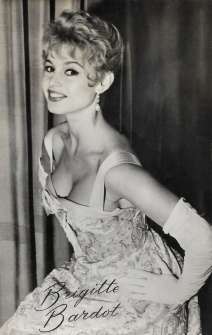
Brigitte Bardot
Dutch postcard by Uitg. Takken, Utrecht, no. AX 350.French actress Brigitte Bardot (1934) died on 28 December 2025, at the age of 91. In the 1950s, she was the sex kitten of the European film industry. BB starred in 48 films, performed in numerous musical shows, and recorded 80 songs. After her retirement in 1973, she became an animal rights activist. In the coming weeks, we will continue to post a BB postcard every day to remember her as she once was.Brigitte Bardot was born in Paris in 1934. Her father, Louis Bardot, had an engineering degree and worked with his father in the family business. Her mother, Ann-Marie Mucel, was 14 years younger than Brigitte's father, and they married in 1933. Brigitte's mother encouraged her daughter to take up music and dance. At the age of 13, she entered the Conservatoire Nationale de Danse to study ballet. By the time she was 15, Brigitte was trying to launch a modelling career and found herself on the cover of the French magazine Elle in May 1949. Her incredible beauty was readily apparent, and Brigitte was noticed by Roger Vadim, then an assistant to the film director Marc Allegrét. Vadim was infatuated with Bardot and encouraged her to start working as a film actress. BB was 18 when she debuted in the comedy Le Trou Normand / Crazy for Love (Jean Boyer, 1952). In the same year, she married Vadim. Brigitte wanted to marry him when she was 17, but her parents quashed any marriage plans until she turned 18. In April 1953, she attended the Cannes Film Festival, where she received massive media attention. She soon was every man's idea of the girl he'd like to meet in Paris. From 1952 to 1956, she appeared in seventeen films. Her films were generally lightweight romantic dramas in which she was cast as an ingénue or siren, often with an element of undress. In 1953, she made her first US production, Un acte d'amour / Act of Love (Anatole Litvak, 1953) with Kirk Douglas, but she continued to make films in France.Roger Vadim was not content with the light fare his wife was offered. He felt Brigitte Bardot was being undersold. Looking for something more like an art film to push her as a serious actress, he showcased her in Et Dieu créa la femme / ...And God Created Woman (Roger Vadim, 1956). This film, about an immoral teenager in a respectable small-town setting, was a smash success on both sides of the Atlantic. Craig Butler at AllMovie: "It's easy enough to say that ...And God Created Woman is much more important for its historical significance than for its actual quality as a film, and that's true to an extent. The immense popularity, due to its willingness to directly embrace an exploration of sex as well as its willingness to show a degree of nudity that was remarkably daring for its day, demonstrated that audiences were willing to view subject matter that was considered too racy for the average moviegoer. This had both positive (freedom to explore, especially for the French filmmakers of the time) and negative (freedom to exploit) consequences, but its impact is undeniable. It's also true that Woman is not a great work of art, not with a story that is ultimately rather thin, some painful dialogue, and an attitude toward its characters and their sexuality that is unclear and inconsistent. Yet Woman is still fascinating, due in no small part to the presence of Brigitte Bardot in the role that made her an international star and sex symbol. She's not demonstrating great acting here, although her performance is actually good and much better than necessary, and her legendary mambo scene at the climax is nothing short of sensational." During the filming of Et Dieu créa la femme / And God Created Woman (Roger Vadim, 1956), directed by her husband, Brigitte Bardot had an affair with her co-star, Jean-Louis Trintignant, who at the time was married to French actress Stéphane Audran. Her divorce from Vadim followed, but they remained friends and collaborated in later work.Et Dieu créa la femme / ...And God Created Woman (Roger Vadim, 1956) helped Brigitte Bardot's international status. The film took the USA by storm, her explosive sexuality being unlike anything seen in the States since the days of the 'flapper' in the 1920s. It gave rise to the phrase 'sex kitten', and fascination with her in America consisted of magazine photographs and dubbed over French films - good, bad or indifferent, her films drew audiences - mainly men - into theatres like lemmings. BB appeared in light comedies like Doctor at Large (Ralph Thomas, 1957) - the third of the British 'Doctor' series starring Dirk Bogarde - and Une Parisienne / La Parisienne (Michel Boisrond, 1957), which suited her acting skills best. However, she was a sensation in the crime drama En cas de malheur / Love is My Profession (Claude Autant-Lara, 1958). Hal Erickson at AllMovie: "This Brigitte Bardot vehicle ran into stiff opposition from the Catholic Legion of Decency, severely limiting its U.S. distribution. Bardot plays a nubile small-time thief named Yvette, who becomes the mistress of influential defence attorney Andre (Jean Gabin). Though Andre can shower Yvette with jewels and furs, he cannot "buy" her heart, and thus it is that it belongs to handsome young student Mazzetti (Franco Interlenghi). Alas, Yvette is no judge of human nature: attractive though Mazzetti can be, he has a dangerous and deadly side. En Cas de Malheur contains a nude scene that has since been reprinted in freeze-frame form innumerable times by both film-history books and girlie magazines." Photographer Sam Lévin's photos contributed considerably to her image of sensuality and slight immorality. One of Lévin's pictures shows Brigitte, dressed in a white corset. It is said that around 1960, postcards with this photograph outsold in Paris those of the Eiffel Tower.Brigitte Bardot divorced Vadim in 1957, and in 1959 she married actor Jacques Charrier, with whom she starred in Babette s'en va-t-en guerre / Babette Goes to War (Christian-Jaque, 1959). The paparazzi preyed upon her marriage, while she and her husband clashed over the direction of her career
Her films became more substantial, but this brought a heavy pressure of dual celebrity as she sought critical acclaim while remaining a glamour model for most of the world. Vie privée / Private Life (1962), directed by Louis Malle, has more than an element of autobiography in it. James Travers at French Films: "Brigitte Bardot hadn’t quite reached the high point of her career when she agreed to make this film with high-profile New Wave film director Louis Malle. Even so, the pressure of being a living icon was obviously beginning to get to France’s sex goddess, and Vie privée is as much an attempt by Bardot to come to terms with her celebrity as anything else. Malle is clearly fascinated by Bardot, and the documentary approach he adopts for this film reinforces the impression that it is more a biography of the actress than a work of fiction. Of course, it’s not entirely biographical, but the story is remarkably close to Bardot’s own life and comes pretty close to predicting how her career would end." The scene in which, returning to her apartment, Bardot's character is harangued in the elevator by a middle-aged cleaning lady calling her offensive names was based on an actual incident, and is a resonant image of celebrity in the mid-20th century. Soon afterwards, Bardot withdrew to the seclusion of Southern France.Brigitte Bardot's other husbands were German millionaire Playboy Gunter Sachs and right-wing politician Bernard d'Ormale. She is reputed to have had relationships with many other men, including Samy Frey, her co-star in La Vérité / The Truth (Henri-Georges Clouzot, 1960), and musicians Serge Gainsbourg and Sacha Distel. In 1963, Brigitte Bardot starred in Jean-Luc Godard's critically acclaimed film Le Mépris / Contempt (Jean-Luc Godard, 1963) opposite Michel Piccoli. She was also featured along with such notable actors as Alain Delon in Amours célèbres / Famous Love Affairs (Michel Boisrond, 1961) and Histoires extraordinaires /Tales of Mystery (Louis Malle, 1968), Jeanne Moreau in Viva Maria! (Louis Malle, 1965), Sean Connery in Shalako (Edward Dmytryk, 1968), and Claudia Cardinale in Les Pétroleuses / Petroleum Girls (Christian-Jaque, 1971). She participated in various musical shows and recorded many popular songs in the 1960s and 1970s, mostly in collaboration with Serge Gainsbourg, Bob Zagury and Sacha Distel, including 'Harley Davidson', 'Le Soleil De Ma Vie' (the cover of Stevie Wonder's 'You Are the Sunshine of My Life') and the notorious 'Je t'aime... moi non plus'.Brigitte Bardot’s film career showed a steady decline in the late 1960s and early 1970s. In 1973, just before her fortieth birthday, she announced her retirement. She chose to use her fame to promote animal rights. In 1976, she established the Brigitte Bardot Foundation for the Welfare and Protection of Animals. She became a vegetarian and raised three million French francs to fund the foundation by auctioning off jewellery and many personal belongings. For this work, she was awarded the Légion d’honneur in 1984. During the 1990s, she was also outspoken in her criticism of immigration, interracial relationships, Islam in France and homosexuality. Her husband Bernard d'Ormal was a former adviser of the far-right Front National party. Bardot has been convicted five times for 'inciting racial hatred'. More fun is that Bardot is recognised for popularising bikini swimwear, in such early films as Manina / Woman without a Veil (Willy Rozier, 1952), in her appearances at Cannes and in many photo shoots. Bardot also brought into fashion the 'choucroute' ('Sauerkraut') hairstyle (a sort of beehive hairstyle) and gingham clothes after wearing a checkered pink dress, designed by Jacques Esterel, at her wedding to Charrier. The fashions of the 1960s looked effortlessly right and spontaneous on her. Time Magazine: "She is the princess of pout, the countess of come hither. Brigitte Bardot exuded a carefree, naïve sexuality that brought a whole new audience to French films."Sources: Denny Jackson (IMDb), Hal Erickson (AllMovie), Craig Butler (AllMovie), James Travers (French Films), French Films, Wikipedia and IMDb.And please check out our blog European Film Star Postcards.
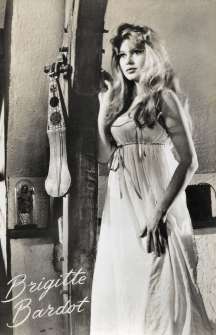
Brigitte Bardot in Une Parisienne (1957)
Dutch postcard, no. AX 4004. Photo: N.V. City Film, Den Haag. Brigitte Bardot in Une Parisienne / The Parisian (Michel Boisrond, 1957).French actress Brigitte Bardot (1934) died on 28 December 2025, at the age of 91. In the 1950s, she was the sex kitten of the European film industry. BB starred in 48 films, performed in numerous musical shows, and recorded 80 songs. After her retirement in 1973, she became an animal rights activist. In the coming weeks, we will continue to post a BB postcard every day to remember her as she once was.Brigitte Bardot was born in Paris in 1934. Her father, Louis Bardot, had an engineering degree and worked with his father in the family business. Her mother, Ann-Marie Mucel, was 14 years younger than Brigitte's father, and they married in 1933. Brigitte's mother encouraged her daughter to take up music and dance. At the age of 13, she entered the Conservatoire Nationale de Danse to study ballet. By the time she was 15, Brigitte was trying to launch a modelling career and found herself on the cover of the French magazine Elle in May 1949. Her incredible beauty was readily apparent, and Brigitte was noticed by Roger Vadim, then an assistant to the film director Marc Allegrét. Vadim was infatuated with Bardot and encouraged her to start working as a film actress. BB was 18 when she debuted in the comedy Le Trou Normand / Crazy for Love (Jean Boyer, 1952). In the same year, she married Vadim. Brigitte wanted to marry him when she was 17, but her parents quashed any marriage plans until she turned 18. In April 1953, she attended the Cannes Film Festival, where she received massive media attention. She soon was every man's idea of the girl he'd like to meet in Paris. From 1952 to 1956, she appeared in seventeen films. Her films were generally lightweight romantic dramas in which she was cast as an ingénue or siren, often with an element of undress. In 1953, she made her first US production, Un acte d'amour / Act of Love (Anatole Litvak, 1953) with Kirk Douglas, but she continued to make films in France.Roger Vadim was not content with the light fare his wife was offered. He felt Brigitte Bardot was being undersold. Looking for something more like an art film to push her as a serious actress, he showcased her in Et Dieu créa la femme / ...And God Created Woman (Roger Vadim, 1956). This film, about an immoral teenager in a respectable small-town setting, was a smash success on both sides of the Atlantic. Craig Butler at AllMovie: "It's easy enough to say that ...And God Created Woman is much more important for its historical significance than for its actual quality as a film, and that's true to an extent. The immense popularity, due to its willingness to directly embrace an exploration of sex as well as its willingness to show a degree of nudity that was remarkably daring for its day, demonstrated that audiences were willing to view subject matter that was considered too racy for the average moviegoer. This had both positive (freedom to explore, especially for the French filmmakers of the time) and negative (freedom to exploit) consequences, but its impact is undeniable. It's also true that Woman is not a great work of art, not with a story that is ultimately rather thin, some painful dialogue, and an attitude toward its characters and their sexuality that is unclear and inconsistent. Yet Woman is still fascinating, due in no small part to the presence of Brigitte Bardot in the role that made her an international star and sex symbol. She's not demonstrating great acting here, although her performance is actually good and much better than necessary, and her legendary mambo scene at the climax is nothing short of sensational." During the filming of Et Dieu créa la femme / And God Created Woman (Roger Vadim, 1956), directed by her husband, Brigitte Bardot had an affair with her co-star, Jean-Louis Trintignant, who at the time was married to French actress Stéphane Audran. Her divorce from Vadim followed, but they remained friends and collaborated in later work.Et Dieu créa la femme / ...And God Created Woman (Roger Vadim, 1956) helped Brigitte Bardot's international status. The film took the USA by storm, her explosive sexuality being unlike anything seen in the States since the days of the 'flapper' in the 1920s. It gave rise to the phrase 'sex kitten', and fascination with her in America consisted of magazine photographs and dubbed over French films - good, bad or indifferent, her films drew audiences - mainly men - into theatres like lemmings. BB appeared in light comedies like Doctor at Large (Ralph Thomas, 1957) - the third of the British 'Doctor' series starring Dirk Bogarde - and Une Parisienne / La Parisienne (Michel Boisrond, 1957), which suited her acting skills best. However, she was a sensation in the crime drama En cas de malheur / Love is My Profession (Claude Autant-Lara, 1958). Hal Erickson at AllMovie: "This Brigitte Bardot vehicle ran into stiff opposition from the Catholic Legion of Decency, severely limiting its U.S. distribution. Bardot plays a nubile small-time thief named Yvette, who becomes the mistress of influential defence attorney Andre (Jean Gabin). Though Andre can shower Yvette with jewels and furs, he cannot "buy" her heart, and thus it is that it belongs to handsome young student Mazzetti (Franco Interlenghi). Alas, Yvette is no judge of human nature: attractive though Mazzetti can be, he has a dangerous and deadly side. En Cas de Malheur contains a nude scene that has since been reprinted in freeze-frame form innumerable times by both film-history books and girlie magazines." Photographer Sam Lévin's photos contributed considerably to her image of sensuality and slight immorality. One of Lévin's pictures shows Brigitte, dressed in a white corset. It is said that around 1960, postcards with this photograph outsold in Paris those of the Eiffel Tower.Brigitte Bardot divorced Vadim in 1957, and in 1959 she married actor Jacques Charrier, with whom she starred in Babette s'en va-t-en guerre / Babette Goes to War (Christian-Jaque, 1959). The paparazzi preyed upon her marriage, while she and her husband clashed over the direction of her career
Her films became more substantial, but this brought a heavy pressure of dual celebrity as she sought critical acclaim while remaining a glamour model for most of the world. Vie privée / Private Life (1962), directed by Louis Malle, has more than an element of autobiography in it. James Travers at French Films: "Brigitte Bardot hadn’t quite reached the high point of her career when she agreed to make this film with high-profile New Wave film director Louis Malle. Even so, the pressure of being a living icon was obviously beginning to get to France’s sex goddess, and Vie privée is as much an attempt by Bardot to come to terms with her celebrity as anything else. Malle is clearly fascinated by Bardot, and the documentary approach he adopts for this film reinforces the impression that it is more a biography of the actress than a work of fiction. Of course, it’s not entirely biographical, but the story is remarkably close to Bardot’s own life and comes pretty close to predicting how her career would end." The scene in which, returning to her apartment, Bardot's character is harangued in the elevator by a middle-aged cleaning lady calling her offensive names was based on an actual incident, and is a resonant image of celebrity in the mid-20th century. Soon afterwards, Bardot withdrew to the seclusion of Southern France.Brigitte Bardot's other husbands were German millionaire Playboy Gunter Sachs and right-wing politician Bernard d'Ormale. She is reputed to have had relationships with many other men, including Samy Frey, her co-star in La Vérité / The Truth (Henri-Georges Clouzot, 1960), and musicians Serge Gainsbourg and Sacha Distel. In 1963, Brigitte Bardot starred in Jean-Luc Godard's critically acclaimed film Le Mépris / Contempt (Jean-Luc Godard, 1963) opposite Michel Piccoli. She was also featured along with such notable actors as Alain Delon in Amours célèbres / Famous Love Affairs (Michel Boisrond, 1961) and Histoires extraordinaires /Tales of Mystery (Louis Malle, 1968), Jeanne Moreau in Viva Maria! (Louis Malle, 1965), Sean Connery in Shalako (Edward Dmytryk, 1968), and Claudia Cardinale in Les Pétroleuses / Petroleum Girls (Christian-Jaque, 1971). She participated in various musical shows and recorded many popular songs in the 1960s and 1970s, mostly in collaboration with Serge Gainsbourg, Bob Zagury and Sacha Distel, including 'Harley Davidson', 'Le Soleil De Ma Vie' (the cover of Stevie Wonder's 'You Are the Sunshine of My Life') and the notorious 'Je t'aime... moi non plus'.Brigitte Bardot’s film career showed a steady decline in the late 1960s and early 1970s. In 1973, just before her fortieth birthday, she announced her retirement. She chose to use her fame to promote animal rights. In 1976, she established the Brigitte Bardot Foundation for the Welfare and Protection of Animals. She became a vegetarian and raised three million French francs to fund the foundation by auctioning off jewellery and many personal belongings. For this work, she was awarded the Légion d’honneur in 1984. During the 1990s, she was also outspoken in her criticism of immigration, interracial relationships, Islam in France and homosexuality. Her husband Bernard d'Ormal was a former adviser of the far-right Front National party. Bardot has been convicted five times for 'inciting racial hatred'. More fun is that Bardot is recognised for popularising bikini swimwear, in such early films as Manina / Woman without a Veil (Willy Rozier, 1952), in her appearances at Cannes and in many photo shoots. Bardot also brought into fashion the 'choucroute' ('Sauerkraut') hairstyle (a sort of beehive hairstyle) and gingham clothes after wearing a checkered pink dress, designed by Jacques Esterel, at her wedding to Charrier. The fashions of the 1960s looked effortlessly right and spontaneous on her. Time Magazine: "She is the princess of pout, the countess of come hither. Brigitte Bardot exuded a carefree, naïve sexuality that brought a whole new audience to French films."Sources: Denny Jackson (IMDb), Hal Erickson (AllMovie), Craig Butler (AllMovie), James Travers (French Films), French Films, Wikipedia and IMDb.And please check out our blog European Film Star Postcards.
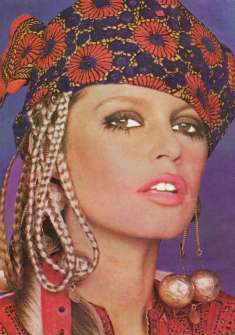
Brigitte Bardot
Romanian postcard by Casa Filmului Acin, no. 378.French actress Brigitte Bardot (1934) died on 28 December 2025, at the age of 91. In the 1950s, she was the sex kitten of the European film industry. BB starred in 48 films, performed in numerous musical shows, and recorded 80 songs. After her retirement in 1973, she became an animal rights activist. In the coming weeks, we will continue to post a BB postcard every day to remember her as she once was.Brigitte Bardot was born in Paris in 1934. Her father, Louis Bardot, had an engineering degree and worked with his father in the family business. Her mother, Ann-Marie Mucel, was 14 years younger than Brigitte's father, and they married in 1933. Brigitte's mother encouraged her daughter to take up music and dance. At the age of 13, she entered the Conservatoire Nationale de Danse to study ballet. By the time she was 15, Brigitte was trying to launch a modelling career and found herself on the cover of the French magazine Elle in May 1949. Her incredible beauty was readily apparent, and Brigitte was noticed by Roger Vadim, then an assistant to the film director Marc Allegrét. Vadim was infatuated with Bardot and encouraged her to start working as a film actress. BB was 18 when she debuted in the comedy Le Trou Normand / Crazy for Love (Jean Boyer, 1952). In the same year, she married Vadim. Brigitte wanted to marry him when she was 17, but her parents quashed any marriage plans until she turned 18. In April 1953, she attended the Cannes Film Festival, where she received massive media attention. She soon was every man's idea of the girl he'd like to meet in Paris. From 1952 to 1956, she appeared in seventeen films. Her films were generally lightweight romantic dramas in which she was cast as an ingénue or siren, often with an element of undress. In 1953, she made her first US production, Un acte d'amour / Act of Love (Anatole Litvak, 1953) with Kirk Douglas, but she continued to make films in France.Roger Vadim was not content with the light fare his wife was offered. He felt Brigitte Bardot was being undersold. Looking for something more like an art film to push her as a serious actress, he showcased her in Et Dieu créa la femme / ...And God Created Woman (Roger Vadim, 1956). This film, about an immoral teenager in a respectable small-town setting, was a smash success on both sides of the Atlantic. Craig Butler at AllMovie: "It's easy enough to say that ...And God Created Woman is much more important for its historical significance than for its actual quality as a film, and that's true to an extent. The immense popularity, due to its willingness to directly embrace an exploration of sex as well as its willingness to show a degree of nudity that was remarkably daring for its day, demonstrated that audiences were willing to view subject matter that was considered too racy for the average moviegoer. This had both positive (freedom to explore, especially for the French filmmakers of the time) and negative (freedom to exploit) consequences, but its impact is undeniable. It's also true that Woman is not a great work of art, not with a story that is ultimately rather thin, some painful dialogue, and an attitude toward its characters and their sexuality that is unclear and inconsistent. Yet Woman is still fascinating, due in no small part to the presence of Brigitte Bardot in the role that made her an international star and sex symbol. She's not demonstrating great acting here, although her performance is actually good and much better than necessary, and her legendary mambo scene at the climax is nothing short of sensational." During the shooting of Et Dieu créa la femme / And God Created Woman (Roger Vadim, 1956), directed by her husband, Brigitte Bardot had an affair with her co-star Jean-Louis Trintignant, who at that time was married to French actress Stéphane Audran. Her divorce from Vadim followed, but they remained friends and collaborated in later work.Et Dieu créa la femme / ...And God Created Woman (Roger Vadim, 1956) helped Brigitte Bardot's international status. The film took the USA by storm, her explosive sexuality being unlike anything seen in the States since the days of the 'flapper' in the 1920s. It gave rise to the phrase 'sex kitten', and fascination with her in America consisted of magazine photographs and dubbed over French films - good, bad or indifferent, her films drew audiences - mainly men - into theatres like lemmings. BB appeared in light comedies like Doctor at Large (Ralph Thomas, 1957) - the third of the British 'Doctor' series starring Dirk Bogarde - and Une Parisienne / La Parisienne (Michel Boisrond, 1957), which suited her acting skills best. However, she was a sensation in the crime drama En cas de malheur / Love is My Profession (Claude Autant-Lara, 1958). Hal Erickson at AllMovie: "This Brigitte Bardot vehicle ran into stiff opposition from the Catholic Legion of Decency, severely limiting its U.S. distribution. Bardot plays a nubile small-time thief named Yvette, who becomes the mistress of influential defence attorney Andre (Jean Gabin). Though Andre can shower Yvette with jewels and furs, he cannot "buy" her heart, and thus it is that it belongs to handsome young student Mazzetti (Franco Interlenghi). Alas, Yvette is no judge of human nature: attractive though Mazzetti can be, he has a dangerous and deadly side. En Cas de Malheur contains a nude scene that has since been reprinted in freeze-frame form innumerable times by both film-history books and girlie magazines." Photographer Sam Lévin's photos contributed considerably to her image of sensuality and slight immorality. One of Lévin's pictures shows Brigitte, dressed in a white corset. It is said that around 1960, postcards with this photograph outsold in Paris those of the Eiffel Tower.Brigitte Bardot divorced Vadim in 1957, and in 1959 she married actor Jacques Charrier, with whom she starred in Babette s'en va-t-en guerre / Babette Goes to War (Christian-Jaque, 1959). The paparazzi preyed upon her marriage, while she and her husband clashed over the direction of her career
Her films became more substantial, but this brought a heavy pressure of dual celebrity as she sought critical acclaim while remaining a glamour model for most of the world. Vie privée / Private Life (1962), directed by Louis Malle, has more than an element of autobiography in it. James Travers at French Films: "Brigitte Bardot hadn’t quite reached the high point of her career when she agreed to make this film with high-profile New Wave film director Louis Malle. Even so, the pressure of being a living icon was obviously beginning to get to France’s sex goddess, and Vie privée is as much an attempt by Bardot to come to terms with her celebrity as anything else. Malle is clearly fascinated by Bardot, and the documentary approach he adopts for this film reinforces the impression that it is more a biography of the actress than a work of fiction. Of course, it’s not entirely biographical, but the story is remarkably close to Bardot’s own life and comes pretty close to predicting how her career would end." The scene in which, returning to her apartment, Bardot's character is harangued in the elevator by a middle-aged cleaning lady calling her offensive names was based on an actual incident, and is a resonant image of celebrity in the mid-20th century. Soon afterwards, Bardot withdrew to the seclusion of Southern France.Brigitte Bardot's other husbands were German millionaire Playboy Gunter Sachs and right-wing politician Bernard d'Ormale. She is reputed to have had relationships with many other men, including Samy Frey, her co-star in La Vérité / The Truth (Henri-Georges Clouzot, 1960), and musicians Serge Gainsbourg and Sacha Distel. In 1963, Brigitte Bardot starred in Jean-Luc Godard's critically acclaimed film Le Mépris / Contempt (Jean-Luc Godard, 1963) opposite Michel Piccoli. She was also featured along with such notable actors as Alain Delon in Amours célèbres / Famous Love Affairs (Michel Boisrond, 1961) and Histoires extraordinaires /Tales of Mystery (Louis Malle, 1968), Jeanne Moreau in Viva Maria! (Louis Malle, 1965), Sean Connery in Shalako (Edward Dmytryk, 1968), and Claudia Cardinale in Les Pétroleuses / Petroleum Girls (Christian-Jaque, 1971). She participated in various musical shows and recorded many popular songs in the 1960s and 1970s, mostly in collaboration with Serge Gainsbourg, Bob Zagury and Sacha Distel, including 'Harley Davidson', 'Le Soleil De Ma Vie' (the cover of Stevie Wonder's 'You Are the Sunshine of My Life') and the notorious 'Je t'aime... moi non plus'.Brigitte Bardot’s film career showed a steady decline in the late 1960s and early 1970s. In 1973, just before her fortieth birthday, she announced her retirement. She chose to use her fame to promote animal rights. In 1976, she established the Brigitte Bardot Foundation for the Welfare and Protection of Animals. She became a vegetarian and raised three million French francs to fund the foundation by auctioning off jewellery and many personal belongings. For this work, she was awarded the Légion d’honneur in 1984. During the 1990s, she was also outspoken in her criticism of immigration, interracial relationships, Islam in France and homosexuality. Her husband Bernard d'Ormal was a former adviser of the far-right Front National party. Bardot has been convicted five times for 'inciting racial hatred'. More fun is that Bardot is recognised for popularising bikini swimwear, in such early films as Manina / Woman without a Veil (Willy Rozier, 1952), in her appearances at Cannes and in many photo shoots. Bardot also brought into fashion the 'choucroute' ('Sauerkraut') hairstyle (a sort of beehive hairstyle) and gingham clothes after wearing a checkered pink dress, designed by Jacques Esterel, at her wedding to Charrier. The fashions of the 1960s looked effortlessly right and spontaneous on her. Time Magazine: "She is the princess of pout, the countess of come hither. Brigitte Bardot exuded a carefree, naïve sexuality that brought a whole new audience to French films."Sources: Denny Jackson (IMDb), Hal Erickson (AllMovie), Craig Butler (AllMovie), James Travers (French Films), French Films, Wikipedia and IMDb.And please check out our blog European Film Star Postcards.
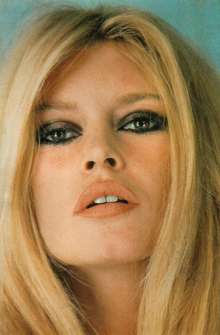
Brigitte Bardot
French postcard by Editions Lyna, Paris, offered by Corvisart, Epinal, no. 2085. Photo: Sam Lévin.French actress Brigitte Bardot (1934) died on 28 December 2025, at the age of 91. In the 1950s, she was the sex kitten of the European film industry. BB starred in 48 films, performed in numerous musical shows, and recorded 80 songs. After her retirement in 1973, she became an animal rights activist. In the coming weeks, we will continue to post a BB postcard every day to remember her as she once was.Brigitte Bardot was born in Paris in 1934. Her father, Louis Bardot, had an engineering degree and worked with his father in the family business. Her mother, Ann-Marie Mucel, was 14 years younger than Brigitte's father, and they married in 1933. Brigitte's mother encouraged her daughter to take up music and dance. At the age of 13, she entered the Conservatoire Nationale de Danse to study ballet. By the time she was 15, Brigitte was trying to launch a modelling career and found herself on the cover of the French magazine Elle in May 1949. Her incredible beauty was readily apparent, and Brigitte was noticed by Roger Vadim, then an assistant to the film director Marc Allegrét. Vadim was infatuated with Bardot and encouraged her to start working as a film actress. BB was 18 when she debuted in the comedy Le Trou Normand / Crazy for Love (Jean Boyer, 1952). In the same year, she married Vadim. Brigitte wanted to marry him when she was 17, but her parents quashed any marriage plans until she turned 18. In April 1953, she attended the Cannes Film Festival, where she received massive media attention. She soon was every man's idea of the girl he'd like to meet in Paris. From 1952 to 1956, she appeared in seventeen films. Her films were generally lightweight romantic dramas in which she was cast as an ingénue or siren, often with an element of undress. In 1953, she made her first US production, Un acte d'amour / Act of Love (Anatole Litvak, 1953) with Kirk Douglas, but she continued to make films in France.Roger Vadim was not content with the light fare his wife was offered. He felt Brigitte Bardot was being undersold. Looking for something more like an art film to push her as a serious actress, he showcased her in Et Dieu créa la femme / ...And God Created Woman (Roger Vadim, 1956). This film, about an immoral teenager in a respectable small-town setting, was a smash success on both sides of the Atlantic. Craig Butler at AllMovie: "It's easy enough to say that ...And God Created Woman is much more important for its historical significance than for its actual quality as a film, and that's true to an extent. The immense popularity, due to its willingness to directly embrace an exploration of sex as well as its willingness to show a degree of nudity that was remarkably daring for its day, demonstrated that audiences were willing to view subject matter that was considered too racy for the average moviegoer. This had both positive (freedom to explore, especially for the French filmmakers of the time) and negative (freedom to exploit) consequences, but its impact is undeniable. It's also true that Woman is not a great work of art, not with a story that is ultimately rather thin, some painful dialogue, and an attitude toward its characters and their sexuality that is unclear and inconsistent. Yet Woman is still fascinating, due in no small part to the presence of Brigitte Bardot in the role that made her an international star and sex symbol. She's not demonstrating great acting here, although her performance is actually good and much better than necessary, and her legendary mambo scene at the climax is nothing short of sensational." During the shooting of Et Dieu créa la femme / And God Created Woman (Roger Vadim, 1956), directed by her husband, Brigitte Bardot had an affair with her co-star Jean-Louis Trintignant, who at that time was married to French actress Stéphane Audran. Her divorce from Vadim followed, but they remained friends and collaborated in later work.Et Dieu créa la femme / ...And God Created Woman (Roger Vadim, 1956) helped Brigitte Bardot's international status. The film took the USA by storm, her explosive sexuality being unlike anything seen in the States since the days of the 'flapper' in the 1920s. It gave rise to the phrase 'sex kitten', and fascination with her in America consisted of magazine photographs and dubbed over French films - good, bad or indifferent, her films drew audiences - mainly men - into theatres like lemmings. BB appeared in light comedies like Doctor at Large (Ralph Thomas, 1957) - the third of the British 'Doctor' series starring Dirk Bogarde - and Une Parisienne / La Parisienne (Michel Boisrond, 1957), which suited her acting skills best. However, she was a sensation in the crime drama En cas de malheur / Love is My Profession (Claude Autant-Lara, 1958). Hal Erickson at AllMovie: "This Brigitte Bardot vehicle ran into stiff opposition from the Catholic Legion of Decency, severely limiting its U.S. distribution. Bardot plays a nubile small-time thief named Yvette, who becomes the mistress of influential defence attorney Andre (Jean Gabin). Though Andre can shower Yvette with jewels and furs, he cannot "buy" her heart, and thus it is that it belongs to handsome young student Mazzetti (Franco Interlenghi). Alas, Yvette is no judge of human nature: attractive though Mazzetti can be, he has a dangerous and deadly side. En Cas de Malheur contains a nude scene that has since been reprinted in freeze-frame form innumerable times by both film-history books and girlie magazines." Photographer Sam Lévin's photos contributed considerably to her image of sensuality and slight immorality. One of Lévin's pictures shows Brigitte, dressed in a white corset. It is said that around 1960, postcards with this photograph outsold in Paris those of the Eiffel Tower.Brigitte Bardot divorced Vadim in 1957, and in 1959 she married actor Jacques Charrier, with whom she starred in Babette s'en va-t-en guerre / Babette Goes to War (Christian-Jaque, 1959). The paparazzi preyed upon her marriage, while she and her husband clashed over the direction of her career
Her films became more substantial, but this brought a heavy pressure of dual celebrity as she sought critical acclaim while remaining a glamour model for most of the world. Vie privée / Private Life (1962), directed by Louis Malle, has more than an element of autobiography in it. James Travers at French Films: "Brigitte Bardot hadn’t quite reached the high point of her career when she agreed to make this film with high-profile New Wave film director Louis Malle. Even so, the pressure of being a living icon was obviously beginning to get to France’s sex goddess, and Vie privée is as much an attempt by Bardot to come to terms with her celebrity as anything else. Malle is clearly fascinated by Bardot, and the documentary approach he adopts for this film reinforces the impression that it is more a biography of the actress than a work of fiction. Of course, it’s not entirely biographical, but the story is remarkably close to Bardot’s own life and comes pretty close to predicting how her career would end." The scene in which, returning to her apartment, Bardot's character is harangued in the elevator by a middle-aged cleaning lady calling her offensive names was based on an actual incident, and is a resonant image of celebrity in the mid-20th century. Soon afterwards, Bardot withdrew to the seclusion of Southern France.Brigitte Bardot's other husbands were German millionaire Playboy Gunter Sachs and right-wing politician Bernard d'Ormale. She is reputed to have had relationships with many other men, including Samy Frey, her co-star in La Vérité / The Truth (Henri-Georges Clouzot, 1960), and musicians Serge Gainsbourg and Sacha Distel. In 1963, Brigitte Bardot starred in Jean-Luc Godard's critically acclaimed film Le Mépris / Contempt (Jean-Luc Godard, 1963) opposite Michel Piccoli. She was also featured along with such notable actors as Alain Delon in Amours célèbres / Famous Love Affairs (Michel Boisrond, 1961) and Histoires extraordinaires /Tales of Mystery (Louis Malle, 1968), Jeanne Moreau in Viva Maria! (Louis Malle, 1965), Sean Connery in Shalako (Edward Dmytryk, 1968), and Claudia Cardinale in Les Pétroleuses / Petroleum Girls (Christian-Jaque, 1971). She participated in various musical shows and recorded many popular songs in the 1960s and 1970s, mostly in collaboration with Serge Gainsbourg, Bob Zagury and Sacha Distel, including 'Harley Davidson', 'Le Soleil De Ma Vie' (the cover of Stevie Wonder's 'You Are the Sunshine of My Life') and the notorious 'Je t'aime... moi non plus'.Brigitte Bardot’s film career showed a steady decline in the late 1960s and early 1970s. In 1973, just before her fortieth birthday, she announced her retirement. She chose to use her fame to promote animal rights. In 1976, she established the Brigitte Bardot Foundation for the Welfare and Protection of Animals. She became a vegetarian and raised three million French francs to fund the foundation by auctioning off jewellery and many personal belongings. For this work, she was awarded the Légion d’honneur in 1984. During the 1990s, she was also outspoken in her criticism of immigration, interracial relationships, Islam in France and homosexuality. Her husband Bernard d'Ormal was a former adviser of the far-right Front National party. Bardot has been convicted five times for 'inciting racial hatred'. More fun is that Bardot is recognised for popularising bikini swimwear, in such early films as Manina / Woman without a Veil (Willy Rozier, 1952), in her appearances at Cannes and in many photo shoots. Bardot also brought into fashion the 'choucroute' ('Sauerkraut') hairstyle (a sort of beehive hairstyle) and gingham clothes after wearing a checkered pink dress, designed by Jacques Esterel, at her wedding to Charrier. The fashions of the 1960s looked effortlessly right and spontaneous on her. Time Magazine: "She is the princess of pout, the countess of come hither. Brigitte Bardot exuded a carefree, naïve sexuality that brought a whole new audience to French films."Sources: Denny Jackson (IMDb), Hal Erickson (AllMovie), Craig Butler (AllMovie), James Travers (French Films), French Films, Wikipedia and IMDb.And please check out our blog European Film Star Postcards.

Brigitte Bardot
French postcard by E.D.U.G., offered by Corvisart, Epinal, no. 264. Photo: Sam Lévin.French actress Brigitte Bardot (1934) died on 28 December 2025, at the age of 91. In the 1950s, she was the sex kitten of the European film industry. BB starred in 48 films, performed in numerous musical shows, and recorded 80 songs. After her retirement in 1973, she became an animal rights activist. In the coming weeks, we will continue to post a BB postcard every day to remember her as she once was.Brigitte Bardot was born in Paris in 1934. Her father, Louis Bardot, had an engineering degree and worked with his father in the family business. Her mother, Ann-Marie Mucel, was 14 years younger than Brigitte's father, and they married in 1933. Brigitte's mother encouraged her daughter to take up music and dance. At the age of 13, she entered the Conservatoire Nationale de Danse to study ballet. By the time she was 15, Brigitte was trying to launch a modelling career and found herself on the cover of the French magazine Elle in May 1949. Her incredible beauty was readily apparent, and Brigitte was noticed by Roger Vadim, then an assistant to the film director Marc Allegrét. Vadim was infatuated with Bardot and encouraged her to start working as a film actress. BB was 18 when she debuted in the comedy Le Trou Normand / Crazy for Love (Jean Boyer, 1952). In the same year, she married Vadim. Brigitte wanted to marry him when she was 17, but her parents quashed any marriage plans until she turned 18. In April 1953, she attended the Cannes Film Festival, where she received massive media attention. She soon was every man's idea of the girl he'd like to meet in Paris. From 1952 to 1956, she appeared in seventeen films. Her films were generally lightweight romantic dramas in which she was cast as an ingénue or siren, often with an element of undress. In 1953, she made her first US production, Un acte d'amour / Act of Love (Anatole Litvak, 1953) with Kirk Douglas, but she continued to make films in France.Roger Vadim was not content with the light fare his wife was offered. He felt Brigitte Bardot was being undersold. Looking for something more like an art film to push her as a serious actress, he showcased her in Et Dieu créa la femme / ...And God Created Woman (Roger Vadim, 1956). This film, about an immoral teenager in a respectable small-town setting, was a smash success on both sides of the Atlantic. Craig Butler at AllMovie: "It's easy enough to say that ...And God Created Woman is much more important for its historical significance than for its actual quality as a film, and that's true to an extent. The immense popularity, due to its willingness to directly embrace an exploration of sex as well as its willingness to show a degree of nudity that was remarkably daring for its day, demonstrated that audiences were willing to view subject matter that was considered too racy for the average moviegoer. This had both positive (freedom to explore, especially for the French filmmakers of the time) and negative (freedom to exploit) consequences, but its impact is undeniable. It's also true that Woman is not a great work of art, not with a story that is ultimately rather thin, some painful dialogue, and an attitude toward its characters and their sexuality that is unclear and inconsistent. Yet Woman is still fascinating, due in no small part to the presence of Brigitte Bardot in the role that made her an international star and sex symbol. She's not demonstrating great acting here, although her performance is actually good and much better than necessary, and her legendary mambo scene at the climax is nothing short of sensational." During the shooting of Et Dieu créa la femme / And God Created Woman (Roger Vadim, 1956), directed by her husband, Brigitte Bardot had an affair with her co-star Jean-Louis Trintignant, who at that time was married to French actress Stéphane Audran. Her divorce from Vadim followed, but they remained friends and collaborated in later work.Et Dieu créa la femme / ...And God Created Woman (Roger Vadim, 1956) helped Brigitte Bardot's international status. The film took the USA by storm, her explosive sexuality being unlike anything seen in the States since the days of the 'flapper' in the 1920s. It gave rise to the phrase 'sex kitten', and fascination with her in America consisted of magazine photographs and dubbed over French films - good, bad or indifferent, her films drew audiences - mainly men - into theatres like lemmings. BB appeared in light comedies like Doctor at Large (Ralph Thomas, 1957) - the third of the British 'Doctor' series starring Dirk Bogarde - and Une Parisienne / La Parisienne (Michel Boisrond, 1957), which suited her acting skills best. However, she was a sensation in the crime drama En cas de malheur / Love is My Profession (Claude Autant-Lara, 1958). Hal Erickson at AllMovie: "This Brigitte Bardot vehicle ran into stiff opposition from the Catholic Legion of Decency, severely limiting its U.S. distribution. Bardot plays a nubile small-time thief named Yvette, who becomes the mistress of influential defence attorney Andre (Jean Gabin). Though Andre can shower Yvette with jewels and furs, he cannot "buy" her heart, and thus it is that it belongs to handsome young student Mazzetti (Franco Interlenghi). Alas, Yvette is no judge of human nature: attractive though Mazzetti can be, he has a dangerous and deadly side. En Cas de Malheur contains a nude scene that has since been reprinted in freeze-frame form innumerable times by both film-history books and girlie magazines." Photographer Sam Lévin's photos contributed considerably to her image of sensuality and slight immorality. One of Lévin's pictures shows Brigitte, dressed in a white corset. It is said that around 1960, postcards with this photograph outsold in Paris those of the Eiffel Tower.Brigitte Bardot divorced Vadim in 1957, and in 1959 she married actor Jacques Charrier, with whom she starred in Babette s'en va-t-en guerre / Babette Goes to War (Christian-Jaque, 1959). The paparazzi preyed upon her marriage, while she and her husband clashed over the direction of her career
Her films became more substantial, but this brought a heavy pressure of dual celebrity as she sought critical acclaim while remaining a glamour model for most of the world. Vie privée / Private Life (1962), directed by Louis Malle, has more than an element of autobiography in it. James Travers at French Films: "Brigitte Bardot hadn’t quite reached the high point of her career when she agreed to make this film with high-profile New Wave film director Louis Malle. Even so, the pressure of being a living icon was obviously beginning to get to France’s sex goddess, and Vie privée is as much an attempt by Bardot to come to terms with her celebrity as anything else. Malle is clearly fascinated by Bardot, and the documentary approach he adopts for this film reinforces the impression that it is more a biography of the actress than a work of fiction. Of course, it’s not entirely biographical, but the story is remarkably close to Bardot’s own life and comes pretty close to predicting how her career would end." The scene in which, returning to her apartment, Bardot's character is harangued in the elevator by a middle-aged cleaning lady calling her offensive names was based on an actual incident, and is a resonant image of celebrity in the mid-20th century. Soon afterwards, Bardot withdrew to the seclusion of Southern France.Brigitte Bardot's other husbands were German millionaire Playboy Gunter Sachs and right-wing politician Bernard d'Ormale. She is reputed to have had relationships with many other men, including Samy Frey, her co-star in La Vérité / The Truth (Henri-Georges Clouzot, 1960), and musicians Serge Gainsbourg and Sacha Distel. In 1963, Brigitte Bardot starred in Jean-Luc Godard's critically acclaimed film Le Mépris / Contempt (Jean-Luc Godard, 1963) opposite Michel Piccoli. She was also featured along with such notable actors as Alain Delon in Amours célèbres / Famous Love Affairs (Michel Boisrond, 1961) and Histoires extraordinaires /Tales of Mystery (Louis Malle, 1968), Jeanne Moreau in Viva Maria! (Louis Malle, 1965), Sean Connery in Shalako (Edward Dmytryk, 1968), and Claudia Cardinale in Les Pétroleuses / Petroleum Girls (Christian-Jaque, 1971). She participated in various musical shows and recorded many popular songs in the 1960s and 1970s, mostly in collaboration with Serge Gainsbourg, Bob Zagury and Sacha Distel, including 'Harley Davidson', 'Le Soleil De Ma Vie' (the cover of Stevie Wonder's 'You Are the Sunshine of My Life') and the notorious 'Je t'aime... moi non plus'.Brigitte Bardot’s film career showed a steady decline in the late 1960s and early 1970s. In 1973, just before her fortieth birthday, she announced her retirement. She chose to use her fame to promote animal rights. In 1976, she established the Brigitte Bardot Foundation for the Welfare and Protection of Animals. She became a vegetarian and raised three million French francs to fund the foundation by auctioning off jewellery and many personal belongings. For this work, she was awarded the Légion d’honneur in 1984. During the 1990s, she was also outspoken in her criticism of immigration, interracial relationships, Islam in France and homosexuality. Her husband Bernard d'Ormal was a former adviser of the far-right Front National party. Bardot has been convicted five times for 'inciting racial hatred'. More fun is that Bardot is recognised for popularising bikini swimwear, in such early films as Manina / Woman without a Veil (Willy Rozier, 1952), in her appearances at Cannes and in many photo shoots. Bardot also brought into fashion the 'choucroute' ('Sauerkraut') hairstyle (a sort of beehive hairstyle) and gingham clothes after wearing a checkered pink dress, designed by Jacques Esterel, at her wedding to Charrier. The fashions of the 1960s looked effortlessly right and spontaneous on her. Time Magazine: "She is the princess of pout, the countess of come hither. Brigitte Bardot exuded a carefree, naïve sexuality that brought a whole new audience to French films."Sources: Denny Jackson (IMDb), Hal Erickson (AllMovie), Craig Butler (AllMovie), James Travers (French Films), French Films, Wikipedia and IMDb.And please check out our blog European Film Star Postcards.
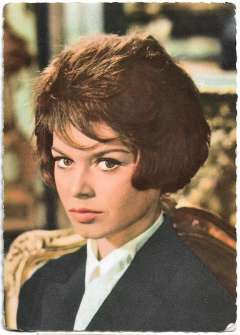
Brigitte Bardot
West German postcard by Ufa, Berlin-Tempelhof, no. CK 257. Photo: Moudial Agency.French actress Brigitte Bardot (1934) died on 28 December 2025, at the age of 91. In the 1950s, she was the sex kitten of the European film industry. BB starred in 48 films, performed in numerous musical shows, and recorded 80 songs. After her retirement in 1973, she established herself as an animal rights activist. In the coming weeks, we will continue to post a BB postcard every day to remember her as she once was.Brigitte Bardot was born in Paris in 1934. Her father, Louis Bardot, had an engineering degree and worked with his father in the family business. Her mother, Ann-Marie Mucel, was 14 years younger than Brigitte's father, and they married in 1933. Brigitte's mother encouraged her daughter to take up music and dance. At the age of 13, she entered the Conservatoire Nationale de Danse to study ballet. By the time she was 15, Brigitte was trying a modelling career and found herself in May 1949 on the cover of the French magazine Elle. Her incredible beauty was readily apparent, and Brigitte was noticed by Roger Vadim, then an assistant to the film director Marc Allegrét. Vadim was infatuated with Bardot and encouraged her to start working as a film actress. BB was 18 when she debuted in the comedy Le Trou Normand / Crazy for Love (Jean Boyer, 1952). In the same year, she married Vadim. Brigitte wanted to marry him when she was 17, but her parents quashed any marriage plans until she turned 18. In April 1953, she attended the Cannes Film Festival, where she received massive media attention. She soon was every man's idea of the girl he'd like to meet in Paris. From 1952 to 1956, she appeared in seventeen films. Her films were generally lightweight romantic dramas in which she was cast as an ingénue or siren, often with an element of undress. In 1953, she made her first US production, Un acte d'amour / Act of Love (Anatole Litvak, 1953) with Kirk Douglas, but she continued to make films in France.Roger Vadim was not content with the light fare his wife was offered. He felt Brigitte Bardot was being undersold. Looking for something more like an art film to push her as a serious actress, he showcased her in Et Dieu créa la femme / ...And God Created Woman (Roger Vadim, 1956). This film, about an immoral teenager in a respectable small-town setting, was a smash success on both sides of the Atlantic. Craig Butler at AllMovie: "It's easy enough to say that ...And God Created Woman is much more important for its historical significance than for its actual quality as a film, and that's true to an extent. The immense popularity, due to its willingness to directly embrace an exploration of sex as well as its willingness to show a degree of nudity that was remarkably daring for its day, demonstrated that audiences were willing to view subject matter that was considered too racy for the average moviegoer. This had both positive (freedom to explore, especially for the French filmmakers of the time) and negative (freedom to exploit) consequences, but its impact is undeniable. It's also true that Woman is not a great work of art, not with a story that is ultimately rather thin, some painful dialogue, and an attitude toward its characters and their sexuality that is unclear and inconsistent. Yet Woman is still fascinating, due in no small part to the presence of Brigitte Bardot in the role that made her an international star and sex symbol. She's not demonstrating great acting here, although her performance is actually good and much better than necessary, and her legendary mambo scene at the climax is nothing short of sensational." During the shooting of Et Dieu créa la femme / And God Created Woman (Roger Vadim, 1956), directed by her husband, Brigitte Bardot had an affair with her co-star Jean-Louis Trintignant, who at that time was married to French actress Stéphane Audran. Her divorce from Vadim followed, but they remained friends and collaborated in later work.Et Dieu créa la femme / ...And God Created Woman (Roger Vadim, 1956) helped Brigitte Bardot's international status. The film took the USA by storm, her explosive sexuality being unlike anything seen in the States since the days of the 'flapper' in the 1920s. It gave rise to the phrase 'sex kitten', and fascination with her in America consisted of magazine photographs and dubbed over French films - good, bad or indifferent, her films drew audiences - mainly men - into theatres like lemmings. BB appeared in light comedies like Doctor at Large (Ralph Thomas, 1957) - the third of the British 'Doctor' series starring Dirk Bogarde - and Une Parisienne / La Parisienne (Michel Boisrond, 1957), which suited her acting skills best. However, she was a sensation in the crime drama En cas de malheur / Love is My Profession (Claude Autant-Lara, 1958). Hal Erickson at AllMovie: "This Brigitte Bardot vehicle ran into stiff opposition from the Catholic Legion of Decency, severely limiting its U.S. distribution. Bardot plays a nubile small-time thief named Yvette, who becomes the mistress of influential defence attorney Andre (Jean Gabin). Though Andre can shower Yvette with jewels and furs, he cannot "buy" her heart, and thus it is that it belongs to handsome young student Mazzetti (Franco Interlenghi). Alas, Yvette is no judge of human nature: attractive though Mazzetti can be, he has a dangerous and deadly side. En Cas de Malheur contains a nude scene that has since been reprinted in freeze-frame form innumerable times by both film-history books and girlie magazines." Photographer Sam Lévin's photos contributed considerably to her image of sensuality and slight immorality. One of Lévin's pictures shows Brigitte, dressed in a white corset. It is said that around 1960, postcards with this photograph outsold in Paris those of the Eiffel Tower.Brigitte Bardot divorced Vadim in 1957, and in 1959 she married actor Jacques Charrier, with whom she starred in Babette s'en va-t-en guerre / Babette Goes to War (Christian-Jaque, 1959). The paparazzi preyed upon her marriage, while she and her husband clashed over the direction of her career
Her films became more substantial, but this brought a heavy pressure of dual celebrity as she sought critical acclaim while remaining a glamour model for most of the world. Vie privée / Private Life (1962), directed by Louis Malle, has more than an element of autobiography in it. James Travers at French Films: "Brigitte Bardot hadn’t quite reached the high point of her career when she agreed to make this film with high-profile New Wave film director Louis Malle. Even so, the pressure of being a living icon was obviously beginning to get to France’s sex goddess, and Vie privée is as much an attempt by Bardot to come to terms with her celebrity as anything else. Malle is clearly fascinated by Bardot, and the documentary approach he adopts for this film reinforces the impression that it is more a biography of the actress than a work of fiction. Of course, it’s not entirely biographical, but the story is remarkably close to Bardot’s own life and comes pretty close to predicting how her career would end." The scene in which, returning to her apartment, Bardot's character is harangued in the elevator by a middle-aged cleaning lady calling her offensive names was based on an actual incident, and is a resonant image of celebrity in the mid-20th century. Soon afterwards, Bardot withdrew to the seclusion of Southern France.Brigitte Bardot's other husbands were German millionaire Playboy Gunter Sachs and right-wing politician Bernard d'Ormale. She is reputed to have had relationships with many other men, including Samy Frey, her co-star in La Vérité / The Truth (Henri-Georges Clouzot, 1960), and musicians Serge Gainsbourg and Sacha Distel. In 1963, Brigitte Bardot starred in Jean-Luc Godard's critically acclaimed film Le Mépris / Contempt (Jean-Luc Godard, 1963) opposite Michel Piccoli. She was also featured along with such notable actors as Alain Delon in Amours célèbres / Famous Love Affairs (Michel Boisrond, 1961) and Histoires extraordinaires /Tales of Mystery (Louis Malle, 1968), Jeanne Moreau in Viva Maria! (Louis Malle, 1965), Sean Connery in Shalako (Edward Dmytryk, 1968), and Claudia Cardinale in Les Pétroleuses / Petroleum Girls (Christian-Jaque, 1971). She participated in various musical shows and recorded many popular songs in the 1960s and 1970s, mostly in collaboration with Serge Gainsbourg, Bob Zagury and Sacha Distel, including 'Harley Davidson', 'Le Soleil De Ma Vie' (the cover of Stevie Wonder's 'You Are the Sunshine of My Life') and the notorious 'Je t'aime... moi non plus'.Brigitte Bardot’s film career showed a steady decline in the late 1960s and early 1970s. In 1973, just before her fortieth birthday, she announced her retirement. She chose to use her fame to promote animal rights. In 1976, she established the Brigitte Bardot Foundation for the Welfare and Protection of Animals. She became a vegetarian and raised three million French francs to fund the foundation by auctioning off jewellery and many personal belongings. For this work, she was awarded the Légion d’honneur in 1984. During the 1990s, she was also outspoken in her criticism of immigration, interracial relationships, Islam in France and homosexuality. Her husband Bernard d'Ormal was a former adviser of the far-right Front National party. Bardot has been convicted five times for 'inciting racial hatred'. More fun is that Bardot is recognised for popularising bikini swimwear, in such early films as Manina / Woman without a Veil (Willy Rozier, 1952), in her appearances at Cannes and in many photo shoots. Bardot also brought into fashion the 'choucroute' ('Sauerkraut') hairstyle (a sort of beehive hairstyle) and gingham clothes after wearing a checkered pink dress, designed by Jacques Esterel, at her wedding to Charrier. The fashions of the 1960s looked effortlessly right and spontaneous on her. Time Magazine: "She is the princess of pout, the countess of come hither. Brigitte Bardot exuded a carefree, naïve sexuality that brought a whole new audience to French films."Sources: Denny Jackson (IMDb), Hal Erickson (AllMovie), Craig Butler (AllMovie), James Travers (French Films), French Films, Wikipedia and IMDb.And please check out our blog European Film Star Postcards.
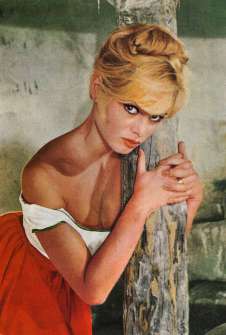
Brigitte Bardot in Les bijoutiers du clair de lune (1958)
German postcard by Terra-Color. Brigitte Bardot in Les bijoutiers du clair de lune / The Night Heaven Fell (Roger Vadim, 1958).French actress Brigitte Bardot (1934) died on 28 December 2025, at the age of 91. In the 1950s, she was the sex kitten of the European film industry. BB starred in 48 films, performed in numerous musical shows, and recorded 80 songs. After her retirement in 1973, she established herself as an animal rights activist. In the coming weeks, we will continue to post a BB postcard every day to remember her as she once was.Brigitte Bardot was born in Paris in 1934. Her father, Louis Bardot, had an engineering degree and worked with his father in the family business. Her mother, Ann-Marie Mucel, was 14 years younger than Brigitte's father, and they married in 1933. Brigitte's mother encouraged her daughter to take up music and dance. At the age of 13, she entered the Conservatoire Nationale de Danse to study ballet. By the time she was 15, Brigitte was trying a modelling career and found herself in May 1949 on the cover of the French magazine Elle. Her incredible beauty was readily apparent, and Brigitte was noticed by Roger Vadim, then an assistant to the film director Marc Allegrét. Vadim was infatuated with Bardot and encouraged her to start working as a film actress. BB was 18 when she debuted in the comedy Le Trou Normand / Crazy for Love (Jean Boyer, 1952). In the same year, she married Vadim. Brigitte wanted to marry him when she was 17, but her parents quashed any marriage plans until she turned 18. In April 1953, she attended the Cannes Film Festival, where she received massive media attention. She soon was every man's idea of the girl he'd like to meet in Paris. From 1952 to 1956, she appeared in seventeen films. Her films were generally lightweight romantic dramas in which she was cast as an ingénue or siren, often with an element of undress. In 1953, she made her first US production, Un acte d'amour / Act of Love (Anatole Litvak, 1953) with Kirk Douglas, but she continued to make films in France.Roger Vadim was not content with the light fare his wife was offered. He felt Brigitte Bardot was being undersold. Looking for something more like an art film to push her as a serious actress, he showcased her in Et Dieu créa la femme / ...And God Created Woman (Roger Vadim, 1956). This film, about an immoral teenager in a respectable small-town setting, was a smash success on both sides of the Atlantic. Craig Butler at AllMovie: "It's easy enough to say that ...And God Created Woman is much more important for its historical significance than for its actual quality as a film, and that's true to an extent. The immense popularity, due to its willingness to directly embrace an exploration of sex as well as its willingness to show a degree of nudity that was remarkably daring for its day, demonstrated that audiences were willing to view subject matter that was considered too racy for the average moviegoer. This had both positive (freedom to explore, especially for the French filmmakers of the time) and negative (freedom to exploit) consequences, but its impact is undeniable. It's also true that Woman is not a great work of art, not with a story that is ultimately rather thin, some painful dialogue, and an attitude toward its characters and their sexuality that is unclear and inconsistent. Yet Woman is still fascinating, due in no small part to the presence of Brigitte Bardot in the role that made her an international star and sex symbol. She's not demonstrating great acting here, although her performance is actually good and much better than necessary, and her legendary mambo scene at the climax is nothing short of sensational." During the shooting of Et Dieu créa la femme / And God Created Woman (Roger Vadim, 1956), directed by her husband, Brigitte Bardot had an affair with her co-star Jean-Louis Trintignant, who at that time was married to French actress Stéphane Audran. Her divorce from Vadim followed, but they remained friends and collaborated in later work.Et Dieu créa la femme / ...And God Created Woman (Roger Vadim, 1956) helped Brigitte Bardot's international status. The film took the USA by storm, her explosive sexuality being unlike anything seen in the States since the days of the 'flapper' in the 1920s. It gave rise to the phrase 'sex kitten', and fascination with her in America consisted of magazine photographs and dubbed over French films - good, bad or indifferent, her films drew audiences - mainly men - into theatres like lemmings. BB appeared in light comedies like Doctor at Large (Ralph Thomas, 1957) - the third of the British 'Doctor' series starring Dirk Bogarde - and Une Parisienne / La Parisienne (Michel Boisrond, 1957), which suited her acting skills best. However, she was a sensation in the crime drama En cas de malheur / Love is My Profession (Claude Autant-Lara, 1958). Hal Erickson at AllMovie: "This Brigitte Bardot vehicle ran into stiff opposition from the Catholic Legion of Decency, severely limiting its U.S. distribution. Bardot plays a nubile small-time thief named Yvette, who becomes the mistress of influential defence attorney Andre (Jean Gabin). Though Andre can shower Yvette with jewels and furs, he cannot "buy" her heart, and thus it is that it belongs to handsome young student Mazzetti (Franco Interlenghi). Alas, Yvette is no judge of human nature: attractive though Mazzetti can be, he has a dangerous and deadly side. En Cas de Malheur contains a nude scene that has since been reprinted in freeze-frame form innumerable times by both film-history books and girlie magazines." Photographer Sam Lévin's photos contributed considerably to her image of sensuality and slight immorality. One of Lévin's pictures shows Brigitte, dressed in a white corset. It is said that around 1960, postcards with this photograph outsold in Paris those of the Eiffel Tower.Brigitte Bardot divorced Vadim in 1957, and in 1959 she married actor Jacques Charrier, with whom she starred in Babette s'en va-t-en guerre / Babette Goes to War (Christian-Jaque, 1959). The paparazzi preyed upon her marriage, while she and her husband clashed over the direction of her career
Her films became more substantial, but this brought a heavy pressure of dual celebrity as she sought critical acclaim while remaining a glamour model for most of the world. Vie privée / Private Life (1962), directed by Louis Malle, has more than an element of autobiography in it. James Travers at French Films: "Brigitte Bardot hadn’t quite reached the high point of her career when she agreed to make this film with high-profile New Wave film director Louis Malle. Even so, the pressure of being a living icon was obviously beginning to get to France’s sex goddess, and Vie privée is as much an attempt by Bardot to come to terms with her celebrity as anything else. Malle is clearly fascinated by Bardot, and the documentary approach he adopts for this film reinforces the impression that it is more a biography of the actress than a work of fiction. Of course, it’s not entirely biographical, but the story is remarkably close to Bardot’s own life and comes pretty close to predicting how her career would end." The scene in which, returning to her apartment, Bardot's character is harangued in the elevator by a middle-aged cleaning lady calling her offensive names was based on an actual incident, and is a resonant image of celebrity in the mid-20th century. Soon afterwards, Bardot withdrew to the seclusion of Southern France.Brigitte Bardot's other husbands were German millionaire Playboy Gunter Sachs and right-wing politician Bernard d'Ormale. She is reputed to have had relationships with many other men, including Samy Frey, her co-star in La Vérité / The Truth (Henri-Georges Clouzot, 1960), and musicians Serge Gainsbourg and Sacha Distel. In 1963, Brigitte Bardot starred in Jean-Luc Godard's critically acclaimed film Le Mépris / Contempt (Jean-Luc Godard, 1963) opposite Michel Piccoli. She was also featured along with such notable actors as Alain Delon in Amours célèbres / Famous Love Affairs (Michel Boisrond, 1961) and Histoires extraordinaires /Tales of Mystery (Louis Malle, 1968), Jeanne Moreau in Viva Maria! (Louis Malle, 1965), Sean Connery in Shalako (Edward Dmytryk, 1968), and Claudia Cardinale in Les Pétroleuses / Petroleum Girls (Christian-Jaque, 1971). She participated in various musical shows and recorded many popular songs in the 1960s and 1970s, mostly in collaboration with Serge Gainsbourg, Bob Zagury and Sacha Distel, including 'Harley Davidson', 'Le Soleil De Ma Vie' (the cover of Stevie Wonder's 'You Are the Sunshine of My Life') and the notorious 'Je t'aime... moi non plus'.Brigitte Bardot’s film career showed a steady decline in the late 1960s and early 1970s. In 1973, just before her fortieth birthday, she announced her retirement. She chose to use her fame to promote animal rights. In 1976, she established the Brigitte Bardot Foundation for the Welfare and Protection of Animals. She became a vegetarian and raised three million French francs to fund the foundation by auctioning off jewellery and many personal belongings. For this work, she was awarded the Légion d’honneur in 1984. During the 1990s, she was also outspoken in her criticism of immigration, interracial relationships, Islam in France and homosexuality. Her husband Bernard d'Ormal was a former adviser of the far-right Front National party. Bardot has been convicted five times for 'inciting racial hatred'. More fun is that Bardot is recognised for popularising bikini swimwear, in such early films as Manina / Woman without a Veil (Willy Rozier, 1952), in her appearances at Cannes and in many photo shoots. Bardot also brought into fashion the 'choucroute' ('Sauerkraut') hairstyle (a sort of beehive hairstyle) and gingham clothes after wearing a checkered pink dress, designed by Jacques Esterel, at her wedding to Charrier. The fashions of the 1960s looked effortlessly right and spontaneous on her. Time Magazine: "She is the princess of pout, the countess of come hither. Brigitte Bardot exuded a carefree, naïve sexuality that brought a whole new audience to French films."Sources: Denny Jackson (IMDb), Hal Erickson (AllMovie), Craig Butler (AllMovie), James Travers (French Films), French Films, Wikipedia and IMDb.And please check out our blog European Film Star Postcards.
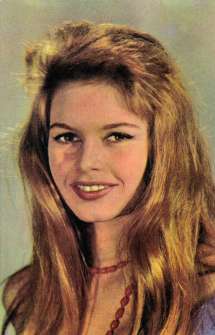
Brigitte Bardot
French postcard by Imp. De Marchi Frères, Marseille.French actress Brigitte Bardot (1934) died on 28 December 2025, at the age of 91. In the 1950s, she was the sex kitten of the European film industry. BB starred in 48 films, performed in numerous musical shows, and recorded 80 songs. After her retirement in 1973, she established herself as an animal rights activist. In the coming weeks, we will continue to post a BB postcard every day to remember her as she once was.Brigitte Bardot was born in Paris in 1934. Her father, Louis Bardot, had an engineering degree and worked with his father in the family business. Her mother, Ann-Marie Mucel, was 14 years younger than Brigitte's father, and they married in 1933. Brigitte's mother encouraged her daughter to take up music and dance. At the age of 13, she entered the Conservatoire Nationale de Danse to study ballet. By the time she was 15, Brigitte was trying a modelling career and found herself in May 1949 on the cover of the French magazine Elle. Her incredible beauty was readily apparent, and Brigitte was noticed by Roger Vadim, then an assistant to the film director Marc Allegrét. Vadim was infatuated with Bardot and encouraged her to start working as a film actress. BB was 18 when she debuted in the comedy Le Trou Normand / Crazy for Love (Jean Boyer, 1952). In the same year, she married Vadim. Brigitte wanted to marry him when she was 17, but her parents quashed any marriage plans until she turned 18. In April 1953, she attended the Cannes Film Festival, where she received massive media attention. She soon was every man's idea of the girl he'd like to meet in Paris. From 1952 to 1956, she appeared in seventeen films. Her films were generally lightweight romantic dramas in which she was cast as an ingénue or siren, often with an element of undress. In 1953, she made her first US production, Un acte d'amour / Act of Love (Anatole Litvak, 1953) with Kirk Douglas, but she continued to make films in France.Roger Vadim was not content with the light fare his wife was offered. He felt Brigitte Bardot was being undersold. Looking for something more like an art film to push her as a serious actress, he showcased her in Et Dieu créa la femme / ...And God Created Woman (Roger Vadim, 1956). This film, about an immoral teenager in a respectable small-town setting, was a smash success on both sides of the Atlantic. Craig Butler at AllMovie: "It's easy enough to say that ...And God Created Woman is much more important for its historical significance than for its actual quality as a film, and that's true to an extent. The immense popularity, due to its willingness to directly embrace an exploration of sex as well as its willingness to show a degree of nudity that was remarkably daring for its day, demonstrated that audiences were willing to view subject matter that was considered too racy for the average moviegoer. This had both positive (freedom to explore, especially for the French filmmakers of the time) and negative (freedom to exploit) consequences, but its impact is undeniable. It's also true that Woman is not a great work of art, not with a story that is ultimately rather thin, some painful dialogue, and an attitude toward its characters and their sexuality that is unclear and inconsistent. Yet Woman is still fascinating, due in no small part to the presence of Brigitte Bardot in the role that made her an international star and sex symbol. She's not demonstrating great acting here, although her performance is actually good and much better than necessary, and her legendary mambo scene at the climax is nothing short of sensational." During the shooting of Et Dieu créa la femme / And God Created Woman (Roger Vadim, 1956), directed by her husband, Brigitte Bardot had an affair with her co-star Jean-Louis Trintignant, who at that time was married to French actress Stéphane Audran. Her divorce from Vadim followed, but they remained friends and collaborated in later work.Et Dieu créa la femme / ...And God Created Woman (Roger Vadim, 1956) helped Brigitte Bardot's international status. The film took the USA by storm, her explosive sexuality being unlike anything seen in the States since the days of the 'flapper' in the 1920s. It gave rise to the phrase 'sex kitten', and fascination with her in America consisted of magazine photographs and dubbed over French films - good, bad or indifferent, her films drew audiences - mainly men - into theatres like lemmings. BB appeared in light comedies like Doctor at Large (Ralph Thomas, 1957) - the third of the British 'Doctor' series starring Dirk Bogarde - and Une Parisienne / La Parisienne (Michel Boisrond, 1957), which suited her acting skills best. However, she was a sensation in the crime drama En cas de malheur / Love is My Profession (Claude Autant-Lara, 1958). Hal Erickson at AllMovie: "This Brigitte Bardot vehicle ran into stiff opposition from the Catholic Legion of Decency, severely limiting its U.S. distribution. Bardot plays a nubile small-time thief named Yvette, who becomes the mistress of influential defence attorney Andre (Jean Gabin). Though Andre can shower Yvette with jewels and furs, he cannot "buy" her heart, and thus it is that it belongs to handsome young student Mazzetti (Franco Interlenghi). Alas, Yvette is no judge of human nature: attractive though Mazzetti can be, he has a dangerous and deadly side. En Cas de Malheur contains a nude scene that has since been reprinted in freeze-frame form innumerable times by both film-history books and girlie magazines." Photographer Sam Lévin's photos contributed considerably to her image of sensuality and slight immorality. One of Lévin's pictures shows Brigitte, dressed in a white corset. It is said that around 1960, postcards with this photograph outsold in Paris those of the Eiffel Tower.Brigitte Bardot divorced Vadim in 195,7 and in 1959 she married actor Jacques Charrier, with whom she starred in Babette s'en va-t-en guerre / Babette Goes to War (Christian-Jaque, 1959). The paparazzi preyed upon her marriage, while she and her husband clashed over the direction of her career
Her films became more substantial, but this brought a heavy pressure of dual celebrity as she sought critical acclaim while remaining a glamour model for most of the world. Vie privée / Private Life (1962), directed by Louis Malle, has more than an element of autobiography in it. James Travers at French Films: "Brigitte Bardot hadn’t quite reached the high point of her career when she agreed to make this film with high-profile New Wave film director Louis Malle. Even so, the pressure of being a living icon was obviously beginning to get to France’s sex goddess, and Vie privée is as much an attempt by Bardot to come to terms with her celebrity as anything else. Malle is clearly fascinated by Bardot, and the documentary approach he adopts for this film reinforces the impression that it is more a biography of the actress than a work of fiction. Of course, it’s not entirely biographical, but the story is remarkably close to Bardot’s own life and comes pretty close to predicting how her career would end." The scene in which, returning to her apartment, Bardot's character is harangued in the elevator by a middle-aged cleaning lady calling her offensive names was based on an actual incident, and is a resonant image of celebrity in the mid-20th century. Soon afterwards, Bardot withdrew to the seclusion of Southern France.Brigitte Bardot's other husbands were German millionaire Playboy Gunter Sachs and right-wing politician Bernard d'Ormale. She is reputed to have had relationships with many other men, including Samy Frey, her co-star in La Vérité / The Truth (Henri-Georges Clouzot, 1960), and musicians Serge Gainsbourg and Sacha Distel. In 1963, Brigitte Bardot starred in Jean-Luc Godard's critically acclaimed film Le Mépris / Contempt (Jean-Luc Godard, 1963) opposite Michel Piccoli. She was also featured along with such notable actors as Alain Delon in Amours célèbres / Famous Love Affairs (Michel Boisrond, 1961) and Histoires extraordinaires /Tales of Mystery (Louis Malle, 1968), Jeanne Moreau in Viva Maria! (Louis Malle, 1965), Sean Connery in Shalako (Edward Dmytryk, 1968), and Claudia Cardinale in Les Pétroleuses / Petroleum Girls (Christian-Jaque, 1971). She participated in various musical shows and recorded many popular songs in the 1960s and 1970s, mostly in collaboration with Serge Gainsbourg, Bob Zagury and Sacha Distel, including 'Harley Davidson', 'Le Soleil De Ma Vie' (the cover of Stevie Wonder's 'You Are the Sunshine of My Life') and the notorious 'Je t'aime... moi non plus'.Brigitte Bardot’s film career showed a steady decline in the late 1960s and early 1970s. In 1973, just before her fortieth birthday, she announced her retirement. She chose to use her fame to promote animal rights. In 1976, she established the Brigitte Bardot Foundation for the Welfare and Protection of Animals. She became a vegetarian and raised three million French francs to fund the foundation by auctioning off jewellery and many personal belongings. For this work, she was awarded the Légion d’honneur in 1984. During the 1990s, she was also outspoken in her criticism of immigration, interracial relationships, Islam in France and homosexuality. Her husband Bernard d'Ormal was a former adviser of the far-right Front National party. Bardot has been convicted five times for 'inciting racial hatred'. More fun is that Bardot is recognised for popularising bikini swimwear, in such early films as Manina / Woman without a Veil (Willy Rozier, 1952), in her appearances at Cannes and in many photo shoots. Bardot also brought into fashion the 'choucroute' ('Sauerkraut') hairstyle (a sort of beehive hairstyle) and gingham clothes after wearing a checkered pink dress, designed by Jacques Esterel, at her wedding to Charrier. The fashions of the 1960s looked effortlessly right and spontaneous on her. Time Magazine: "She is the princess of pout, the countess of come hither. Brigitte Bardot exuded a carefree, naïve sexuality that brought a whole new audience to French films."Sources: Denny Jackson (IMDb), Hal Erickson (AllMovie), Craig Butler (AllMovie), James Travers (French Films), French Films, Wikipedia and IMDb.And please check out our blog European Film Star Postcards.
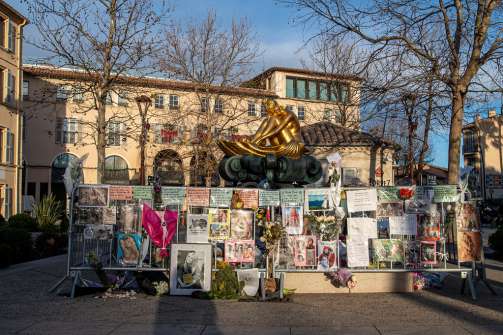
Hommage à B. Bardot
55032724304_1911512844_b
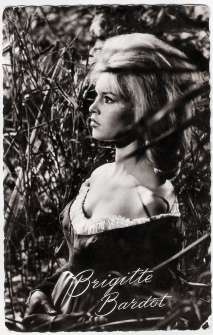
Brigitte Bardot
West German postcard by Filmbilder-Vertrieb Ernst Freihoff, Essen, no. AX 4832.French actress Brigitte Bardot (1934) died on 28 December 2025, at the age of 91. In the 1950s, she was the sex kitten of the European film industry. BB starred in 48 films, performed in numerous musical shows, and recorded 80 songs. After her retirement in 1973, she established herself as an animal rights activist. In the coming weeks, we will post a BB postcard every day to remember her as she once was.Brigitte Bardot was born in Paris in 1934. Her father, Louis Bardot, had an engineering degree and worked with his father in the family business. Her mother, Ann-Marie Mucel, was 14 years younger than Brigitte's father, and they married in 1933. Brigitte's mother encouraged her daughter to take up music and dance. At the age of 13, she entered the Conservatoire Nationale de Danse to study ballet. By the time she was 15, Brigitte was trying a modelling career and found herself in May 1949 on the cover of the French magazine Elle. Her incredible beauty was readily apparent, and Brigitte was noticed by Roger Vadim, then an assistant to the film director Marc Allegrét. Vadim was infatuated with Bardot and encouraged her to start working as a film actress. BB was 18 when she debuted in the comedy Le Trou Normand / Crazy for Love (Jean Boyer, 1952). In the same year, she married Vadim. Brigitte wanted to marry him when she was 17, but her parents quashed any marriage plans until she turned 18. In April 1953, she attended the Cannes Film Festival, where she received massive media attention. She soon was every man's idea of the girl he'd like to meet in Paris. From 1952 to 1956, she appeared in seventeen films. Her films were generally lightweight romantic dramas in which she was cast as an ingénue or siren, often with an element of undress. In 1953, she made her first US production, Un acte d'amour / Act of Love (Anatole Litvak, 1953) with Kirk Douglas, but she continued to make films in France.Roger Vadim was not content with the light fare his wife was offered. He felt Brigitte Bardot was being undersold. Looking for something more like an art film to push her as a serious actress, he showcased her in Et Dieu créa la femme / ...And God Created Woman (Roger Vadim, 1956). This film, about an immoral teenager in a respectable small-town setting, was a smash success on both sides of the Atlantic. Craig Butler at AllMovie: "It's easy enough to say that ...And God Created Woman is much more important for its historical significance than for its actual quality as a film, and that's true to an extent. The immense popularity, due to its willingness to directly embrace an exploration of sex as well as its willingness to show a degree of nudity that was remarkably daring for its day, demonstrated that audiences were willing to view subject matter that was considered too racy for the average moviegoer. This had both positive (freedom to explore, especially for the French filmmakers of the time) and negative (freedom to exploit) consequences, but its impact is undeniable. It's also true that Woman is not a great work of art, not with a story that is ultimately rather thin, some painful dialogue, and an attitude toward its characters and their sexuality that is unclear and inconsistent. Yet Woman is still fascinating, due in no small part to the presence of Brigitte Bardot in the role that made her an international star and sex symbol. She's not demonstrating great acting here, although her performance is actually good and much better than necessary, and her legendary mambo scene at the climax is nothing short of sensational." During the shooting of Et Dieu créa la femme / And God Created Woman (Roger Vadim, 1956), directed by her husband, Brigitte Bardot had an affair with her co-star Jean-Louis Trintignant, who at that time was married to French actress Stéphane Audran. Her divorce from Vadim followed, but they remained friends and collaborated in later work.Et Dieu créa la femme / ...And God Created Woman (Roger Vadim, 1956) helped Brigitte Bardot's international status. The film took the USA by storm, her explosive sexuality being unlike anything seen in the States since the days of the 'flapper' in the 1920s. It gave rise to the phrase 'sex kitten', and fascination with her in America consisted of magazine photographs and dubbed over French films - good, bad or indifferent, her films drew audiences - mainly men - into theatres like lemmings. BB appeared in light comedies like Doctor at Large (Ralph Thomas, 1957) - the third of the British 'Doctor' series starring Dirk Bogarde - and Une Parisienne / La Parisienne (Michel Boisrond, 1957), which suited her acting skills best. However, she was a sensation in the crime drama En cas de malheur / Love is My Profession (Claude Autant-Lara, 1958). Hal Erickson at AllMovie: "This Brigitte Bardot vehicle ran into stiff opposition from the Catholic Legion of Decency, severely limiting its U.S. distribution. Bardot plays a nubile small-time thief named Yvette, who becomes the mistress of influential defence attorney Andre (Jean Gabin). Though Andre can shower Yvette with jewels and furs, he cannot "buy" her heart, and thus it is that it belongs to handsome young student Mazzetti (Franco Interlenghi). Alas, Yvette is no judge of human nature: attractive though Mazzetti can be, he has a dangerous and deadly side. En Cas de Malheur contains a nude scene that has since been reprinted in freeze-frame form innumerable times by both film-history books and girlie magazines." Photographer Sam Lévin's photos contributed considerably to her image of sensuality and slight immorality. One of Lévin's pictures shows Brigitte, dressed in a white corset. It is said that around 1960, postcards with this photograph outsold in Paris those of the Eiffel Tower.Brigitte Bardot divorced Vadim in 195,7 and in 1959 she married actor Jacques Charrier, with whom she starred in Babette s'en va-t-en guerre / Babette Goes to War (Christian-Jaque, 1959). The paparazzi preyed upon her marriage, while she and her husband clashed over the direction of her career
Her films became more substantial, but this brought a heavy pressure of dual celebrity as she sought critical acclaim while remaining a glamour model for most of the world. Vie privée / Private Life (1962), directed by Louis Malle, has more than an element of autobiography in it. James Travers at French Films: "Brigitte Bardot hadn’t quite reached the high point of her career when she agreed to make this film with high-profile New Wave film director Louis Malle. Even so, the pressure of being a living icon was obviously beginning to get to France’s sex goddess, and Vie privée is as much an attempt by Bardot to come to terms with her celebrity as anything else. Malle is clearly fascinated by Bardot, and the documentary approach he adopts for this film reinforces the impression that it is more a biography of the actress than a work of fiction. Of course, it’s not entirely biographical, but the story is remarkably close to Bardot’s own life and comes pretty close to predicting how her career would end." The scene in which, returning to her apartment, Bardot's character is harangued in the elevator by a middle-aged cleaning lady calling her offensive names was based on an actual incident, and is a resonant image of celebrity in the mid-20th century. Soon afterwards, Bardot withdrew to the seclusion of Southern France.Brigitte Bardot's other husbands were German millionaire Playboy Gunter Sachs and right-wing politician Bernard d'Ormale. She is reputed to have had relationships with many other men, including Samy Frey, her co-star in La Vérité / The Truth (Henri-Georges Clouzot, 1960), and musicians Serge Gainsbourg and Sacha Distel. In 1963, Brigitte Bardot starred in Jean-Luc Godard's critically acclaimed film Le Mépris / Contempt (Jean-Luc Godard, 1963) opposite Michel Piccoli. She was also featured along with such notable actors as Alain Delon in Amours célèbres / Famous Love Affairs (Michel Boisrond, 1961) and Histoires extraordinaires /Tales of Mystery (Louis Malle, 1968), Jeanne Moreau in Viva Maria! (Louis Malle, 1965), Sean Connery in Shalako (Edward Dmytryk, 1968), and Claudia Cardinale in Les Pétroleuses / Petroleum Girls (Christian-Jaque, 1971). She participated in various musical shows and recorded many popular songs in the 1960s and 1970s, mostly in collaboration with Serge Gainsbourg, Bob Zagury and Sacha Distel, including 'Harley Davidson', 'Le Soleil De Ma Vie' (the cover of Stevie Wonder's 'You Are the Sunshine of My Life') and the notorious 'Je t'aime... moi non plus'.Brigitte Bardot’s film career showed a steady decline in the late 1960s and early 1970s. In 1973, just before her fortieth birthday, she announced her retirement. She chose to use her fame to promote animal rights. In 1976, she established the Brigitte Bardot Foundation for the Welfare and Protection of Animals. She became a vegetarian and raised three million French francs to fund the foundation by auctioning off jewellery and many personal belongings. For this work, she was awarded the Légion d’honneur in 1984. During the 1990s, she was also outspoken in her criticism of immigration, interracial relationships, Islam in France and homosexuality. Her husband Bernard d'Ormal was a former adviser of the far-right Front National party. Bardot has been convicted five times for 'inciting racial hatred'. More fun is that Bardot is recognised for popularising bikini swimwear, in such early films as Manina / Woman without a Veil (Willy Rozier, 1952), in her appearances at Cannes and in many photo shoots. Bardot also brought into fashion the 'choucroute' ('Sauerkraut') hairstyle (a sort of beehive hairstyle) and gingham clothes after wearing a checkered pink dress, designed by Jacques Esterel, at her wedding to Charrier. The fashions of the 1960s looked effortlessly right and spontaneous on her. Time Magazine: "She is the princess of pout, the countess of come hither. Brigitte Bardot exuded a carefree, naïve sexuality that brought a whole new audience to French films."Sources: Denny Jackson (IMDb), Hal Erickson (AllMovie), Craig Butler (AllMovie), James Travers (French Films), French Films, Wikipedia and IMDb.And please check out our blog European Film Star Postcards.
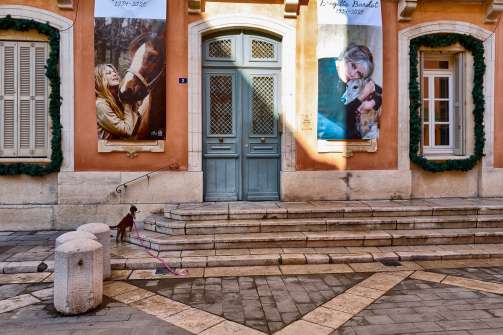
Une admiratrice de Brigitte Bardot
Mairie de St Tropez
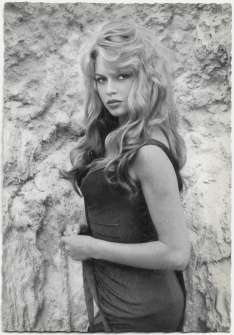
Brigitte Bardot
West German postcard by WS-Druck, Wanne-Eickel, no. 439. Photo: Atchiv Filmpress Zürich.French actress Brigitte Bardot (1934) died on 28 December 2025, at the age of 91. In the 1950s, she was the sex kitten of the European film industry. BB starred in 48 films, performed in numerous musical shows, and recorded 80 songs. After her retirement in 1973, she established herself as an animal rights activist. In the coming weeks, we will post a BB postcard every day to remember her as she once was.Brigitte Bardot was born in Paris in 1934. Her father, Louis Bardot, had an engineering degree and worked with his father in the family business. Her mother, Ann-Marie Mucel, was 14 years younger than Brigitte's father, and they married in 1933. Brigitte's mother encouraged her daughter to take up music and dance. At the age of 13, she entered the Conservatoire Nationale de Danse to study ballet. By the time she was 15, Brigitte was trying a modelling career and found herself in May 1949 on the cover of the French magazine Elle. Her incredible beauty was readily apparent, and Brigitte was noticed by Roger Vadim, then an assistant to the film director Marc Allegrét. Vadim was infatuated with Bardot and encouraged her to start working as a film actress. BB was 18 when she debuted in the comedy Le Trou Normand / Crazy for Love (Jean Boyer, 1952). In the same year, she married Vadim. Brigitte wanted to marry him when she was 17, but her parents quashed any marriage plans until she turned 18. In April 1953, she attended the Cannes Film Festival, where she received massive media attention. She soon was every man's idea of the girl he'd like to meet in Paris. From 1952 to 1956, she appeared in seventeen films. Her films were generally lightweight romantic dramas in which she was cast as an ingénue or siren, often with an element of undress. In 1953, she made her first US production, Un acte d'amour / Act of Love (Anatole Litvak, 1953) with Kirk Douglas, but she continued to make films in France.Roger Vadim was not content with the light fare his wife was offered. He felt Brigitte Bardot was being undersold. Looking for something more like an art film to push her as a serious actress, he showcased her in Et Dieu créa la femme / ...And God Created Woman (Roger Vadim, 1956). This film, about an immoral teenager in a respectable small-town setting, was a smash success on both sides of the Atlantic. Craig Butler at AllMovie: "It's easy enough to say that ...And God Created Woman is much more important for its historical significance than for its actual quality as a film, and that's true to an extent. The immense popularity, due to its willingness to directly embrace an exploration of sex as well as its willingness to show a degree of nudity that was remarkably daring for its day, demonstrated that audiences were willing to view subject matter that was considered too racy for the average moviegoer. This had both positive (freedom to explore, especially for the French filmmakers of the time) and negative (freedom to exploit) consequences, but its impact is undeniable. It's also true that Woman is not a great work of art, not with a story that is ultimately rather thin, some painful dialogue, and an attitude toward its characters and their sexuality that is unclear and inconsistent. Yet Woman is still fascinating, due in no small part to the presence of Brigitte Bardot in the role that made her an international star and sex symbol. She's not demonstrating great acting here, although her performance is actually good and much better than necessary, and her legendary mambo scene at the climax is nothing short of sensational." During the shooting of Et Dieu créa la femme / And God Created Woman (Roger Vadim, 1956), directed by her husband, Brigitte Bardot had an affair with her co-star Jean-Louis Trintignant, who at that time was married to French actress Stéphane Audran. Her divorce from Vadim followed, but they remained friends and collaborated in later work.Et Dieu créa la femme / ...And God Created Woman (Roger Vadim, 1956) helped Brigitte Bardot's international status. The film took the USA by storm, her explosive sexuality being unlike anything seen in the States since the days of the 'flapper' in the 1920s. It gave rise to the phrase 'sex kitten', and fascination with her in America consisted of magazine photographs and dubbed over French films - good, bad or indifferent, her films drew audiences - mainly men - into theatres like lemmings. BB appeared in light comedies like Doctor at Large (Ralph Thomas, 1957) - the third of the British 'Doctor' series starring Dirk Bogarde - and Une Parisienne / La Parisienne (Michel Boisrond, 1957), which suited her acting skills best. However, she was a sensation in the crime drama En cas de malheur / Love is My Profession (Claude Autant-Lara, 1958). Hal Erickson at AllMovie: "This Brigitte Bardot vehicle ran into stiff opposition from the Catholic Legion of Decency, severely limiting its U.S. distribution. Bardot plays a nubile small-time thief named Yvette, who becomes the mistress of influential defence attorney Andre (Jean Gabin). Though Andre can shower Yvette with jewels and furs, he cannot "buy" her heart, and thus it is that it belongs to handsome young student Mazzetti (Franco Interlenghi). Alas, Yvette is no judge of human nature: attractive though Mazzetti can be, he has a dangerous and deadly side. En Cas de Malheur contains a nude scene that has since been reprinted in freeze-frame form innumerable times by both film-history books and girlie magazines." Photographer Sam Lévin's photos contributed considerably to her image of sensuality and slight immorality. One of Lévin's pictures shows Brigitte, dressed in a white corset. It is said that around 1960, postcards with this photograph outsold in Paris those of the Eiffel Tower.Brigitte Bardot divorced Vadim in 195,7 and in 1959 she married actor Jacques Charrier, with whom she starred in Babette s'en va-t-en guerre / Babette Goes to War (Christian-Jaque, 1959). The paparazzi preyed upon her marriage, while she and her husband clashed over the direction of her career
Her films became more substantial, but this brought a heavy pressure of dual celebrity as she sought critical acclaim while remaining a glamour model for most of the world. Vie privée / Private Life (1962), directed by Louis Malle, has more than an element of autobiography in it. James Travers at French Films: "Brigitte Bardot hadn’t quite reached the high point of her career when she agreed to make this film with high-profile New Wave film director Louis Malle. Even so, the pressure of being a living icon was obviously beginning to get to France’s sex goddess, and Vie privée is as much an attempt by Bardot to come to terms with her celebrity as anything else. Malle is clearly fascinated by Bardot, and the documentary approach he adopts for this film reinforces the impression that it is more a biography of the actress than a work of fiction. Of course, it’s not entirely biographical, but the story is remarkably close to Bardot’s own life and comes pretty close to predicting how her career would end." The scene in which, returning to her apartment, Bardot's character is harangued in the elevator by a middle-aged cleaning lady calling her offensive names was based on an actual incident, and is a resonant image of celebrity in the mid-20th century. Soon afterwards, Bardot withdrew to the seclusion of Southern France.Brigitte Bardot's other husbands were German millionaire Playboy Gunter Sachs and right-wing politician Bernard d'Ormale. She is reputed to have had relationships with many other men, including Samy Frey, her co-star in La Vérité / The Truth (Henri-Georges Clouzot, 1960), and musicians Serge Gainsbourg and Sacha Distel. In 1963, Brigitte Bardot starred in Jean-Luc Godard's critically acclaimed film Le Mépris / Contempt (Jean-Luc Godard, 1963) opposite Michel Piccoli. She was also featured along with such notable actors as Alain Delon in Amours célèbres / Famous Love Affairs (Michel Boisrond, 1961) and Histoires extraordinaires /Tales of Mystery (Louis Malle, 1968), Jeanne Moreau in Viva Maria! (Louis Malle, 1965), Sean Connery in Shalako (Edward Dmytryk, 1968), and Claudia Cardinale in Les Pétroleuses / Petroleum Girls (Christian-Jaque, 1971). She participated in various musical shows and recorded many popular songs in the 1960s and 1970s, mostly in collaboration with Serge Gainsbourg, Bob Zagury and Sacha Distel, including 'Harley Davidson', 'Le Soleil De Ma Vie' (the cover of Stevie Wonder's 'You Are the Sunshine of My Life') and the notorious 'Je t'aime... moi non plus'.Brigitte Bardot’s film career showed a steady decline in the late 1960s and early 1970s. In 1973, just before her fortieth birthday, she announced her retirement. She chose to use her fame to promote animal rights. In 1976, she established the Brigitte Bardot Foundation for the Welfare and Protection of Animals. She became a vegetarian and raised three million French francs to fund the foundation by auctioning off jewellery and many personal belongings. For this work, she was awarded the Légion d’honneur in 1984. During the 1990s, she was also outspoken in her criticism of immigration, interracial relationships, Islam in France and homosexuality. Her husband Bernard d'Ormal was a former adviser of the far-right Front National party. Bardot has been convicted five times for 'inciting racial hatred'. More fun is that Bardot is recognised for popularising bikini swimwear, in such early films as Manina / Woman without a Veil (Willy Rozier, 1952), in her appearances at Cannes and in many photo shoots. Bardot also brought into fashion the 'choucroute' ('Sauerkraut') hairstyle (a sort of beehive hairstyle) and gingham clothes after wearing a checkered pink dress, designed by Jacques Esterel, at her wedding to Charrier. The fashions of the 1960s looked effortlessly right and spontaneous on her. Time Magazine: "She is the princess of pout, the countess of come hither. Brigitte Bardot exuded a carefree, naïve sexuality that brought a whole new audience to French films."Sources: Denny Jackson (IMDb), Hal Erickson (AllMovie), Craig Butler (AllMovie), James Travers (French Films), French Films, Wikipedia and IMDb.And please check out our blog European Film Star Postcards.
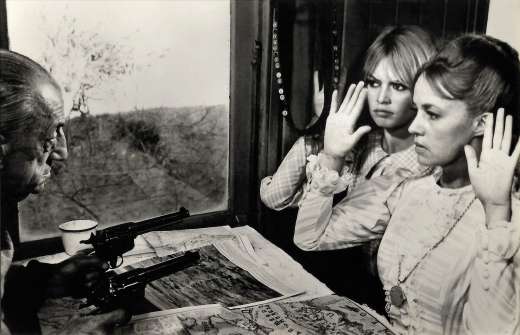
Jeanne Moreau and Brigitte Bardot in Viva Maria (1965)
Czech collector card by Pressfoto, Praha (Prague), no. S 144/10. Jeanne Moreau and Brigitte Bardot in Viva Maria (Louis Malle, 1965).Legendary film star Jeanne Moreau (1928-2017) was the personification of French womanhood and sensuality. She had a diverse career as a magnificent stage and film actress, a producer, screenwriter, and film director, a successful singer with a substantial recording career, and a theatre and opera director. She combined off-kilter beauty with strong character in Nouveau Vague (New Wave) classics as Ascenseur pour l'échafaud (1958) and Les Amants (1959). Her role as the flamboyant, free-spirited Catherine with her devil-may-care sensuality, in Jules et Jim (1962) is one of the greatest performances in the history of the cinema. Throughout her long career with more than 130 films, Moreau continued to work with some of the most notable film directors.French actress Brigitte Bardot (1934) died on 28 December 2025, at the age of 91. In the 1950s, she was the sex kitten of the European film industry. BB starred in 48 films, performed in numerous musical shows, and recorded 80 songs. After her retirement in 1973, she established herself as an animal rights activist. In the coming weeks, we will post a BB postcard every day to remember her as she once was.And please check out our blog European Film Star Postcards.
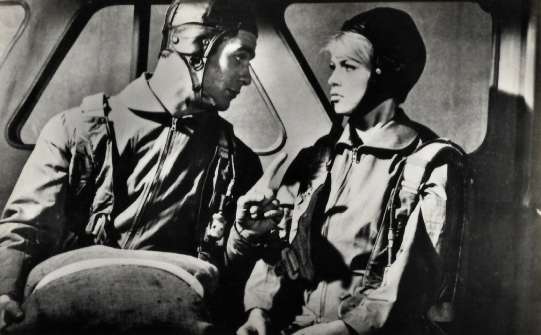
Jacques Charrier and Brigitte Bardot in Babette s'en va-t-en guerre (1959)
Small Czech collector card by Pressfoto, Praha (Prague), no. S 70-5. Jacques Charrier and Brigitte Bardot in Babette s'en va-t-en guerre / Babette Goes to War (Christian-Jaque, 1959)French actor and film producer Jacques Charrier (1936) played leading roles in the late 1950s and 1960s, but gained the most notoriety when he married Brigitte Bardot. His personal problems punctuated their brief, tumultuous marriage.French actress Brigitte Bardot (1934) died on 28 December 2025, at the age of 91. In the 1950s, she was the sex kitten of the European film industry. BB starred in 48 films, performed in numerous musical shows, and recorded 80 songs. After her retirement in 1973, she established herself as an animal rights activist. This month, we will post a BB postcard every day to remember her as she once was.And, please check out our blog European Film Star Postcards.
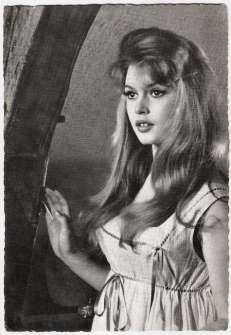
Brigitte Bardot
West German postcard by WS-Druck, Wanne-Eickel, no. 366.French actress Brigitte Bardot (1934) died on 28 December 2025, at the age of 91. In the 1950s, she was the sex kitten of the European film industry. BB starred in 48 films, performed in numerous musical shows, and recorded 80 songs. After her retirement in 1973, she established herself as an animal rights activist. In the coming weeks, we will post a BB postcard every day to remember her as she once was.Brigitte Bardot was born in Paris in 1934. Her father, Louis Bardot, had an engineering degree and worked with his father in the family business. Her mother, Ann-Marie Mucel, was 14 years younger than Brigitte's father, and they married in 1933. Brigitte's mother encouraged her daughter to take up music and dance. At the age of 13, she entered the Conservatoire Nationale de Danse to study ballet. By the time she was 15, Brigitte was trying a modelling career and found herself in May 1949 on the cover of the French magazine Elle. Her incredible beauty was readily apparent, and Brigitte was noticed by Roger Vadim, then an assistant to the film director Marc Allegrét. Vadim was infatuated with Bardot and encouraged her to start working as a film actress. BB was 18 when she debuted in the comedy Le Trou Normand / Crazy for Love (Jean Boyer, 1952). In the same year, she married Vadim. Brigitte wanted to marry him when she was 17, but her parents quashed any marriage plans until she turned 18. In April 1953, she attended the Cannes Film Festival, where she received massive media attention. She soon was every man's idea of the girl he'd like to meet in Paris. From 1952 to 1956, she appeared in seventeen films. Her films were generally lightweight romantic dramas in which she was cast as an ingénue or siren, often with an element of undress. In 1953, she made her first US production, Un acte d'amour / Act of Love (Anatole Litvak, 1953) with Kirk Douglas, but she continued to make films in France.Roger Vadim was not content with the light fare his wife was offered. He felt Brigitte Bardot was being undersold. Looking for something more like an art film to push her as a serious actress, he showcased her in Et Dieu créa la femme / ...And God Created Woman (Roger Vadim, 1956). This film, about an immoral teenager in a respectable small-town setting, was a smash success on both sides of the Atlantic. Craig Butler at AllMovie: "It's easy enough to say that ...And God Created Woman is much more important for its historical significance than for its actual quality as a film, and that's true to an extent. The immense popularity, due to its willingness to directly embrace an exploration of sex as well as its willingness to show a degree of nudity that was remarkably daring for its day, demonstrated that audiences were willing to view subject matter that was considered too racy for the average moviegoer. This had both positive (freedom to explore, especially for the French filmmakers of the time) and negative (freedom to exploit) consequences, but its impact is undeniable. It's also true that Woman is not a great work of art, not with a story that is ultimately rather thin, some painful dialogue, and an attitude toward its characters and their sexuality that is unclear and inconsistent. Yet Woman is still fascinating, due in no small part to the presence of Brigitte Bardot in the role that made her an international star and sex symbol. She's not demonstrating great acting here, although her performance is actually good and much better than necessary, and her legendary mambo scene at the climax is nothing short of sensational." During the shooting of Et Dieu créa la femme / And God Created Woman (Roger Vadim, 1956), directed by her husband, Brigitte Bardot had an affair with her co-star Jean-Louis Trintignant, who at that time was married to French actress Stéphane Audran. Her divorce from Vadim followed, but they remained friends and collaborated in later work.Et Dieu créa la femme / ...And God Created Woman (Roger Vadim, 1956) helped Brigitte Bardot's international status. The film took the USA by storm, her explosive sexuality being unlike anything seen in the States since the days of the 'flapper' in the 1920s. It gave rise to the phrase 'sex kitten', and fascination with her in America consisted of magazine photographs and dubbed over French films - good, bad or indifferent, her films drew audiences - mainly men - into theatres like lemmings. BB appeared in light comedies like Doctor at Large (Ralph Thomas, 1957) - the third of the British 'Doctor' series starring Dirk Bogarde - and Une Parisienne / La Parisienne (Michel Boisrond, 1957), which suited her acting skills best. However, she was a sensation in the crime drama En cas de malheur / Love is My Profession (Claude Autant-Lara, 1958). Hal Erickson at AllMovie: "This Brigitte Bardot vehicle ran into stiff opposition from the Catholic Legion of Decency, severely limiting its U.S. distribution. Bardot plays a nubile small-time thief named Yvette, who becomes the mistress of influential defence attorney Andre (Jean Gabin). Though Andre can shower Yvette with jewels and furs, he cannot "buy" her heart, and thus it is that it belongs to handsome young student Mazzetti (Franco Interlenghi). Alas, Yvette is no judge of human nature: attractive though Mazzetti can be, he has a dangerous and deadly side. En Cas de Malheur contains a nude scene that has since been reprinted in freeze-frame form innumerable times by both film-history books and girlie magazines." Photographer Sam Lévin's photos contributed considerably to her image of sensuality and slight immorality. One of Lévin's pictures shows Brigitte, dressed in a white corset. It is said that around 1960, postcards with this photograph outsold in Paris those of the Eiffel Tower.Brigitte Bardot divorced Vadim in 195,7 and in 1959 she married actor Jacques Charrier, with whom she starred in Babette s'en va-t-en guerre / Babette Goes to War (Christian-Jaque, 1959). The paparazzi preyed upon her marriage, while she and her husband clashed over the direction of her career
Her films became more substantial, but this brought a heavy pressure of dual celebrity as she sought critical acclaim while remaining a glamour model for most of the world. Vie privée / Private Life (1962), directed by Louis Malle, has more than an element of autobiography in it. James Travers at French Films: "Brigitte Bardot hadn’t quite reached the high point of her career when she agreed to make this film with high-profile New Wave film director Louis Malle. Even so, the pressure of being a living icon was obviously beginning to get to France’s sex goddess, and Vie privée is as much an attempt by Bardot to come to terms with her celebrity as anything else. Malle is clearly fascinated by Bardot, and the documentary approach he adopts for this film reinforces the impression that it is more a biography of the actress than a work of fiction. Of course, it’s not entirely biographical, but the story is remarkably close to Bardot’s own life and comes pretty close to predicting how her career would end." The scene in which, returning to her apartment, Bardot's character is harangued in the elevator by a middle-aged cleaning lady calling her offensive names was based on an actual incident, and is a resonant image of celebrity in the mid-20th century. Soon afterwards, Bardot withdrew to the seclusion of Southern France.Brigitte Bardot's other husbands were German millionaire Playboy Gunter Sachs and right-wing politician Bernard d'Ormale. She is reputed to have had relationships with many other men, including Samy Frey, her co-star in La Vérité / The Truth (Henri-Georges Clouzot, 1960), and musicians Serge Gainsbourg and Sacha Distel. In 1963, Brigitte Bardot starred in Jean-Luc Godard's critically acclaimed film Le Mépris / Contempt (Jean-Luc Godard, 1963) opposite Michel Piccoli. She was also featured along with such notable actors as Alain Delon in Amours célèbres / Famous Love Affairs (Michel Boisrond, 1961) and Histoires extraordinaires /Tales of Mystery (Louis Malle, 1968), Jeanne Moreau in Viva Maria! (Louis Malle, 1965), Sean Connery in Shalako (Edward Dmytryk, 1968), and Claudia Cardinale in Les Pétroleuses / Petroleum Girls (Christian-Jaque, 1971). She participated in various musical shows and recorded many popular songs in the 1960s and 1970s, mostly in collaboration with Serge Gainsbourg, Bob Zagury and Sacha Distel, including 'Harley Davidson', 'Le Soleil De Ma Vie' (the cover of Stevie Wonder's 'You Are the Sunshine of My Life') and the notorious 'Je t'aime... moi non plus'.Brigitte Bardot’s film career showed a steady decline in the late 1960s and early 1970s. In 1973, just before her fortieth birthday, she announced her retirement. She chose to use her fame to promote animal rights. In 1976, she established the Brigitte Bardot Foundation for the Welfare and Protection of Animals. She became a vegetarian and raised three million French francs to fund the foundation by auctioning off jewellery and many personal belongings. For this work, she was awarded the Légion d’honneur in 1984. During the 1990s, she was also outspoken in her criticism of immigration, interracial relationships, Islam in France and homosexuality. Her husband Bernard d'Ormal was a former adviser of the far-right Front National party. Bardot has been convicted five times for 'inciting racial hatred'. More fun is that Bardot is recognised for popularising bikini swimwear, in such early films as Manina / Woman without a Veil (Willy Rozier, 1952), in her appearances at Cannes and in many photo shoots. Bardot also brought into fashion the 'choucroute' ('Sauerkraut') hairstyle (a sort of beehive hairstyle) and gingham clothes after wearing a checkered pink dress, designed by Jacques Esterel, at her wedding to Charrier. The fashions of the 1960s looked effortlessly right and spontaneous on her. Time Magazine: "She is the princess of pout, the countess of come hither. Brigitte Bardot exuded a carefree, naïve sexuality that brought a whole new audience to French films."Sources: Denny Jackson (IMDb), Hal Erickson (AllMovie), Craig Butler (AllMovie), James Travers (French Films), French Films, Wikipedia and IMDb.And please check out our blog European Film Star Postcards.
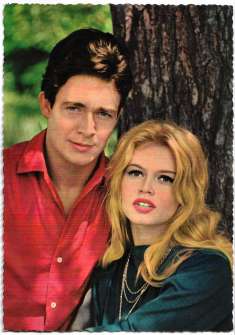
Jacques Charrier and Brigitte Bardot
West German postcard by Krüger, no. 902 / 337. Photo: Gérard Decaux. On the backside of the postcard, Jacques Charrier is misidentified as Sacha Distel.French actor and film producer Jacques Charrier (1936) played leading roles in the late 1950s and 1960s, but gained the most notoriety when he married Brigitte Bardot. His personal problems punctuated their brief, tumultuous marriage.French actress Brigitte Bardot (1934) died on 28 December 2025, at the age of 91. In the 1950s, she was the sex kitten of the European film industry. BB starred in 48 films, performed in numerous musical shows, and recorded 80 songs. After her retirement in 1973, she established herself as an animal rights activist. This month, we will post a BB postcard every day to remember her as she once was.And, please check out our blog European Film Star Postcards.
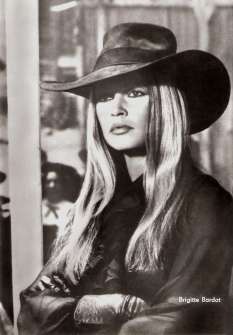
Brigitte Bardot in Les Petroleuses (1971)
East German postcard by VEB Progress Film-Verleih, Berlin, no. 159/73. Brigitte Bardot in Les pétroleuses / The Legend of Frenchie King (Christian-Jaque, Guy Casaril, 1971).French actress Brigitte Bardot (1934) died on 28 December 2025, at the age of 91. In the 1950s, she was the sex kitten of the European film industry. BB starred in 48 films, performed in numerous musical shows, and recorded 80 songs. After her retirement in 1973, she established herself as an animal rights activist. In the coming weeks, we will post a BB postcard every day to remember her as she once was.Brigitte Bardot was born in Paris in 1934. Her father, Louis Bardot, had an engineering degree and worked with his father in the family business. Her mother, Ann-Marie Mucel, was 14 years younger than Brigitte's father, and they married in 1933. Brigitte's mother encouraged her daughter to take up music and dance. At the age of 13, she entered the Conservatoire Nationale de Danse to study ballet. By the time she was 15, Brigitte was trying a modelling career and found herself in May 1949 on the cover of the French magazine Elle. Her incredible beauty was readily apparent, and Brigitte was noticed by Roger Vadim, then an assistant to the film director Marc Allegrét. Vadim was infatuated with Bardot and encouraged her to start working as a film actress. BB was 18 when she debuted in the comedy Le Trou Normand / Crazy for Love (Jean Boyer, 1952). In the same year, she married Vadim. Brigitte wanted to marry him when she was 17, but her parents quashed any marriage plans until she turned 18. In April 1953, she attended the Cannes Film Festival, where she received massive media attention. She soon was every man's idea of the girl he'd like to meet in Paris. From 1952 to 1956, she appeared in seventeen films. Her films were generally lightweight romantic dramas in which she was cast as an ingénue or siren, often with an element of undress. In 1953, she made her first US production, Un acte d'amour / Act of Love (Anatole Litvak, 1953) with Kirk Douglas, but she continued to make films in France.Roger Vadim was not content with the light fare his wife was offered. He felt Brigitte Bardot was being undersold. Looking for something more like an art film to push her as a serious actress, he showcased her in Et Dieu créa la femme / ...And God Created Woman (Roger Vadim, 1956). This film, about an immoral teenager in a respectable small-town setting, was a smash success on both sides of the Atlantic. Craig Butler at AllMovie: "It's easy enough to say that ...And God Created Woman is much more important for its historical significance than for its actual quality as a film, and that's true to an extent. The immense popularity, due to its willingness to directly embrace an exploration of sex as well as its willingness to show a degree of nudity that was remarkably daring for its day, demonstrated that audiences were willing to view subject matter that was considered too racy for the average moviegoer. This had both positive (freedom to explore, especially for the French filmmakers of the time) and negative (freedom to exploit) consequences, but its impact is undeniable. It's also true that Woman is not a great work of art, not with a story that is ultimately rather thin, some painful dialogue, and an attitude toward its characters and their sexuality that is unclear and inconsistent. Yet Woman is still fascinating, due in no small part to the presence of Brigitte Bardot in the role that made her an international star and sex symbol. She's not demonstrating great acting here, although her performance is actually good and much better than necessary, and her legendary mambo scene at the climax is nothing short of sensational." During the shooting of Et Dieu créa la femme / And God Created Woman (Roger Vadim, 1956), directed by her husband, Brigitte Bardot had an affair with her co-star Jean-Louis Trintignant, who at that time was married to French actress Stéphane Audran. Her divorce from Vadim followed, but they remained friends and collaborated in later work.Et Dieu créa la femme / ...And God Created Woman (Roger Vadim, 1956) helped Brigitte Bardot's international status. The film took the USA by storm, her explosive sexuality being unlike anything seen in the States since the days of the 'flapper' in the 1920s. It gave rise to the phrase 'sex kitten', and fascination with her in America consisted of magazine photographs and dubbed over French films - good, bad or indifferent, her films drew audiences - mainly men - into theatres like lemmings. BB appeared in light comedies like Doctor at Large (Ralph Thomas, 1957) - the third of the British 'Doctor' series starring Dirk Bogarde - and Une Parisienne / La Parisienne (Michel Boisrond, 1957), which suited her acting skills best. However, she was a sensation in the crime drama En cas de malheur / Love is My Profession (Claude Autant-Lara, 1958). Hal Erickson at AllMovie: "This Brigitte Bardot vehicle ran into stiff opposition from the Catholic Legion of Decency, severely limiting its U.S. distribution. Bardot plays a nubile small-time thief named Yvette, who becomes the mistress of influential defence attorney Andre (Jean Gabin). Though Andre can shower Yvette with jewels and furs, he cannot "buy" her heart, and thus it is that it belongs to handsome young student Mazzetti (Franco Interlenghi). Alas, Yvette is no judge of human nature: attractive though Mazzetti can be, he has a dangerous and deadly side. En Cas de Malheur contains a nude scene that has since been reprinted in freeze-frame form innumerable times by both film-history books and girlie magazines." Photographer Sam Lévin's photos contributed considerably to her image of sensuality and slight immorality. One of Lévin's pictures shows Brigitte, dressed in a white corset. It is said that around 1960, postcards with this photograph outsold in Paris those of the Eiffel Tower.Brigitte Bardot divorced Vadim in 195,7 and in 1959 she married actor Jacques Charrier, with whom she starred in Babette s'en va-t-en guerre / Babette Goes to War (Christian-Jaque, 1959). The paparazzi preyed upon her marriage, while she and her husband clashed over the direction of her career
Her films became more substantial, but this brought a heavy pressure of dual celebrity as she sought critical acclaim while remaining a glamour model for most of the world. Vie privée / Private Life (1962), directed by Louis Malle, has more than an element of autobiography in it. James Travers at French Films: "Brigitte Bardot hadn’t quite reached the high point of her career when she agreed to make this film with high-profile New Wave film director Louis Malle. Even so, the pressure of being a living icon was obviously beginning to get to France’s sex goddess, and Vie privée is as much an attempt by Bardot to come to terms with her celebrity as anything else. Malle is clearly fascinated by Bardot, and the documentary approach he adopts for this film reinforces the impression that it is more a biography of the actress than a work of fiction. Of course, it’s not entirely biographical, but the story is remarkably close to Bardot’s own life and comes pretty close to predicting how her career would end." The scene in which, returning to her apartment, Bardot's character is harangued in the elevator by a middle-aged cleaning lady calling her offensive names was based on an actual incident, and is a resonant image of celebrity in the mid-20th century. Soon afterwards, Bardot withdrew to the seclusion of Southern France.Brigitte Bardot's other husbands were German millionaire Playboy Gunter Sachs and right-wing politician Bernard d'Ormale. She is reputed to have had relationships with many other men, including Samy Frey, her co-star in La Vérité / The Truth (Henri-Georges Clouzot, 1960), and musicians Serge Gainsbourg and Sacha Distel. In 1963, Brigitte Bardot starred in Jean-Luc Godard's critically acclaimed film Le Mépris / Contempt (Jean-Luc Godard, 1963) opposite Michel Piccoli. She was also featured along with such notable actors as Alain Delon in Amours célèbres / Famous Love Affairs (Michel Boisrond, 1961) and Histoires extraordinaires /Tales of Mystery (Louis Malle, 1968), Jeanne Moreau in Viva Maria! (Louis Malle, 1965), Sean Connery in Shalako (Edward Dmytryk, 1968), and Claudia Cardinale in Les Pétroleuses / Petroleum Girls (Christian-Jaque, 1971). She participated in various musical shows and recorded many popular songs in the 1960s and 1970s, mostly in collaboration with Serge Gainsbourg, Bob Zagury and Sacha Distel, including 'Harley Davidson', 'Le Soleil De Ma Vie' (the cover of Stevie Wonder's 'You Are the Sunshine of My Life') and the notorious 'Je t'aime... moi non plus'.Brigitte Bardot’s film career showed a steady decline in the late 1960s and early 1970s. In 1973, just before her fortieth birthday, she announced her retirement. She chose to use her fame to promote animal rights. In 1976, she established the Brigitte Bardot Foundation for the Welfare and Protection of Animals. She became a vegetarian and raised three million French francs to fund the foundation by auctioning off jewellery and many personal belongings. For this work, she was awarded the Légion d’honneur in 1984. During the 1990s, she was also outspoken in her criticism of immigration, interracial relationships, Islam in France and homosexuality. Her husband Bernard d'Ormal was a former adviser of the far-right Front National party. Bardot has been convicted five times for 'inciting racial hatred'. More fun is that Bardot is recognised for popularising bikini swimwear, in such early films as Manina / Woman without a Veil (Willy Rozier, 1952), in her appearances at Cannes and in many photo shoots. Bardot also brought into fashion the 'choucroute' ('Sauerkraut') hairstyle (a sort of beehive hairstyle) and gingham clothes after wearing a checkered pink dress, designed by Jacques Esterel, at her wedding to Charrier. The fashions of the 1960s looked effortlessly right and spontaneous on her. Time Magazine: "She is the princess of pout, the countess of come hither. Brigitte Bardot exuded a carefree, naïve sexuality that brought a whole new audience to French films."Sources: Denny Jackson (IMDb), Hal Erickson (AllMovie), Craig Butler (AllMovie), James Travers (French Films), French Films, Wikipedia and IMDb.And please check out our blog European Film Star Postcards.
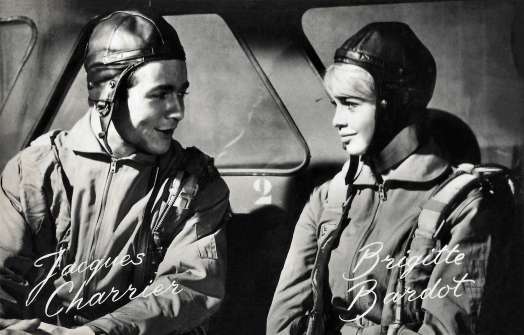
Jacques Charrier and Brigitte Bardot in Babette s'en va-t-en guerre (1959)
Dutch postcard by Takken, Utrecht, no. AX 4100. Jacques Charrier and Brigitte Bardot in Babette s'en va-t-en guerre / Babette Goes To War (Christian-Jaque, 1959).French actress Brigitte Bardot (1934) died on 28 December 2025, at the age of 91. In the 1950s, she was the sex kitten of the European film industry. BB starred in 48 films, performed in numerous musical shows, and recorded 80 songs. After her retirement in 1973, she established herself as an animal rights activist. This month, we will post a BB postcard every day to remember her as she once was.French actor and film producer Jacques Charrier (1936) played leading roles in the late 1950s and 1960s, but gained the most notoriety when he married Brigitte Bardot. His personal problems punctuated their brief, tumultuous marriage.And, please check out our blog European Film Star Postcards.
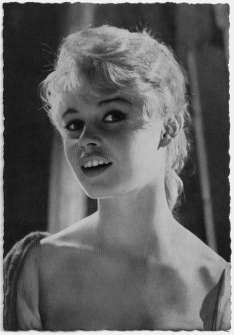
Brigitte Bardot
West German postcard by WS-Druck, Wanne-Eickel, no. 221. Photo: Archiv Filmpress Zürich.French actress Brigitte Bardot (1934) died on 28 December 2025, at the age of 91. In the 1950s, she was the sex kitten of the European film industry. BB starred in 48 films, performed in numerous musical shows, and recorded 80 songs. After her retirement in 1973, she established herself as an animal rights activist and made vegetarianism sexy. In the coming weeks, we will post a BB postcard every day to remember her as she once was.Brigitte Bardot was born in Paris in 1934. Her father, Louis Bardot, had an engineering degree and worked with his father in the family business. Her mother, Ann-Marie Mucel, was 14 years younger than Brigitte's father, and they married in 1933. Brigitte's mother encouraged her daughter to take up music and dance. At the age of 13, she entered the Conservatoire Nationale de Danse to study ballet. By the time she was 15, Brigitte was trying a modelling career and found herself in May 1949 on the cover of the French magazine Elle. Her incredible beauty was readily apparent, and Brigitte was noticed by Roger Vadim, then an assistant to the film director Marc Allegrét. Vadim was infatuated with Bardot and encouraged her to start working as a film actress. BB was 18 when she debuted in the comedy Le Trou Normand / Crazy for Love (Jean Boyer, 1952). In the same year, she married Vadim. Brigitte wanted to marry him when she was 17, but her parents quashed any marriage plans until she turned 18. In April 1953, she attended the Cannes Film Festival, where she received massive media attention. She soon was every man's idea of the girl he'd like to meet in Paris. From 1952 to 1956, she appeared in seventeen films. Her films were generally lightweight romantic dramas in which she was cast as an ingénue or siren, often with an element of undress. In 1953, she made her first US production, Un acte d'amour / Act of Love (Anatole Litvak, 1953) with Kirk Douglas, but she continued to make films in France.Roger Vadim was not content with the light fare his wife was offered. He felt Brigitte Bardot was being undersold. Looking for something more like an art film to push her as a serious actress, he showcased her in Et Dieu créa la femme / ...And God Created Woman (Roger Vadim, 1956). This film, about an immoral teenager in a respectable small-town setting, was a smash success on both sides of the Atlantic. Craig Butler at AllMovie: "It's easy enough to say that ...And God Created Woman is much more important for its historical significance than for its actual quality as a film, and that's true to an extent. The immense popularity, due to its willingness to directly embrace an exploration of sex as well as its willingness to show a degree of nudity that was remarkably daring for its day, demonstrated that audiences were willing to view subject matter that was considered too racy for the average moviegoer. This had both positive (freedom to explore, especially for the French filmmakers of the time) and negative (freedom to exploit) consequences, but its impact is undeniable. It's also true that Woman is not a great work of art, not with a story that is ultimately rather thin, some painful dialogue, and an attitude toward its characters and their sexuality that is unclear and inconsistent. Yet Woman is still fascinating, due in no small part to the presence of Brigitte Bardot in the role that made her an international star and sex symbol. She's not demonstrating great acting here, although her performance is actually good and much better than necessary, and her legendary mambo scene at the climax is nothing short of sensational." During the shooting of Et Dieu créa la femme / And God Created Woman (Roger Vadim, 1956), directed by her husband, Brigitte Bardot had an affair with her co-star Jean-Louis Trintignant, who at that time was married to French actress Stéphane Audran. Her divorce from Vadim followed, but they remained friends and collaborated in later work.Et Dieu créa la femme / ...And God Created Woman (Roger Vadim, 1956) helped Brigitte Bardot's international status. The film took the USA by storm, her explosive sexuality being unlike anything seen in the States since the days of the 'flapper' in the 1920s. It gave rise to the phrase 'sex kitten', and fascination with her in America consisted of magazine photographs and dubbed over French films - good, bad or indifferent, her films drew audiences - mainly men - into theatres like lemmings. BB appeared in light comedies like Doctor at Large (Ralph Thomas, 1957) - the third of the British 'Doctor' series starring Dirk Bogarde - and Une Parisienne / La Parisienne (Michel Boisrond, 1957), which suited her acting skills best. However, she was a sensation in the crime drama En cas de malheur / Love is My Profession (Claude Autant-Lara, 1958). Hal Erickson at AllMovie: "This Brigitte Bardot vehicle ran into stiff opposition from the Catholic Legion of Decency, severely limiting its U.S. distribution. Bardot plays a nubile small-time thief named Yvette, who becomes the mistress of influential defence attorney Andre (Jean Gabin). Though Andre can shower Yvette with jewels and furs, he cannot "buy" her heart, and thus it is that it belongs to handsome young student Mazzetti (Franco Interlenghi). Alas, Yvette is no judge of human nature: attractive though Mazzetti can be, he has a dangerous and deadly side. En Cas de Malheur contains a nude scene that has since been reprinted in freeze-frame form innumerable times by both film-history books and girlie magazines." Photographer Sam Lévin's photos contributed considerably to her image of sensuality and slight immorality. One of Lévin's pictures shows Brigitte, dressed in a white corset. It is said that around 1960, postcards with this photograph outsold in Paris those of the Eiffel Tower.Brigitte Bardot divorced Vadim in 195,7 and in 1959 she married actor Jacques Charrier, with whom she starred in Babette s'en va-t-en guerre / Babette Goes to War (Christian-Jaque, 1959). The paparazzi preyed upon her marriage, while she and her husband clashed over the direction of her career
Her films became more substantial, but this brought a heavy pressure of dual celebrity as she sought critical acclaim while remaining a glamour model for most of the world. Vie privée / Private Life (1962), directed by Louis Malle, has more than an element of autobiography in it. James Travers at French Films: "Brigitte Bardot hadn’t quite reached the high point of her career when she agreed to make this film with high-profile New Wave film director Louis Malle. Even so, the pressure of being a living icon was obviously beginning to get to France’s sex goddess, and Vie privée is as much an attempt by Bardot to come to terms with her celebrity as anything else. Malle is clearly fascinated by Bardot, and the documentary approach he adopts for this film reinforces the impression that it is more a biography of the actress than a work of fiction. Of course, it’s not entirely biographical, but the story is remarkably close to Bardot’s own life and comes pretty close to predicting how her career would end." The scene in which, returning to her apartment, Bardot's character is harangued in the elevator by a middle-aged cleaning lady calling her offensive names was based on an actual incident, and is a resonant image of celebrity in the mid-20th century. Soon afterwards, Bardot withdrew to the seclusion of Southern France.Brigitte Bardot's other husbands were German millionaire Playboy Gunter Sachs and right-wing politician Bernard d'Ormale. She is reputed to have had relationships with many other men, including Samy Frey, her co-star in La Vérité / The Truth (Henri-Georges Clouzot, 1960), and musicians Serge Gainsbourg and Sacha Distel. In 1963, Brigitte Bardot starred in Jean-Luc Godard's critically acclaimed film Le Mépris / Contempt (Jean-Luc Godard, 1963) opposite Michel Piccoli. She was also featured along with such notable actors as Alain Delon in Amours célèbres / Famous Love Affairs (Michel Boisrond, 1961) and Histoires extraordinaires /Tales of Mystery (Louis Malle, 1968), Jeanne Moreau in Viva Maria! (Louis Malle, 1965), Sean Connery in Shalako (Edward Dmytryk, 1968), and Claudia Cardinale in Les Pétroleuses / Petroleum Girls (Christian-Jaque, 1971). She participated in various musical shows and recorded many popular songs in the 1960s and 1970s, mostly in collaboration with Serge Gainsbourg, Bob Zagury and Sacha Distel, including 'Harley Davidson', 'Le Soleil De Ma Vie' (the cover of Stevie Wonder's 'You Are the Sunshine of My Life') and the notorious 'Je t'aime... moi non plus'.Brigitte Bardot’s film career showed a steady decline in the late 1960s and early 1970s. In 1973, just before her fortieth birthday, she announced her retirement. She chose to use her fame to promote animal rights. In 1976, she established the Brigitte Bardot Foundation for the Welfare and Protection of Animals. She became a vegetarian and raised three million French francs to fund the foundation by auctioning off jewellery and many personal belongings. For this work, she was awarded the Légion d’honneur in 1984. During the 1990s, she was also outspoken in her criticism of immigration, interracial relationships, Islam in France and homosexuality. Her husband Bernard d'Ormal was a former adviser of the far-right Front National party. Bardot has been convicted five times for 'inciting racial hatred'. More fun is that Bardot is recognised for popularising bikini swimwear, in such early films as Manina / Woman without a Veil (Willy Rozier, 1952), in her appearances at Cannes and in many photo shoots. Bardot also brought into fashion the 'choucroute' ('Sauerkraut') hairstyle (a sort of beehive hairstyle) and gingham clothes after wearing a checkered pink dress, designed by Jacques Esterel, at her wedding to Charrier. The fashions of the 1960s looked effortlessly right and spontaneous on her. Time Magazine: "She is the princess of pout, the countess of come hither. Brigitte Bardot exuded a carefree, naïve sexuality that brought a whole new audience to French films."Sources: Denny Jackson (IMDb), Hal Erickson (AllMovie), Craig Butler (AllMovie), James Travers (French Films), French Films, Wikipedia and IMDb.And please check out our blog European Film Star Postcards.
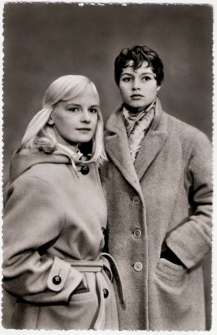
Isabelle Pia and Brigitte Bardot in Futures Vedettes (1955)
Vintage postcard. Isabelle Pia and Brigitte Bardot in Futures Vedettes / School for Love (Marc Allégret, 1955).Delicate French film actress Isabelle Pia (1935 – 2008) had a short career in the French cinema of the mid-1950s. After a promising start with seven films in 30 months, she refused a MGM contract and mysteriously retired.French actress Brigitte Bardot (1934) died on 28 December 2025, at the age of 91. In the 1950s, she was the sex kitten of the European film industry. BB starred in 48 films, performed in numerous musical shows, and recorded 80 songs. After her retirement in 1973, she established herself as an animal rights activist and made vegetarianism sexy. In the coming weeks, we will post a BB postcard every day to remember her as she once was.And please check out our blog European Film Star Postcards.
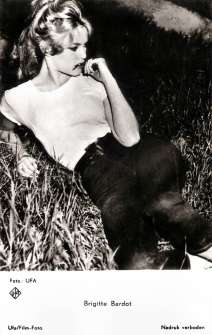
Brigitte Bardot
Dutch postcard by Gebr. Spanjersberg N.V., Rotterdam, no. 3647. Spanjersberg was the Dutch licensee holder of Universum-Film Aktiengesellschaft, Berlin-Tempelhof. Photo: Ufa. Sent by mail in 1961.French actress Brigitte Bardot (1934) died on 28 December 2025, at the age of 91. In the 1950s, she was the sex kitten of the European film industry. BB starred in 48 films, performed in numerous musical shows, and recorded 80 songs. After her retirement in 1973, she established herself as an animal rights activist and made vegetarianism sexy. In the coming weeks, we will post a BB postcard every day to remember her as she once was.Brigitte Bardot was born in Paris in 1934. Her father, Louis Bardot, had an engineering degree and worked with his father in the family business. Her mother, Ann-Marie Mucel, was 14 years younger than Brigitte's father, and they married in 1933. Brigitte's mother encouraged her daughter to take up music and dance. At the age of 13, she entered the Conservatoire Nationale de Danse to study ballet. By the time she was 15, Brigitte was trying a modelling career and found herself in May 1949 on the cover of the French magazine Elle. Her incredible beauty was readily apparent, and Brigitte was noticed by Roger Vadim, then an assistant to the film director Marc Allegrét. Vadim was infatuated with Bardot and encouraged her to start working as a film actress. BB was 18 when she debuted in the comedy Le Trou Normand / Crazy for Love (Jean Boyer, 1952). In the same year, she married Vadim. Brigitte wanted to marry him when she was 17, but her parents quashed any marriage plans until she turned 18. In April 1953, she attended the Cannes Film Festival, where she received massive media attention. She soon was every man's idea of the girl he'd like to meet in Paris. From 1952 to 1956, she appeared in seventeen films. Her films were generally lightweight romantic dramas in which she was cast as an ingénue or siren, often with an element of undress. In 1953, she made her first US production, Un acte d'amour / Act of Love (Anatole Litvak, 1953) with Kirk Douglas, but she continued to make films in France.Roger Vadim was not content with the light fare his wife was offered. He felt Brigitte Bardot was being undersold. Looking for something more like an art film to push her as a serious actress, he showcased her in Et Dieu créa la femme / ...And God Created Woman (Roger Vadim, 1956). This film, about an immoral teenager in a respectable small-town setting, was a smash success on both sides of the Atlantic. Craig Butler at AllMovie: "It's easy enough to say that ...And God Created Woman is much more important for its historical significance than for its actual quality as a film, and that's true to an extent. The immense popularity, due to its willingness to directly embrace an exploration of sex as well as its willingness to show a degree of nudity that was remarkably daring for its day, demonstrated that audiences were willing to view subject matter that was considered too racy for the average moviegoer. This had both positive (freedom to explore, especially for the French filmmakers of the time) and negative (freedom to exploit) consequences, but its impact is undeniable. It's also true that Woman is not a great work of art, not with a story that is ultimately rather thin, some painful dialogue, and an attitude toward its characters and their sexuality that is unclear and inconsistent. Yet Woman is still fascinating, due in no small part to the presence of Brigitte Bardot in the role that made her an international star and sex symbol. She's not demonstrating great acting here, although her performance is actually good and much better than necessary, and her legendary mambo scene at the climax is nothing short of sensational." During the shooting of Et Dieu créa la femme / And God Created Woman (Roger Vadim, 1956), directed by her husband, Brigitte Bardot had an affair with her co-star Jean-Louis Trintignant, who at that time was married to French actress Stéphane Audran. Her divorce from Vadim followed, but they remained friends and collaborated in later work.Et Dieu créa la femme / ...And God Created Woman (Roger Vadim, 1956) helped Brigitte Bardot's international status. The film took the USA by storm, her explosive sexuality being unlike anything seen in the States since the days of the 'flapper' in the 1920s. It gave rise to the phrase 'sex kitten', and fascination with her in America consisted of magazine photographs and dubbed over French films - good, bad or indifferent, her films drew audiences - mainly men - into theatres like lemmings. BB appeared in light comedies like Doctor at Large (Ralph Thomas, 1957) - the third of the British 'Doctor' series starring Dirk Bogarde - and Une Parisienne / La Parisienne (Michel Boisrond, 1957), which suited her acting skills best. However, she was a sensation in the crime drama En cas de malheur / Love is My Profession (Claude Autant-Lara, 1958). Hal Erickson at AllMovie: "This Brigitte Bardot vehicle ran into stiff opposition from the Catholic Legion of Decency, severely limiting its U.S. distribution. Bardot plays a nubile small-time thief named Yvette, who becomes the mistress of influential defence attorney Andre (Jean Gabin). Though Andre can shower Yvette with jewels and furs, he cannot "buy" her heart, and thus it is that it belongs to handsome young student Mazzetti (Franco Interlenghi). Alas, Yvette is no judge of human nature: attractive though Mazzetti can be, he has a dangerous and deadly side. En Cas de Malheur contains a nude scene that has since been reprinted in freeze-frame form innumerable times by both film-history books and girlie magazines." Photographer Sam Lévin's photos contributed considerably to her image of sensuality and slight immorality. One of Lévin's pictures shows Brigitte, dressed in a white corset. It is said that around 1960, postcards with this photograph outsold in Paris those of the Eiffel Tower.Brigitte Bardot divorced Vadim in 195,7 and in 1959 she married actor Jacques Charrier, with whom she starred in Babette s'en va-t-en guerre / Babette Goes to War (Christian-Jaque, 1959). The paparazzi preyed upon her marriage, while she and her husband clashed over the direction of her career
Her films became more substantial, but this brought a heavy pressure of dual celebrity as she sought critical acclaim while remaining a glamour model for most of the world. Vie privée / Private Life (1962), directed by Louis Malle, has more than an element of autobiography in it. James Travers at French Films: "Brigitte Bardot hadn’t quite reached the high point of her career when she agreed to make this film with high-profile New Wave film director Louis Malle. Even so, the pressure of being a living icon was obviously beginning to get to France’s sex goddess, and Vie privée is as much an attempt by Bardot to come to terms with her celebrity as anything else. Malle is clearly fascinated by Bardot, and the documentary approach he adopts for this film reinforces the impression that it is more a biography of the actress than a work of fiction. Of course, it’s not entirely biographical, but the story is remarkably close to Bardot’s own life and comes pretty close to predicting how her career would end." The scene in which, returning to her apartment, Bardot's character is harangued in the elevator by a middle-aged cleaning lady calling her offensive names was based on an actual incident, and is a resonant image of celebrity in the mid-20th century. Soon afterwards, Bardot withdrew to the seclusion of Southern France.Brigitte Bardot's other husbands were German millionaire Playboy Gunter Sachs and right-wing politician Bernard d'Ormale. She is reputed to have had relationships with many other men, including Samy Frey, her co-star in La Vérité / The Truth (Henri-Georges Clouzot, 1960), and musicians Serge Gainsbourg and Sacha Distel. In 1963, Brigitte Bardot starred in Jean-Luc Godard's critically acclaimed film Le Mépris / Contempt (Jean-Luc Godard, 1963) opposite Michel Piccoli. She was also featured along with such notable actors as Alain Delon in Amours célèbres / Famous Love Affairs (Michel Boisrond, 1961) and Histoires extraordinaires /Tales of Mystery (Louis Malle, 1968), Jeanne Moreau in Viva Maria! (Louis Malle, 1965), Sean Connery in Shalako (Edward Dmytryk, 1968), and Claudia Cardinale in Les Pétroleuses / Petroleum Girls (Christian-Jaque, 1971). She participated in various musical shows and recorded many popular songs in the 1960s and 1970s, mostly in collaboration with Serge Gainsbourg, Bob Zagury and Sacha Distel, including 'Harley Davidson', 'Le Soleil De Ma Vie' (the cover of Stevie Wonder's 'You Are the Sunshine of My Life') and the notorious 'Je t'aime... moi non plus'.Brigitte Bardot’s film career showed a steady decline in the late 1960s and early 1970s. In 1973, just before her fortieth birthday, she announced her retirement. She chose to use her fame to promote animal rights. In 1976, she established the Brigitte Bardot Foundation for the Welfare and Protection of Animals. She became a vegetarian and raised three million French francs to fund the foundation by auctioning off jewellery and many personal belongings. For this work, she was awarded the Légion d’honneur in 1984. During the 1990s, she was also outspoken in her criticism of immigration, interracial relationships, Islam in France and homosexuality. Her husband Bernard d'Ormal was a former adviser of the far-right Front National party. Bardot has been convicted five times for 'inciting racial hatred'. More fun is that Bardot is recognised for popularising bikini swimwear, in such early films as Manina / Woman without a Veil (Willy Rozier, 1952), in her appearances at Cannes and in many photo shoots. Bardot also brought into fashion the 'choucroute' ('Sauerkraut') hairstyle (a sort of beehive hairstyle) and gingham clothes after wearing a checkered pink dress, designed by Jacques Esterel, at her wedding to Charrier. The fashions of the 1960s looked effortlessly right and spontaneous on her. Time Magazine: "She is the princess of pout, the countess of come hither. Brigitte Bardot exuded a carefree, naïve sexuality that brought a whole new audience to French films."Sources: Denny Jackson (IMDb), Hal Erickson (AllMovie), Craig Butler (AllMovie), James Travers (French Films), French Films, Wikipedia and IMDb.And please check out our blog European Film Star Postcards.
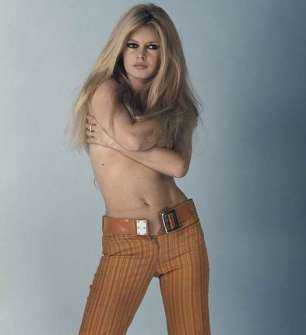
bb 1967
55026290305_efef92f44a_c
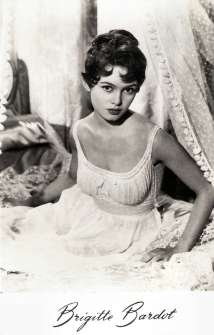
Brigitte Bardot
Dutch postcard by Uitg. Takken, Utrecht, no. 3258.French actress Brigitte Bardot (1934) died on 28 December 2025, at the age of 91. In the 1950s, she was the sex kitten of the European film industry. BB starred in 48 films, performed in numerous musical shows, and recorded 80 songs. After her retirement in 1973, she established herself as an animal rights activist and made vegetarianism sexy. In the coming weeks, we will post a BB postcard every day to remember her as she once was.Brigitte Bardot was born in Paris in 1934. Her father, Louis Bardot, had an engineering degree and worked with his father in the family business. Her mother, Ann-Marie Mucel, was 14 years younger than Brigitte's father, and they married in 1933. Brigitte's mother encouraged her daughter to take up music and dance. At the age of 13, she entered the Conservatoire Nationale de Danse to study ballet. By the time she was 15, Brigitte was trying a modelling career and found herself in May 1949 on the cover of the French magazine Elle. Her incredible beauty was readily apparent, and Brigitte was noticed by Roger Vadim, then an assistant to the film director Marc Allegrét. Vadim was infatuated with Bardot and encouraged her to start working as a film actress. BB was 18 when she debuted in the comedy Le Trou Normand / Crazy for Love (Jean Boyer, 1952). In the same year, she married Vadim. Brigitte wanted to marry him when she was 17, but her parents quashed any marriage plans until she turned 18. In April 1953, she attended the Cannes Film Festival, where she received massive media attention. She soon was every man's idea of the girl he'd like to meet in Paris. From 1952 to 1956, she appeared in seventeen films. Her films were generally lightweight romantic dramas in which she was cast as an ingénue or siren, often with an element of undress. In 1953, she made her first US production, Un acte d'amour / Act of Love (Anatole Litvak, 1953) with Kirk Douglas, but she continued to make films in France.Roger Vadim was not content with the light fare his wife was offered. He felt Brigitte Bardot was being undersold. Looking for something more like an art film to push her as a serious actress, he showcased her in Et Dieu créa la femme / ...And God Created Woman (Roger Vadim, 1956). This film, about an immoral teenager in a respectable small-town setting, was a smash success on both sides of the Atlantic. Craig Butler at AllMovie: "It's easy enough to say that ...And God Created Woman is much more important for its historical significance than for its actual quality as a film, and that's true to an extent. The immense popularity, due to its willingness to directly embrace an exploration of sex as well as its willingness to show a degree of nudity that was remarkably daring for its day, demonstrated that audiences were willing to view subject matter that was considered too racy for the average moviegoer. This had both positive (freedom to explore, especially for the French filmmakers of the time) and negative (freedom to exploit) consequences, but its impact is undeniable. It's also true that Woman is not a great work of art, not with a story that is ultimately rather thin, some painful dialogue, and an attitude toward its characters and their sexuality that is unclear and inconsistent. Yet Woman is still fascinating, due in no small part to the presence of Brigitte Bardot in the role that made her an international star and sex symbol. She's not demonstrating great acting here, although her performance is actually good and much better than necessary, and her legendary mambo scene at the climax is nothing short of sensational." During the shooting of Et Dieu créa la femme / And God Created Woman (Roger Vadim, 1956), directed by her husband, Brigitte Bardot had an affair with her co-star Jean-Louis Trintignant, who at that time was married to French actress Stéphane Audran. Her divorce from Vadim followed, but they remained friends and collaborated in later work.Et Dieu créa la femme / ...And God Created Woman (Roger Vadim, 1956) helped Brigitte Bardot's international status. The film took the USA by storm, her explosive sexuality being unlike anything seen in the States since the days of the 'flapper' in the 1920s. It gave rise to the phrase 'sex kitten', and fascination with her in America consisted of magazine photographs and dubbed over French films - good, bad or indifferent, her films drew audiences - mainly men - into theatres like lemmings. BB appeared in light comedies like Doctor at Large (Ralph Thomas, 1957) - the third of the British 'Doctor' series starring Dirk Bogarde - and Une Parisienne / La Parisienne (Michel Boisrond, 1957), which suited her acting skills best. However, she was a sensation in the crime drama En cas de malheur / Love is My Profession (Claude Autant-Lara, 1958). Hal Erickson at AllMovie: "This Brigitte Bardot vehicle ran into stiff opposition from the Catholic Legion of Decency, severely limiting its U.S. distribution. Bardot plays a nubile small-time thief named Yvette, who becomes the mistress of influential defence attorney Andre (Jean Gabin). Though Andre can shower Yvette with jewels and furs, he cannot "buy" her heart, and thus it is that it belongs to handsome young student Mazzetti (Franco Interlenghi). Alas, Yvette is no judge of human nature: attractive though Mazzetti can be, he has a dangerous and deadly side. En Cas de Malheur contains a nude scene that has since been reprinted in freeze-frame form innumerable times by both film-history books and girlie magazines." Photographer Sam Lévin's photos contributed considerably to her image of sensuality and slight immorality. One of Lévin's pictures shows Brigitte, dressed in a white corset. It is said that around 1960, postcards with this photograph outsold in Paris those of the Eiffel Tower.Brigitte Bardot divorced Vadim in 195,7 and in 1959 she married actor Jacques Charrier, with whom she starred in Babette s'en va-t-en guerre / Babette Goes to War (Christian-Jaque, 1959). The paparazzi preyed upon her marriage, while she and her husband clashed over the direction of her career
Her films became more substantial, but this brought a heavy pressure of dual celebrity as she sought critical acclaim while remaining a glamour model for most of the world. Vie privée / Private Life (1962), directed by Louis Malle, has more than an element of autobiography in it. James Travers at French Films: "Brigitte Bardot hadn’t quite reached the high point of her career when she agreed to make this film with high-profile New Wave film director Louis Malle. Even so, the pressure of being a living icon was obviously beginning to get to France’s sex goddess, and Vie privée is as much an attempt by Bardot to come to terms with her celebrity as anything else. Malle is clearly fascinated by Bardot, and the documentary approach he adopts for this film reinforces the impression that it is more a biography of the actress than a work of fiction. Of course, it’s not entirely biographical, but the story is remarkably close to Bardot’s own life and comes pretty close to predicting how her career would end." The scene in which, returning to her apartment, Bardot's character is harangued in the elevator by a middle-aged cleaning lady calling her offensive names was based on an actual incident, and is a resonant image of celebrity in the mid-20th century. Soon afterwards, Bardot withdrew to the seclusion of Southern France.Brigitte Bardot's other husbands were German millionaire Playboy Gunter Sachs and right-wing politician Bernard d'Ormale. She is reputed to have had relationships with many other men, including Samy Frey, her co-star in La Vérité / The Truth (Henri-Georges Clouzot, 1960), and musicians Serge Gainsbourg and Sacha Distel. In 1963, Brigitte Bardot starred in Jean-Luc Godard's critically acclaimed film Le Mépris / Contempt (Jean-Luc Godard, 1963) opposite Michel Piccoli. She was also featured along with such notable actors as Alain Delon in Amours célèbres / Famous Love Affairs (Michel Boisrond, 1961) and Histoires extraordinaires /Tales of Mystery (Louis Malle, 1968), Jeanne Moreau in Viva Maria! (Louis Malle, 1965), Sean Connery in Shalako (Edward Dmytryk, 1968), and Claudia Cardinale in Les Pétroleuses / Petroleum Girls (Christian-Jaque, 1971). She participated in various musical shows and recorded many popular songs in the 1960s and 1970s, mostly in collaboration with Serge Gainsbourg, Bob Zagury and Sacha Distel, including 'Harley Davidson', 'Le Soleil De Ma Vie' (the cover of Stevie Wonder's 'You Are the Sunshine of My Life') and the notorious 'Je t'aime... moi non plus'.Brigitte Bardot’s film career showed a steady decline in the late 1960s and early 1970s. In 1973, just before her fortieth birthday, she announced her retirement. She chose to use her fame to promote animal rights. In 1976, she established the Brigitte Bardot Foundation for the Welfare and Protection of Animals. She became a vegetarian and raised three million French francs to fund the foundation by auctioning off jewellery and many personal belongings. For this work, she was awarded the Légion d’honneur in 1984. During the 1990s, she was also outspoken in her criticism of immigration, interracial relationships, Islam in France and homosexuality. Her husband Bernard d'Ormal was a former adviser of the far-right Front National party. Bardot has been convicted five times for 'inciting racial hatred'. More fun is that Bardot is recognised for popularising bikini swimwear, in such early films as Manina / Woman without a Veil (Willy Rozier, 1952), in her appearances at Cannes and in many photo shoots. Bardot also brought into fashion the 'choucroute' ('Sauerkraut') hairstyle (a sort of beehive hairstyle) and gingham clothes after wearing a checkered pink dress, designed by Jacques Esterel, at her wedding to Charrier. The fashions of the 1960s looked effortlessly right and spontaneous on her. Time Magazine: "She is the princess of pout, the countess of come hither. Brigitte Bardot exuded a carefree, naïve sexuality that brought a whole new audience to French films."Sources: Denny Jackson (IMDb), Hal Erickson (AllMovie), Craig Butler (AllMovie), James Travers (French Films), French Films, Wikipedia and IMDb.And please check out our blog European Film Star Postcards.
Bardot on the banks of the Thames in ''À Coeur Joie/Two Weeks in September'', 1967.
+ Laurent Terzieff (he's the one clapping).
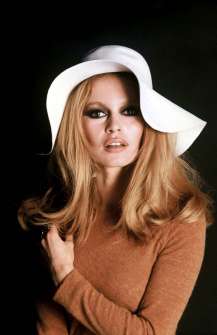
R.I.P. Brigitte Bardot.
55022744131_b4bb83175b_b
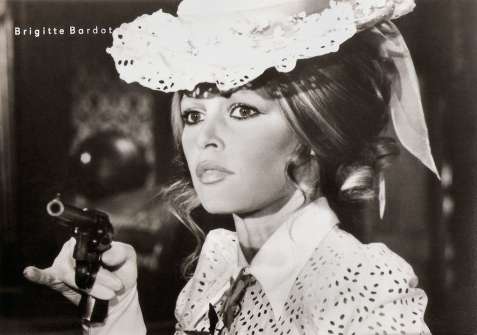
Brigitte Bardot in Les pétroleuses (1971)
East German postcard by VEB Progress Film-Vertrieb, Berlin, no. 111/73. Brigitte Bardot in Les pétroleuses / The Legend of Frenchie King (Christian-Jaque, Guy Casaril, 1971).French actress Brigitte Bardot (1934) died on 28 December 2025, at the age of 91. In the 1950s, she was the sex kitten of the European film industry. BB starred in 48 films, performed in numerous musical shows, and recorded 80 songs. After her retirement in 1973, she established herself as an animal rights activist and made vegetarianism sexy. In the coming weeks, we will post a BB postcard every day to remember her as she once was.Brigitte Bardot was born in Paris in 1934. Her father, Louis Bardot, had an engineering degree and worked with his father in the family business. Her mother, Ann-Marie Mucel, was 14 years younger than Brigitte's father, and they married in 1933. Brigitte's mother encouraged her daughter to take up music and dance. At the age of 13, she entered the Conservatoire Nationale de Danse to study ballet. By the time she was 15, Brigitte was trying a modelling career and found herself in May 1949 on the cover of the French magazine Elle. Her incredible beauty was readily apparent, and Brigitte was noticed by Roger Vadim, then an assistant to the film director Marc Allegrét. Vadim was infatuated with Bardot and encouraged her to start working as a film actress. BB was 18 when she debuted in the comedy Le Trou Normand / Crazy for Love (Jean Boyer, 1952). In the same year, she married Vadim. Brigitte wanted to marry him when she was 17, but her parents quashed any marriage plans until she turned 18. In April 1953, she attended the Cannes Film Festival, where she received massive media attention. She soon was every man's idea of the girl he'd like to meet in Paris. From 1952 to 1956, she appeared in seventeen films. Her films were generally lightweight romantic dramas in which she was cast as an ingénue or siren, often with an element of undress. In 1953, she made her first US production, Un acte d'amour / Act of Love (Anatole Litvak, 1953) with Kirk Douglas, but she continued to make films in France.Roger Vadim was not content with the light fare his wife was offered. He felt Brigitte Bardot was being undersold. Looking for something more like an art film to push her as a serious actress, he showcased her in Et Dieu créa la femme / ...And God Created Woman (Roger Vadim, 1956). This film, about an immoral teenager in a respectable small-town setting, was a smash success on both sides of the Atlantic. Craig Butler at AllMovie: "It's easy enough to say that ...And God Created Woman is much more important for its historical significance than for its actual quality as a film, and that's true to an extent. The immense popularity, due to its willingness to directly embrace an exploration of sex as well as its willingness to show a degree of nudity that was remarkably daring for its day, demonstrated that audiences were willing to view subject matter that was considered too racy for the average moviegoer. This had both positive (freedom to explore, especially for the French filmmakers of the time) and negative (freedom to exploit) consequences, but its impact is undeniable. It's also true that Woman is not a great work of art, not with a story that is ultimately rather thin, some painful dialogue, and an attitude toward its characters and their sexuality that is unclear and inconsistent. Yet Woman is still fascinating, due in no small part to the presence of Brigitte Bardot in the role that made her an international star and sex symbol. She's not demonstrating great acting here, although her performance is actually good and much better than necessary, and her legendary mambo scene at the climax is nothing short of sensational." During the shooting of Et Dieu créa la femme / And God Created Woman (Roger Vadim, 1956), directed by her husband, Brigitte Bardot had an affair with her co-star Jean-Louis Trintignant, who at that time was married to French actress Stéphane Audran. Her divorce from Vadim followed, but they remained friends and collaborated in later work.Et Dieu créa la femme / ...And God Created Woman (Roger Vadim, 1956) helped Brigitte Bardot's international status. The film took the USA by storm, her explosive sexuality being unlike anything seen in the States since the days of the 'flapper' in the 1920s. It gave rise to the phrase 'sex kitten', and fascination with her in America consisted of magazine photographs and dubbed over French films - good, bad or indifferent, her films drew audiences - mainly men - into theatres like lemmings. BB appeared in light comedies like Doctor at Large (Ralph Thomas, 1957) - the third of the British 'Doctor' series starring Dirk Bogarde - and Une Parisienne / La Parisienne (Michel Boisrond, 1957), which suited her acting skills best. However, she was a sensation in the crime drama En cas de malheur / Love is My Profession (Claude Autant-Lara, 1958). Hal Erickson at AllMovie: "This Brigitte Bardot vehicle ran into stiff opposition from the Catholic Legion of Decency, severely limiting its U.S. distribution. Bardot plays a nubile small-time thief named Yvette, who becomes the mistress of influential defence attorney Andre (Jean Gabin). Though Andre can shower Yvette with jewels and furs, he cannot "buy" her heart, and thus it is that it belongs to handsome young student Mazzetti (Franco Interlenghi). Alas, Yvette is no judge of human nature: attractive though Mazzetti can be, he has a dangerous and deadly side. En Cas de Malheur contains a nude scene that has since been reprinted in freeze-frame form innumerable times by both film-history books and girlie magazines." Photographer Sam Lévin's photos contributed considerably to her image of sensuality and slight immorality. One of Lévin's pictures shows Brigitte, dressed in a white corset. It is said that around 1960, postcards with this photograph outsold in Paris those of the Eiffel Tower.Brigitte Bardot divorced Vadim in 195,7 and in 1959 she married actor Jacques Charrier, with whom she starred in Babette s'en va-t-en guerre / Babette Goes to War (Christian-Jaque, 1959). The paparazzi preyed upon her marriage, while she and her husband clashed over the direction of her career
Her films became more substantial, but this brought a heavy pressure of dual celebrity as she sought critical acclaim while remaining a glamour model for most of the world. Vie privée / Private Life (1962), directed by Louis Malle, has more than an element of autobiography in it. James Travers at French Films: "Brigitte Bardot hadn’t quite reached the high point of her career when she agreed to make this film with high-profile New Wave film director Louis Malle. Even so, the pressure of being a living icon was obviously beginning to get to France’s sex goddess, and Vie privée is as much an attempt by Bardot to come to terms with her celebrity as anything else. Malle is clearly fascinated by Bardot, and the documentary approach he adopts for this film reinforces the impression that it is more a biography of the actress than a work of fiction. Of course, it’s not entirely biographical, but the story is remarkably close to Bardot’s own life and comes pretty close to predicting how her career would end." The scene in which, returning to her apartment, Bardot's character is harangued in the elevator by a middle-aged cleaning lady calling her offensive names was based on an actual incident, and is a resonant image of celebrity in the mid-20th century. Soon afterwards, Bardot withdrew to the seclusion of Southern France.Brigitte Bardot's other husbands were German millionaire Playboy Gunter Sachs and right-wing politician Bernard d'Ormale. She is reputed to have had relationships with many other men, including Samy Frey, her co-star in La Vérité / The Truth (Henri-Georges Clouzot, 1960), and musicians Serge Gainsbourg and Sacha Distel. In 1963, Brigitte Bardot starred in Jean-Luc Godard's critically acclaimed film Le Mépris / Contempt (Jean-Luc Godard, 1963) opposite Michel Piccoli. She was also featured along with such notable actors as Alain Delon in Amours célèbres / Famous Love Affairs (Michel Boisrond, 1961) and Histoires extraordinaires /Tales of Mystery (Louis Malle, 1968), Jeanne Moreau in Viva Maria! (Louis Malle, 1965), Sean Connery in Shalako (Edward Dmytryk, 1968), and Claudia Cardinale in Les Pétroleuses / Petroleum Girls (Christian-Jaque, 1971). She participated in various musical shows and recorded many popular songs in the 1960s and 1970s, mostly in collaboration with Serge Gainsbourg, Bob Zagury and Sacha Distel, including 'Harley Davidson', 'Le Soleil De Ma Vie' (the cover of Stevie Wonder's 'You Are the Sunshine of My Life') and the notorious 'Je t'aime... moi non plus'.Brigitte Bardot’s film career showed a steady decline in the late 1960s and early 1970s. In 1973, just before her fortieth birthday, she announced her retirement. She chose to use her fame to promote animal rights. In 1976, she established the Brigitte Bardot Foundation for the Welfare and Protection of Animals. She became a vegetarian and raised three million French francs to fund the foundation by auctioning off jewellery and many personal belongings. For this work, she was awarded the Légion d’honneur in 1984. During the 1990s, she was also outspoken in her criticism of immigration, interracial relationships, Islam in France and homosexuality. Her husband Bernard d'Ormal was a former adviser of the far-right Front National party. Bardot has been convicted five times for 'inciting racial hatred'. More fun is that Bardot is recognised for popularising bikini swimwear, in such early films as Manina / Woman without a Veil (Willy Rozier, 1952), in her appearances at Cannes and in many photo shoots. Bardot also brought into fashion the 'choucroute' ('Sauerkraut') hairstyle (a sort of beehive hairstyle) and gingham clothes after wearing a checkered pink dress, designed by Jacques Esterel, at her wedding to Charrier. The fashions of the 1960s looked effortlessly right and spontaneous on her. Time Magazine: "She is the princess of pout, the countess of come hither. Brigitte Bardot exuded a carefree, naïve sexuality that brought a whole new audience to French films."Sources: Denny Jackson (IMDb), Hal Erickson (AllMovie), Craig Butler (AllMovie), James Travers (French Films), French Films, Wikipedia and IMDb.And please check out our blog European Film Star Postcards.
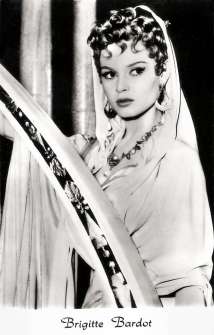
Brigitte Bardot in Mio Figlio Nerone (1956)
Dutch postcard, no. 861. Brigitte Bardot in Mio Figlio Nerone / Nero's Big Weekend (Steno, 1956).French actress Brigitte Bardot (1934) died on 28 December 2025, at the age of 91. In the 1950s, she was the sex kitten of the European film industry. BB starred in 48 films, performed in numerous musical shows, and recorded 80 songs. After her retirement in 1973, she established herself as an animal rights activist and made vegetarianism sexy. In the coming weeks, we will post a BB postcard every day to remember her as she once was.Brigitte Bardot was born in Paris in 1934. Her father, Louis Bardot, had an engineering degree and worked with his father in the family business. Her mother, Ann-Marie Mucel, was 14 years younger than Brigitte's father, and they married in 1933. Brigitte's mother encouraged her daughter to take up music and dance. At the age of 13, she entered the Conservatoire Nationale de Danse to study ballet. By the time she was 15, Brigitte was trying a modelling career and found herself in May 1949 on the cover of the French magazine Elle. Her incredible beauty was readily apparent, and Brigitte was noticed by Roger Vadim, then an assistant to the film director Marc Allegrét. Vadim was infatuated with Bardot and encouraged her to start working as a film actress. BB was 18 when she debuted in the comedy Le Trou Normand / Crazy for Love (Jean Boyer, 1952). In the same year, she married Vadim. Brigitte wanted to marry him when she was 17, but her parents quashed any marriage plans until she turned 18. In April 1953, she attended the Cannes Film Festival, where she received massive media attention. She soon was every man's idea of the girl he'd like to meet in Paris. From 1952 to 1956, she appeared in seventeen films. Her films were generally lightweight romantic dramas in which she was cast as an ingénue or siren, often with an element of undress. In 1953, she made her first US production, Un acte d'amour / Act of Love (Anatole Litvak, 1953) with Kirk Douglas, but she continued to make films in France.Roger Vadim was not content with the light fare his wife was offered. He felt Brigitte Bardot was being undersold. Looking for something more like an art film to push her as a serious actress, he showcased her in Et Dieu créa la femme / ...And God Created Woman (Roger Vadim, 1956). This film, about an immoral teenager in a respectable small-town setting, was a smash success on both sides of the Atlantic. Craig Butler at AllMovie: "It's easy enough to say that ...And God Created Woman is much more important for its historical significance than for its actual quality as a film, and that's true to an extent. The immense popularity, due to its willingness to directly embrace an exploration of sex as well as its willingness to show a degree of nudity that was remarkably daring for its day, demonstrated that audiences were willing to view subject matter that was considered too racy for the average moviegoer. This had both positive (freedom to explore, especially for the French filmmakers of the time) and negative (freedom to exploit) consequences, but its impact is undeniable. It's also true that Woman is not a great work of art, not with a story that is ultimately rather thin, some painful dialogue, and an attitude toward its characters and their sexuality that is unclear and inconsistent. Yet Woman is still fascinating, due in no small part to the presence of Brigitte Bardot in the role that made her an international star and sex symbol. She's not demonstrating great acting here, although her performance is actually good and much better than necessary, and her legendary mambo scene at the climax is nothing short of sensational." During the shooting of Et Dieu créa la femme / And God Created Woman (Roger Vadim, 1956), directed by her husband, Brigitte Bardot had an affair with her co-star Jean-Louis Trintignant, who at that time was married to French actress Stéphane Audran. Her divorce from Vadim followed, but they remained friends and collaborated in later work.Et Dieu créa la femme / ...And God Created Woman (Roger Vadim, 1956) helped Brigitte Bardot's international status. The film took the USA by storm, her explosive sexuality being unlike anything seen in the States since the days of the 'flapper' in the 1920s. It gave rise to the phrase 'sex kitten', and fascination with her in America consisted of magazine photographs and dubbed over French films - good, bad or indifferent, her films drew audiences - mainly men - into theatres like lemmings. BB appeared in light comedies like Doctor at Large (Ralph Thomas, 1957) - the third of the British 'Doctor' series starring Dirk Bogarde - and Une Parisienne / La Parisienne (Michel Boisrond, 1957), which suited her acting skills best. However, she was a sensation in the crime drama En cas de malheur / Love is My Profession (Claude Autant-Lara, 1958). Hal Erickson at AllMovie: "This Brigitte Bardot vehicle ran into stiff opposition from the Catholic Legion of Decency, severely limiting its U.S. distribution. Bardot plays a nubile small-time thief named Yvette, who becomes the mistress of influential defence attorney Andre (Jean Gabin). Though Andre can shower Yvette with jewels and furs, he cannot "buy" her heart, and thus it is that it belongs to handsome young student Mazzetti (Franco Interlenghi). Alas, Yvette is no judge of human nature: attractive though Mazzetti can be, he has a dangerous and deadly side. En Cas de Malheur contains a nude scene that has since been reprinted in freeze-frame form innumerable times by both film-history books and girlie magazines." Photographer Sam Lévin's photos contributed considerably to her image of sensuality and slight immorality. One of Lévin's pictures shows Brigitte, dressed in a white corset. It is said that around 1960, postcards with this photograph outsold in Paris those of the Eiffel Tower.Brigitte Bardot divorced Vadim in 195,7 and in 1959 she married actor Jacques Charrier, with whom she starred in Babette s'en va-t-en guerre / Babette Goes to War (Christian-Jaque, 1959). The paparazzi preyed upon her marriage, while she and her husband clashed over the direction of her career
Her films became more substantial, but this brought a heavy pressure of dual celebrity as she sought critical acclaim while remaining a glamour model for most of the world. Vie privée / Private Life (1962), directed by Louis Malle, has more than an element of autobiography in it. James Travers at French Films: "Brigitte Bardot hadn’t quite reached the high point of her career when she agreed to make this film with high-profile New Wave film director Louis Malle. Even so, the pressure of being a living icon was obviously beginning to get to France’s sex goddess, and Vie privée is as much an attempt by Bardot to come to terms with her celebrity as anything else. Malle is clearly fascinated by Bardot, and the documentary approach he adopts for this film reinforces the impression that it is more a biography of the actress than a work of fiction. Of course, it’s not entirely biographical, but the story is remarkably close to Bardot’s own life and comes pretty close to predicting how her career would end." The scene in which, returning to her apartment, Bardot's character is harangued in the elevator by a middle-aged cleaning lady calling her offensive names was based on an actual incident, and is a resonant image of celebrity in the mid-20th century. Soon afterwards, Bardot withdrew to the seclusion of Southern France.Brigitte Bardot's other husbands were German millionaire Playboy Gunter Sachs and right-wing politician Bernard d'Ormale. She is reputed to have had relationships with many other men, including Samy Frey, her co-star in La Vérité / The Truth (Henri-Georges Clouzot, 1960), and musicians Serge Gainsbourg and Sacha Distel. In 1963, Brigitte Bardot starred in Jean-Luc Godard's critically acclaimed film Le Mépris / Contempt (Jean-Luc Godard, 1963) opposite Michel Piccoli. She was also featured along with such notable actors as Alain Delon in Amours célèbres / Famous Love Affairs (Michel Boisrond, 1961) and Histoires extraordinaires /Tales of Mystery (Louis Malle, 1968), Jeanne Moreau in Viva Maria! (Louis Malle, 1965), Sean Connery in Shalako (Edward Dmytryk, 1968), and Claudia Cardinale in Les Pétroleuses / Petroleum Girls (Christian-Jaque, 1971). She participated in various musical shows and recorded many popular songs in the 1960s and 1970s, mostly in collaboration with Serge Gainsbourg, Bob Zagury and Sacha Distel, including 'Harley Davidson', 'Le Soleil De Ma Vie' (the cover of Stevie Wonder's 'You Are the Sunshine of My Life') and the notorious 'Je t'aime... moi non plus'.Brigitte Bardot’s film career showed a steady decline in the late 1960s and early 1970s. In 1973, just before her fortieth birthday, she announced her retirement. She chose to use her fame to promote animal rights. In 1976, she established the Brigitte Bardot Foundation for the Welfare and Protection of Animals. She became a vegetarian and raised three million French francs to fund the foundation by auctioning off jewellery and many personal belongings. For this work, she was awarded the Légion d’honneur in 1984. During the 1990s, she was also outspoken in her criticism of immigration, interracial relationships, Islam in France and homosexuality. Her husband Bernard d'Ormal was a former adviser of the far-right Front National party. Bardot has been convicted five times for 'inciting racial hatred'. More fun is that Bardot is recognised for popularising bikini swimwear, in such early films as Manina / Woman without a Veil (Willy Rozier, 1952), in her appearances at Cannes and in many photo shoots. Bardot also brought into fashion the 'choucroute' ('Sauerkraut') hairstyle (a sort of beehive hairstyle) and gingham clothes after wearing a checkered pink dress, designed by Jacques Esterel, at her wedding to Charrier. The fashions of the 1960s looked effortlessly right and spontaneous on her. Time Magazine: "She is the princess of pout, the countess of come hither. Brigitte Bardot exuded a carefree, naïve sexuality that brought a whole new audience to French films."Sources: Denny Jackson (IMDb), Hal Erickson (AllMovie), Craig Butler (AllMovie), James Travers (French Films), French Films, Wikipedia and IMDb.And please check out our blog European Film Star Postcards.
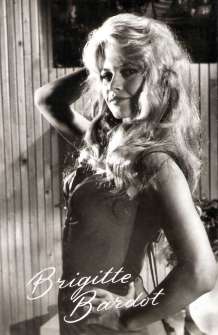
Brigitte Bardot
Dutch postcard by Takken, Utrecht, no. 3255.French actress Brigitte Bardot (1934) died on 28 December 2025, at the age of 91. In the 1950s, she was the sex kitten of the European film industry. BB starred in 48 films, performed in numerous musical shows, and recorded 80 songs. After her retirement in 1973, she established herself as an animal rights activist and made vegetarianism sexy. In the coming weeks, we will post a BB postcard every day to remember her as she once was.Brigitte Bardot was born in Paris in 1934. Her father, Louis Bardot, had an engineering degree and worked with his father in the family business. Her mother, Ann-Marie Mucel, was 14 years younger than Brigitte's father, and they married in 1933. Brigitte's mother encouraged her daughter to take up music and dance. At the age of 13, she entered the Conservatoire Nationale de Danse to study ballet. By the time she was 15, Brigitte was trying a modelling career and found herself in May 1949 on the cover of the French magazine Elle. Her incredible beauty was readily apparent, and Brigitte was noticed by Roger Vadim, then an assistant to the film director Marc Allegrét. Vadim was infatuated with Bardot and encouraged her to start working as a film actress. BB was 18 when she debuted in the comedy Le Trou Normand / Crazy for Love (Jean Boyer, 1952). In the same year, she married Vadim. Brigitte wanted to marry him when she was 17, but her parents quashed any marriage plans until she turned 18. In April 1953, she attended the Cannes Film Festival, where she received massive media attention. She soon was every man's idea of the girl he'd like to meet in Paris. From 1952 to 1956, she appeared in seventeen films. Her films were generally lightweight romantic dramas in which she was cast as an ingénue or siren, often with an element of undress. In 1953, she made her first US production, Un acte d'amour / Act of Love (Anatole Litvak, 1953) with Kirk Douglas, but she continued to make films in France.Roger Vadim was not content with the light fare his wife was offered. He felt Brigitte Bardot was being undersold. Looking for something more like an art film to push her as a serious actress, he showcased her in Et Dieu créa la femme / ...And God Created Woman (Roger Vadim, 1956). This film, about an immoral teenager in a respectable small-town setting, was a smash success on both sides of the Atlantic. Craig Butler at AllMovie: "It's easy enough to say that ...And God Created Woman is much more important for its historical significance than for its actual quality as a film, and that's true to an extent. The immense popularity, due to its willingness to directly embrace an exploration of sex as well as its willingness to show a degree of nudity that was remarkably daring for its day, demonstrated that audiences were willing to view subject matter that was considered too racy for the average moviegoer. This had both positive (freedom to explore, especially for the French filmmakers of the time) and negative (freedom to exploit) consequences, but its impact is undeniable. It's also true that Woman is not a great work of art, not with a story that is ultimately rather thin, some painful dialogue, and an attitude toward its characters and their sexuality that is unclear and inconsistent. Yet Woman is still fascinating, due in no small part to the presence of Brigitte Bardot in the role that made her an international star and sex symbol. She's not demonstrating great acting here, although her performance is actually good and much better than necessary, and her legendary mambo scene at the climax is nothing short of sensational." During the shooting of Et Dieu créa la femme / And God Created Woman (Roger Vadim, 1956), directed by her husband, Brigitte Bardot had an affair with her co-star Jean-Louis Trintignant, who at that time was married to French actress Stéphane Audran. Her divorce from Vadim followed, but they remained friends and collaborated in later work.Et Dieu créa la femme / ...And God Created Woman (Roger Vadim, 1956) helped Brigitte Bardot's international status. The film took the USA by storm, her explosive sexuality being unlike anything seen in the States since the days of the 'flapper' in the 1920s. It gave rise to the phrase 'sex kitten', and fascination with her in America consisted of magazine photographs and dubbed over French films - good, bad or indifferent, her films drew audiences - mainly men - into theatres like lemmings. BB appeared in light comedies like Doctor at Large (Ralph Thomas, 1957) - the third of the British 'Doctor' series starring Dirk Bogarde - and Une Parisienne / La Parisienne (Michel Boisrond, 1957), which suited her acting skills best. However, she was a sensation in the crime drama En cas de malheur / Love is My Profession (Claude Autant-Lara, 1958). Hal Erickson at AllMovie: "This Brigitte Bardot vehicle ran into stiff opposition from the Catholic Legion of Decency, severely limiting its U.S. distribution. Bardot plays a nubile small-time thief named Yvette, who becomes the mistress of influential defence attorney Andre (Jean Gabin). Though Andre can shower Yvette with jewels and furs, he cannot "buy" her heart, and thus it is that it belongs to handsome young student Mazzetti (Franco Interlenghi). Alas, Yvette is no judge of human nature: attractive though Mazzetti can be, he has a dangerous and deadly side. En Cas de Malheur contains a nude scene that has since been reprinted in freeze-frame form innumerable times by both film-history books and girlie magazines." Photographer Sam Lévin's photos contributed considerably to her image of sensuality and slight immorality. One of Lévin's pictures shows Brigitte, dressed in a white corset. It is said that around 1960, postcards with this photograph outsold in Paris those of the Eiffel Tower.Brigitte Bardot divorced Vadim in 195,7 and in 1959 she married actor Jacques Charrier, with whom she starred in Babette s'en va-t-en guerre / Babette Goes to War (Christian-Jaque, 1959). The paparazzi preyed upon her marriage, while she and her husband clashed over the direction of her career
Her films became more substantial, but this brought a heavy pressure of dual celebrity as she sought critical acclaim while remaining a glamour model for most of the world. Vie privée / Private Life (1962), directed by Louis Malle, has more than an element of autobiography in it. James Travers at French Films: "Brigitte Bardot hadn’t quite reached the high point of her career when she agreed to make this film with high-profile New Wave film director Louis Malle. Even so, the pressure of being a living icon was obviously beginning to get to France’s sex goddess, and Vie privée is as much an attempt by Bardot to come to terms with her celebrity as anything else. Malle is clearly fascinated by Bardot, and the documentary approach he adopts for this film reinforces the impression that it is more a biography of the actress than a work of fiction. Of course, it’s not entirely biographical, but the story is remarkably close to Bardot’s own life and comes pretty close to predicting how her career would end." The scene in which, returning to her apartment, Bardot's character is harangued in the elevator by a middle-aged cleaning lady calling her offensive names was based on an actual incident, and is a resonant image of celebrity in the mid-20th century. Soon afterwards, Bardot withdrew to the seclusion of Southern France.Brigitte Bardot's other husbands were German millionaire Playboy Gunter Sachs and right-wing politician Bernard d'Ormale. She is reputed to have had relationships with many other men, including Samy Frey, her co-star in La Vérité / The Truth (Henri-Georges Clouzot, 1960), and musicians Serge Gainsbourg and Sacha Distel. In 1963, Brigitte Bardot starred in Jean-Luc Godard's critically acclaimed film Le Mépris / Contempt (Jean-Luc Godard, 1963) opposite Michel Piccoli. She was also featured along with such notable actors as Alain Delon in Amours célèbres / Famous Love Affairs (Michel Boisrond, 1961) and Histoires extraordinaires /Tales of Mystery (Louis Malle, 1968), Jeanne Moreau in Viva Maria! (Louis Malle, 1965), Sean Connery in Shalako (Edward Dmytryk, 1968), and Claudia Cardinale in Les Pétroleuses / Petroleum Girls (Christian-Jaque, 1971). She participated in various musical shows and recorded many popular songs in the 1960s and 1970s, mostly in collaboration with Serge Gainsbourg, Bob Zagury and Sacha Distel, including 'Harley Davidson', 'Le Soleil De Ma Vie' (the cover of Stevie Wonder's 'You Are the Sunshine of My Life') and the notorious 'Je t'aime... moi non plus'.Brigitte Bardot’s film career showed a steady decline in the late 1960s and early 1970s. In 1973, just before her fortieth birthday, she announced her retirement. She chose to use her fame to promote animal rights. In 1976, she established the Brigitte Bardot Foundation for the Welfare and Protection of Animals. She became a vegetarian and raised three million French francs to fund the foundation by auctioning off jewellery and many personal belongings. For this work, she was awarded the Légion d’honneur in 1984. During the 1990s, she was also outspoken in her criticism of immigration, interracial relationships, Islam in France and homosexuality. Her husband Bernard d'Ormal was a former adviser of the far-right Front National party. Bardot has been convicted five times for 'inciting racial hatred'. More fun is that Bardot is recognised for popularising bikini swimwear, in such early films as Manina / Woman without a Veil (Willy Rozier, 1952), in her appearances at Cannes and in many photo shoots. Bardot also brought into fashion the 'choucroute' ('Sauerkraut') hairstyle (a sort of beehive hairstyle) and gingham clothes after wearing a checkered pink dress, designed by Jacques Esterel, at her wedding to Charrier. The fashions of the 1960s looked effortlessly right and spontaneous on her. Time Magazine: "She is the princess of pout, the countess of come hither. Brigitte Bardot exuded a carefree, naïve sexuality that brought a whole new audience to French films."Sources: Denny Jackson (IMDb), Hal Erickson (AllMovie), Craig Butler (AllMovie), James Travers (French Films), French Films, Wikipedia and IMDb.And please check out our blog European Film Star Postcards.
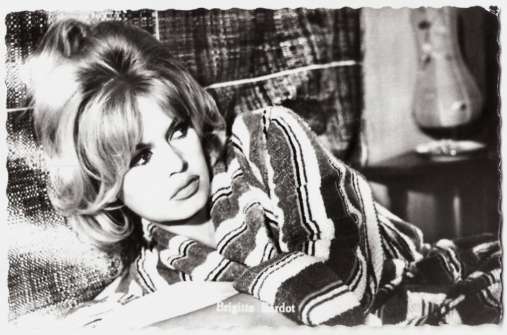
Brigitte Bardot in La vérité (1960)
Dutch postcard, sent by mail in 1961. Brigitte Bardot in La vérité / The Truth (Henri-Georges Clouzot, 1960).French actress Brigitte Bardot (1934) died on 28 December 2025, at the age of 91. In the 1950s, she was the sex kitten of the European film industry. BB starred in 48 films, performed in numerous musical shows, and recorded 80 songs. After her retirement in 1973, she established herself as an animal rights activist and made vegetarianism sexy. In the coming weeks, we will post a BB postcard every day to remember her as she once was.Brigitte Bardot was born in Paris in 1934. Her father, Louis Bardot, had an engineering degree and worked with his father in the family business. Her mother, Ann-Marie Mucel, was 14 years younger than Brigitte's father, and they married in 1933. Brigitte's mother encouraged her daughter to take up music and dance. At the age of 13, she entered the Conservatoire Nationale de Danse to study ballet. By the time she was 15, Brigitte was trying a modelling career and found herself in May 1949 on the cover of the French magazine Elle. Her incredible beauty was readily apparent, and Brigitte was noticed by Roger Vadim, then an assistant to the film director Marc Allegrét. Vadim was infatuated with Bardot and encouraged her to start working as a film actress. BB was 18 when she debuted in the comedy Le Trou Normand / Crazy for Love (Jean Boyer, 1952). In the same year, she married Vadim. Brigitte wanted to marry him when she was 17, but her parents quashed any marriage plans until she turned 18. In April 1953, she attended the Cannes Film Festival, where she received massive media attention. She soon was every man's idea of the girl he'd like to meet in Paris. From 1952 to 1956, she appeared in seventeen films. Her films were generally lightweight romantic dramas in which she was cast as an ingénue or siren, often with an element of undress. In 1953, she made her first US production, Un acte d'amour / Act of Love (Anatole Litvak, 1953) with Kirk Douglas, but she continued to make films in France.Roger Vadim was not content with the light fare his wife was offered. He felt Brigitte Bardot was being undersold. Looking for something more like an art film to push her as a serious actress, he showcased her in Et Dieu créa la femme / ...And God Created Woman (Roger Vadim, 1956). This film, about an immoral teenager in a respectable small-town setting, was a smash success on both sides of the Atlantic. Craig Butler at AllMovie: "It's easy enough to say that ...And God Created Woman is much more important for its historical significance than for its actual quality as a film, and that's true to an extent. The immense popularity, due to its willingness to directly embrace an exploration of sex as well as its willingness to show a degree of nudity that was remarkably daring for its day, demonstrated that audiences were willing to view subject matter that was considered too racy for the average moviegoer. This had both positive (freedom to explore, especially for the French filmmakers of the time) and negative (freedom to exploit) consequences, but its impact is undeniable. It's also true that Woman is not a great work of art, not with a story that is ultimately rather thin, some painful dialogue, and an attitude toward its characters and their sexuality that is unclear and inconsistent. Yet Woman is still fascinating, due in no small part to the presence of Brigitte Bardot in the role that made her an international star and sex symbol. She's not demonstrating great acting here, although her performance is actually good and much better than necessary, and her legendary mambo scene at the climax is nothing short of sensational." During the shooting of Et Dieu créa la femme / And God Created Woman (Roger Vadim, 1956), directed by her husband, Brigitte Bardot had an affair with her co-star Jean-Louis Trintignant, who at that time was married to French actress Stéphane Audran. Her divorce from Vadim followed, but they remained friends and collaborated in later work.Et Dieu créa la femme / ...And God Created Woman (Roger Vadim, 1956) helped Brigitte Bardot's international status. The film took the USA by storm, her explosive sexuality being unlike anything seen in the States since the days of the 'flapper' in the 1920s. It gave rise to the phrase 'sex kitten', and fascination with her in America consisted of magazine photographs and dubbed over French films - good, bad or indifferent, her films drew audiences - mainly men - into theatres like lemmings. BB appeared in light comedies like Doctor at Large (Ralph Thomas, 1957) - the third of the British 'Doctor' series starring Dirk Bogarde - and Une Parisienne / La Parisienne (Michel Boisrond, 1957), which suited her acting skills best. However, she was a sensation in the crime drama En cas de malheur / Love is My Profession (Claude Autant-Lara, 1958). Hal Erickson at AllMovie: "This Brigitte Bardot vehicle ran into stiff opposition from the Catholic Legion of Decency, severely limiting its U.S. distribution. Bardot plays a nubile small-time thief named Yvette, who becomes the mistress of influential defence attorney Andre (Jean Gabin). Though Andre can shower Yvette with jewels and furs, he cannot "buy" her heart, and thus it is that it belongs to handsome young student Mazzetti (Franco Interlenghi). Alas, Yvette is no judge of human nature: attractive though Mazzetti can be, he has a dangerous and deadly side. En Cas de Malheur contains a nude scene that has since been reprinted in freeze-frame form innumerable times by both film-history books and girlie magazines." Photographer Sam Lévin's photos contributed considerably to her image of sensuality and slight immorality. One of Lévin's pictures shows Brigitte, dressed in a white corset. It is said that around 1960, postcards with this photograph outsold in Paris those of the Eiffel Tower.Brigitte Bardot divorced Vadim in 195,7 and in 1959 she married actor Jacques Charrier, with whom she starred in Babette s'en va-t-en guerre / Babette Goes to War (Christian-Jaque, 1959). The paparazzi preyed upon her marriage, while she and her husband clashed over the direction of her career
Her films became more substantial, but this brought a heavy pressure of dual celebrity as she sought critical acclaim while remaining a glamour model for most of the world. Vie privée / Private Life (1962), directed by Louis Malle, has more than an element of autobiography in it. James Travers at French Films: "Brigitte Bardot hadn’t quite reached the high point of her career when she agreed to make this film with high-profile New Wave film director Louis Malle. Even so, the pressure of being a living icon was obviously beginning to get to France’s sex goddess, and Vie privée is as much an attempt by Bardot to come to terms with her celebrity as anything else. Malle is clearly fascinated by Bardot, and the documentary approach he adopts for this film reinforces the impression that it is more a biography of the actress than a work of fiction. Of course, it’s not entirely biographical, but the story is remarkably close to Bardot’s own life and comes pretty close to predicting how her career would end." The scene in which, returning to her apartment, Bardot's character is harangued in the elevator by a middle-aged cleaning lady calling her offensive names was based on an actual incident, and is a resonant image of celebrity in the mid-20th century. Soon afterwards, Bardot withdrew to the seclusion of Southern France.Brigitte Bardot's other husbands were German millionaire Playboy Gunter Sachs and right-wing politician Bernard d'Ormale. She is reputed to have had relationships with many other men, including Samy Frey, her co-star in La Vérité / The Truth (Henri-Georges Clouzot, 1960), and musicians Serge Gainsbourg and Sacha Distel. In 1963, Brigitte Bardot starred in Jean-Luc Godard's critically acclaimed film Le Mépris / Contempt (Jean-Luc Godard, 1963) opposite Michel Piccoli. She was also featured along with such notable actors as Alain Delon in Amours célèbres / Famous Love Affairs (Michel Boisrond, 1961) and Histoires extraordinaires /Tales of Mystery (Louis Malle, 1968), Jeanne Moreau in Viva Maria! (Louis Malle, 1965), Sean Connery in Shalako (Edward Dmytryk, 1968), and Claudia Cardinale in Les Pétroleuses / Petroleum Girls (Christian-Jaque, 1971). She participated in various musical shows and recorded many popular songs in the 1960s and 1970s, mostly in collaboration with Serge Gainsbourg, Bob Zagury and Sacha Distel, including 'Harley Davidson', 'Le Soleil De Ma Vie' (the cover of Stevie Wonder's 'You Are the Sunshine of My Life') and the notorious 'Je t'aime... moi non plus'.Brigitte Bardot’s film career showed a steady decline in the late 1960s and early 1970s. In 1973, just before her fortieth birthday, she announced her retirement. She chose to use her fame to promote animal rights. In 1976, she established the Brigitte Bardot Foundation for the Welfare and Protection of Animals. She became a vegetarian and raised three million French francs to fund the foundation by auctioning off jewellery and many personal belongings. For this work, she was awarded the Légion d’honneur in 1984. During the 1990s, she was also outspoken in her criticism of immigration, interracial relationships, Islam in France and homosexuality. Her husband Bernard d'Ormal was a former adviser of the far-right Front National party. Bardot has been convicted five times for 'inciting racial hatred'. More fun is that Bardot is recognised for popularising bikini swimwear, in such early films as Manina / Woman without a Veil (Willy Rozier, 1952), in her appearances at Cannes and in many photo shoots. Bardot also brought into fashion the 'choucroute' ('Sauerkraut') hairstyle (a sort of beehive hairstyle) and gingham clothes after wearing a checkered pink dress, designed by Jacques Esterel, at her wedding to Charrier. The fashions of the 1960s looked effortlessly right and spontaneous on her. Time Magazine: "She is the princess of pout, the countess of come hither. Brigitte Bardot exuded a carefree, naïve sexuality that brought a whole new audience to French films."Sources: Denny Jackson (IMDb), Hal Erickson (AllMovie), Craig Butler (AllMovie), James Travers (French Films), French Films, Wikipedia and IMDb.And please check out our blog European Film Star Postcards.
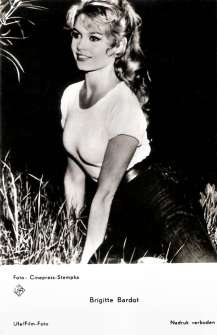
Brigitte Bardot
Dutch postcard by Gebr. Spanjersberg N.V., Rotterdam, Dutch licence holder for Ufa, Berlin-Tempelhof, no. 3649. Photo: Cinepress / Stempka / Ufa.French actress Brigitte Bardot (1934) died on 28 December 2025, at the age of 91. In the 1950s, she was the sex kitten of the European film industry. BB starred in 48 films, performed in numerous musical shows, and recorded 80 songs. After her retirement in 1973, she established herself as an animal rights activist and made vegetarianism sexy. In the coming weeks, we will post a BB postcard every day to remember her as she once was.Brigitte Bardot was born in Paris in 1934. Her father, Louis Bardot, had an engineering degree and worked with his father in the family business. Her mother, Ann-Marie Mucel, was 14 years younger than Brigitte's father, and they married in 1933. Brigitte's mother encouraged her daughter to take up music and dance. At the age of 13, she entered the Conservatoire Nationale de Danse to study ballet. By the time she was 15, Brigitte was trying a modelling career and found herself in May 1949 on the cover of the French magazine Elle. Her incredible beauty was readily apparent, and Brigitte was noticed by Roger Vadim, then an assistant to the film director Marc Allegrét. Vadim was infatuated with Bardot and encouraged her to start working as a film actress. BB was 18 when she debuted in the comedy Le Trou Normand / Crazy for Love (Jean Boyer, 1952). In the same year, she married Vadim. Brigitte wanted to marry him when she was 17, but her parents quashed any marriage plans until she turned 18. In April 1953, she attended the Cannes Film Festival, where she received massive media attention. She soon was every man's idea of the girl he'd like to meet in Paris. From 1952 to 1956, she appeared in seventeen films. Her films were generally lightweight romantic dramas in which she was cast as an ingénue or siren, often with an element of undress. In 1953, she made her first US production, Un acte d'amour / Act of Love (Anatole Litvak, 1953) with Kirk Douglas, but she continued to make films in France.Roger Vadim was not content with the light fare his wife was offered. He felt Brigitte Bardot was being undersold. Looking for something more like an art film to push her as a serious actress, he showcased her in Et Dieu créa la femme / ...And God Created Woman (Roger Vadim, 1956). This film, about an immoral teenager in a respectable small-town setting, was a smash success on both sides of the Atlantic. Craig Butler at AllMovie: "It's easy enough to say that ...And God Created Woman is much more important for its historical significance than for its actual quality as a film, and that's true to an extent. The immense popularity, due to its willingness to directly embrace an exploration of sex as well as its willingness to show a degree of nudity that was remarkably daring for its day, demonstrated that audiences were willing to view subject matter that was considered too racy for the average moviegoer. This had both positive (freedom to explore, especially for the French filmmakers of the time) and negative (freedom to exploit) consequences, but its impact is undeniable. It's also true that Woman is not a great work of art, not with a story that is ultimately rather thin, some painful dialogue, and an attitude toward its characters and their sexuality that is unclear and inconsistent. Yet Woman is still fascinating, due in no small part to the presence of Brigitte Bardot in the role that made her an international star and sex symbol. She's not demonstrating great acting here, although her performance is actually good and much better than necessary, and her legendary mambo scene at the climax is nothing short of sensational." During the shooting of Et Dieu créa la femme / And God Created Woman (Roger Vadim, 1956), directed by her husband, Brigitte Bardot had an affair with her co-star Jean-Louis Trintignant, who at that time was married to French actress Stéphane Audran. Her divorce from Vadim followed, but they remained friends and collaborated in later work.Et Dieu créa la femme / ...And God Created Woman (Roger Vadim, 1956) helped Brigitte Bardot's international status. The film took the USA by storm, her explosive sexuality being unlike anything seen in the States since the days of the 'flapper' in the 1920s. It gave rise to the phrase 'sex kitten', and fascination with her in America consisted of magazine photographs and dubbed over French films - good, bad or indifferent, her films drew audiences - mainly men - into theatres like lemmings. BB appeared in light comedies like Doctor at Large (Ralph Thomas, 1957) - the third of the British 'Doctor' series starring Dirk Bogarde - and Une Parisienne / La Parisienne (Michel Boisrond, 1957), which suited her acting skills best. However, she was a sensation in the crime drama En cas de malheur / Love is My Profession (Claude Autant-Lara, 1958). Hal Erickson at AllMovie: "This Brigitte Bardot vehicle ran into stiff opposition from the Catholic Legion of Decency, severely limiting its U.S. distribution. Bardot plays a nubile small-time thief named Yvette, who becomes the mistress of influential defence attorney Andre (Jean Gabin). Though Andre can shower Yvette with jewels and furs, he cannot "buy" her heart, and thus it is that it belongs to handsome young student Mazzetti (Franco Interlenghi). Alas, Yvette is no judge of human nature: attractive though Mazzetti can be, he has a dangerous and deadly side. En Cas de Malheur contains a nude scene that has since been reprinted in freeze-frame form innumerable times by both film-history books and girlie magazines." Photographer Sam Lévin's photos contributed considerably to her image of sensuality and slight immorality. One of Lévin's pictures shows Brigitte, dressed in a white corset. It is said that around 1960, postcards with this photograph outsold in Paris those of the Eiffel Tower.Brigitte Bardot divorced Vadim in 195,7 and in 1959 she married actor Jacques Charrier, with whom she starred in Babette s'en va-t-en guerre / Babette Goes to War (Christian-Jaque, 1959). The paparazzi preyed upon her marriage, while she and her husband clashed over the direction of her career
Her films became more substantial, but this brought a heavy pressure of dual celebrity as she sought critical acclaim while remaining a glamour model for most of the world. Vie privée / Private Life (1962), directed by Louis Malle, has more than an element of autobiography in it. James Travers at French Films: "Brigitte Bardot hadn’t quite reached the high point of her career when she agreed to make this film with high-profile New Wave film director Louis Malle. Even so, the pressure of being a living icon was obviously beginning to get to France’s sex goddess, and Vie privée is as much an attempt by Bardot to come to terms with her celebrity as anything else. Malle is clearly fascinated by Bardot, and the documentary approach he adopts for this film reinforces the impression that it is more a biography of the actress than a work of fiction. Of course, it’s not entirely biographical, but the story is remarkably close to Bardot’s own life and comes pretty close to predicting how her career would end." The scene in which, returning to her apartment, Bardot's character is harangued in the elevator by a middle-aged cleaning lady calling her offensive names was based on an actual incident, and is a resonant image of celebrity in the mid-20th century. Soon afterwards, Bardot withdrew to the seclusion of Southern France.Brigitte Bardot's other husbands were German millionaire Playboy Gunter Sachs and right-wing politician Bernard d'Ormale. She is reputed to have had relationships with many other men, including Samy Frey, her co-star in La Vérité / The Truth (Henri-Georges Clouzot, 1960), and musicians Serge Gainsbourg and Sacha Distel. In 1963, Brigitte Bardot starred in Jean-Luc Godard's critically acclaimed film Le Mépris / Contempt (Jean-Luc Godard, 1963) opposite Michel Piccoli. She was also featured along with such notable actors as Alain Delon in Amours célèbres / Famous Love Affairs (Michel Boisrond, 1961) and Histoires extraordinaires /Tales of Mystery (Louis Malle, 1968), Jeanne Moreau in Viva Maria! (Louis Malle, 1965), Sean Connery in Shalako (Edward Dmytryk, 1968), and Claudia Cardinale in Les Pétroleuses / Petroleum Girls (Christian-Jaque, 1971). She participated in various musical shows and recorded many popular songs in the 1960s and 1970s, mostly in collaboration with Serge Gainsbourg, Bob Zagury and Sacha Distel, including 'Harley Davidson', 'Le Soleil De Ma Vie' (the cover of Stevie Wonder's 'You Are the Sunshine of My Life') and the notorious 'Je t'aime... moi non plus'.Brigitte Bardot’s film career showed a steady decline in the late 1960s and early 1970s. In 1973, just before her fortieth birthday, she announced her retirement. She chose to use her fame to promote animal rights. In 1976, she established the Brigitte Bardot Foundation for the Welfare and Protection of Animals. She became a vegetarian and raised three million French francs to fund the foundation by auctioning off jewellery and many personal belongings. For this work, she was awarded the Légion d’honneur in 1984. During the 1990s, she was also outspoken in her criticism of immigration, interracial relationships, Islam in France and homosexuality. Her husband Bernard d'Ormal was a former adviser of the far-right Front National party. Bardot has been convicted five times for 'inciting racial hatred'. More fun is that Bardot is recognised for popularising bikini swimwear, in such early films as Manina / Woman without a Veil (Willy Rozier, 1952), in her appearances at Cannes and in many photo shoots. Bardot also brought into fashion the 'choucroute' ('Sauerkraut') hairstyle (a sort of beehive hairstyle) and gingham clothes after wearing a checkered pink dress, designed by Jacques Esterel, at her wedding to Charrier. The fashions of the 1960s looked effortlessly right and spontaneous on her. Time Magazine: "She is the princess of pout, the countess of come hither. Brigitte Bardot exuded a carefree, naïve sexuality that brought a whole new audience to French films."Sources: Denny Jackson (IMDb), Hal Erickson (AllMovie), Craig Butler (AllMovie), James Travers (French Films), French Films, Wikipedia and IMDb.And please check out our blog European Film Star Postcards.
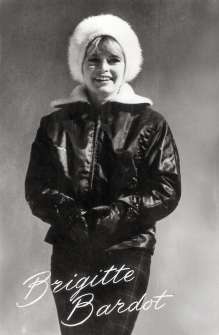
Brigitte Bardot in La Bride sur le cou (1961)
Dutch postcard by Uitg. Takken, Utrecht, no. AX 4712. Brigitte Bardot in La Bride sur le cou / Please, Not Now! (Roger Vadim, Jean Aurel, 1961). The Dutch title was Bandeloos.French actress Brigitte Bardot (1934) died on 28 December 2025, at the age of 91. In the 1950s, she was the sex kitten of the European film industry. BB starred in 48 films, performed in numerous musical shows, and recorded 80 songs. After her retirement in 1973, she established herself as an animal rights activist and made vegetarianism sexy. In the coming weeks, we will post a BB postcard every day to remember her as she once was.Brigitte Bardot was born in Paris in 1934. Her father, Louis Bardot, had an engineering degree and worked with his father in the family business. Her mother, Ann-Marie Mucel, was 14 years younger than Brigitte's father, and they married in 1933. Brigitte's mother encouraged her daughter to take up music and dance. At the age of 13, she entered the Conservatoire Nationale de Danse to study ballet. By the time she was 15, Brigitte was trying a modelling career and found herself in May 1949 on the cover of the French magazine Elle. Her incredible beauty was readily apparent, and Brigitte was noticed by Roger Vadim, then an assistant to the film director Marc Allegrét. Vadim was infatuated with Bardot and encouraged her to start working as a film actress. BB was 18 when she debuted in the comedy Le Trou Normand / Crazy for Love (Jean Boyer, 1952). In the same year, she married Vadim. Brigitte wanted to marry him when she was 17, but her parents quashed any marriage plans until she turned 18. In April 1953, she attended the Cannes Film Festival, where she received massive media attention. She soon was every man's idea of the girl he'd like to meet in Paris. From 1952 to 1956, she appeared in seventeen films. Her films were generally lightweight romantic dramas in which she was cast as an ingénue or siren, often with an element of undress. In 1953, she made her first US production, Un acte d'amour / Act of Love (Anatole Litvak, 1953) with Kirk Douglas, but she continued to make films in France.Roger Vadim was not content with the light fare his wife was offered. He felt Brigitte Bardot was being undersold. Looking for something more like an art film to push her as a serious actress, he showcased her in Et Dieu créa la femme / ...And God Created Woman (Roger Vadim, 1956). This film, about an immoral teenager in a respectable small-town setting, was a smash success on both sides of the Atlantic. Craig Butler at AllMovie: "It's easy enough to say that ...And God Created Woman is much more important for its historical significance than for its actual quality as a film, and that's true to an extent. The immense popularity, due to its willingness to directly embrace an exploration of sex as well as its willingness to show a degree of nudity that was remarkably daring for its day, demonstrated that audiences were willing to view subject matter that was considered too racy for the average moviegoer. This had both positive (freedom to explore, especially for the French filmmakers of the time) and negative (freedom to exploit) consequences, but its impact is undeniable. It's also true that Woman is not a great work of art, not with a story that is ultimately rather thin, some painful dialogue, and an attitude toward its characters and their sexuality that is unclear and inconsistent. Yet Woman is still fascinating, due in no small part to the presence of Brigitte Bardot in the role that made her an international star and sex symbol. She's not demonstrating great acting here, although her performance is actually good and much better than necessary, and her legendary mambo scene at the climax is nothing short of sensational." During the shooting of Et Dieu créa la femme / And God Created Woman (Roger Vadim, 1956), directed by her husband, Brigitte Bardot had an affair with her co-star Jean-Louis Trintignant, who at that time was married to French actress Stéphane Audran. Her divorce from Vadim followed, but they remained friends and collaborated in later work.Et Dieu créa la femme / ...And God Created Woman (Roger Vadim, 1956) helped Brigitte Bardot's international status. The film took the USA by storm, her explosive sexuality being unlike anything seen in the States since the days of the 'flapper' in the 1920s. It gave rise to the phrase 'sex kitten', and fascination with her in America consisted of magazine photographs and dubbed over French films - good, bad or indifferent, her films drew audiences - mainly men - into theatres like lemmings. BB appeared in light comedies like Doctor at Large (Ralph Thomas, 1957) - the third of the British 'Doctor' series starring Dirk Bogarde - and Une Parisienne / La Parisienne (Michel Boisrond, 1957), which suited her acting skills best. However, she was a sensation in the crime drama En cas de malheur / Love is My Profession (Claude Autant-Lara, 1958). Hal Erickson at AllMovie: "This Brigitte Bardot vehicle ran into stiff opposition from the Catholic Legion of Decency, severely limiting its U.S. distribution. Bardot plays a nubile small-time thief named Yvette, who becomes the mistress of influential defence attorney Andre (Jean Gabin). Though Andre can shower Yvette with jewels and furs, he cannot "buy" her heart, and thus it is that it belongs to handsome young student Mazzetti (Franco Interlenghi). Alas, Yvette is no judge of human nature: attractive though Mazzetti can be, he has a dangerous and deadly side. En Cas de Malheur contains a nude scene that has since been reprinted in freeze-frame form innumerable times by both film-history books and girlie magazines." Photographer Sam Lévin's photos contributed considerably to her image of sensuality and slight immorality. One of Lévin's pictures shows Brigitte, dressed in a white corset. It is said that around 1960, postcards with this photograph outsold in Paris those of the Eiffel Tower.Brigitte Bardot divorced Vadim in 195,7 and in 1959 she married actor Jacques Charrier, with whom she starred in Babette s'en va-t-en guerre / Babette Goes to War (Christian-Jaque, 1959). The paparazzi preyed upon her marriage, while she and her husband clashed over the direction of her career
Her films became more substantial, but this brought a heavy pressure of dual celebrity as she sought critical acclaim while remaining a glamour model for most of the world. Vie privée / Private Life (1962), directed by Louis Malle, has more than an element of autobiography in it. James Travers at French Films: "Brigitte Bardot hadn’t quite reached the high point of her career when she agreed to make this film with high-profile New Wave film director Louis Malle. Even so, the pressure of being a living icon was obviously beginning to get to France’s sex goddess, and Vie privée is as much an attempt by Bardot to come to terms with her celebrity as anything else. Malle is clearly fascinated by Bardot, and the documentary approach he adopts for this film reinforces the impression that it is more a biography of the actress than a work of fiction. Of course, it’s not entirely biographical, but the story is remarkably close to Bardot’s own life and comes pretty close to predicting how her career would end." The scene in which, returning to her apartment, Bardot's character is harangued in the elevator by a middle-aged cleaning lady calling her offensive names was based on an actual incident, and is a resonant image of celebrity in the mid-20th century. Soon afterwards, Bardot withdrew to the seclusion of Southern France.Brigitte Bardot's other husbands were German millionaire Playboy Gunter Sachs and right-wing politician Bernard d'Ormale. She is reputed to have had relationships with many other men, including Samy Frey, her co-star in La Vérité / The Truth (Henri-Georges Clouzot, 1960), and musicians Serge Gainsbourg and Sacha Distel. In 1963, Brigitte Bardot starred in Jean-Luc Godard's critically acclaimed film Le Mépris / Contempt (Jean-Luc Godard, 1963) opposite Michel Piccoli. She was also featured along with such notable actors as Alain Delon in Amours célèbres / Famous Love Affairs (Michel Boisrond, 1961) and Histoires extraordinaires /Tales of Mystery (Louis Malle, 1968), Jeanne Moreau in Viva Maria! (Louis Malle, 1965), Sean Connery in Shalako (Edward Dmytryk, 1968), and Claudia Cardinale in Les Pétroleuses / Petroleum Girls (Christian-Jaque, 1971). She participated in various musical shows and recorded many popular songs in the 1960s and 1970s, mostly in collaboration with Serge Gainsbourg, Bob Zagury and Sacha Distel, including 'Harley Davidson', 'Le Soleil De Ma Vie' (the cover of Stevie Wonder's 'You Are the Sunshine of My Life') and the notorious 'Je t'aime... moi non plus'.Brigitte Bardot’s film career showed a steady decline in the late 1960s and early 1970s. In 1973, just before her fortieth birthday, she announced her retirement. She chose to use her fame to promote animal rights. In 1976, she established the Brigitte Bardot Foundation for the Welfare and Protection of Animals. She became a vegetarian and raised three million French francs to fund the foundation by auctioning off jewellery and many personal belongings. For this work, she was awarded the Légion d’honneur in 1984. During the 1990s, she was also outspoken in her criticism of immigration, interracial relationships, Islam in France and homosexuality. Her husband Bernard d'Ormal was a former adviser of the far-right Front National party. Bardot has been convicted five times for 'inciting racial hatred'. More fun is that Bardot is recognised for popularising bikini swimwear, in such early films as Manina / Woman without a Veil (Willy Rozier, 1952), in her appearances at Cannes and in many photo shoots. Bardot also brought into fashion the 'choucroute' ('Sauerkraut') hairstyle (a sort of beehive hairstyle) and gingham clothes after wearing a checkered pink dress, designed by Jacques Esterel, at her wedding to Charrier. The fashions of the 1960s looked effortlessly right and spontaneous on her. Time Magazine: "She is the princess of pout, the countess of come hither. Brigitte Bardot exuded a carefree, naïve sexuality that brought a whole new audience to French films."Sources: Denny Jackson (IMDb), Hal Erickson (AllMovie), Craig Butler (AllMovie), James Travers (French Films), French Films, Wikipedia and IMDb.And please check out our blog European Film Star Postcards.
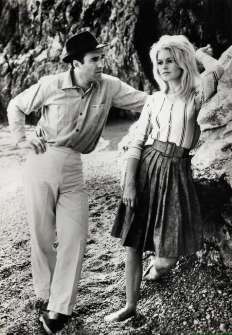
Michel Piccoli and Brigitte Bardot in Le mépris (1963)
Czech postcard by Pressfoto, Praha, no. Cz 13268 769 A 20 71276 3034 567. Photo: UTPF. Michel Piccoli and Brigitte Bardot in Le mépris / Contempt (Jean-Luc Godard, 1963).Michel Piccoli (1925-2020) was one of the most original and versatile French actors of the last half-century. He appeared in many different roles, from seducer to cop to gangster to Pope in more than 200 films and TV films. Among the directors he worked with are Jean Renoir, Jean-Pierre Melville, Jean-Luc Godard, Agnès Varda, Luis Buñuel, and Alfred Hitchcock.French actress Brigitte Bardot (1934) died yesterday, 28 December 2025, at the age of 91. In the 1950s, she was the sex kitten of the European film industry. BB starred in 48 films, performed in numerous musical shows, and recorded 80 songs. After her retirement in 1973, she established herself as an animal rights activist and made vegetarianism sexy.In the coming weeks, we will post a BB postcard every day to remember her as she once was.And please check out our blog European Film Star Postcards.

Omaggio a Brigitte
55010794725_b44b800c2d_b
Nue au Soleil
La dernière photo en stock d'une série sur Saint-Tropez, prise il y a deux mois jour pour jour, qui ne peut qu'être mise en ligne aujourd'hui 28 décembre 2025 et dédiée à la mémoire de l'habitante la plus fameuse de Saint-Trop' (et de toute la France), Brigitte Bardot (1934-2025), femme libre et forte, et à jamais magnifiquement Nue au Soleil
🎼www.youtube.com/watch?v=6xGtIe8bMhM🍒
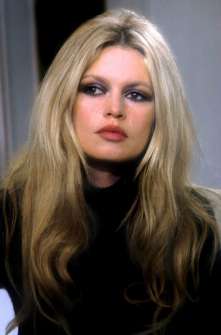
G9QnpRRXcAAkqbN
55010159374_d9a8b87441_b
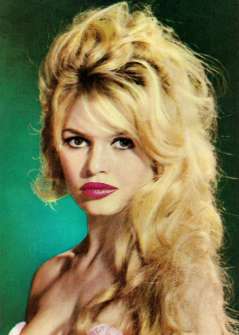
Brigitte Bardot (1934-2025)
Vintage postcard, no. O2. Photo: Sam Lévin.French actress Brigitte Bardot (1934) died today, 28 December 2025, at the age of 91. In the 1950s, she was the sex kitten of the European film industry. BB starred in 48 films, performed in numerous musical shows, and recorded 80 songs. After her retirement in 1973, she established herself as an animal rights activist and made vegetarianism sexy.Brigitte Bardot was born in Paris in 1934. Her father, Louis Bardot, had an engineering degree and worked with his father in the family business. Her mother, Ann-Marie Mucel, was 14 years younger than Brigitte's father, and they married in 1933. Brigitte's mother encouraged her daughter to take up music and dance. At the age of 13, she entered the Conservatoire Nationale de Danse to study ballet. By the time she was 15, Brigitte was trying a modelling career and found herself in May 1949 on the cover of the French magazine Elle. Her incredible beauty was readily apparent, and Brigitte was noticed by Roger Vadim, then an assistant to the film director Marc Allegrét. Vadim was infatuated with Bardot and encouraged her to start working as a film actress. BB was 18 when she debuted in the comedy Le Trou Normand / Crazy for Love (Jean Boyer, 1952). In the same year, she married Vadim. Brigitte wanted to marry him when she was 17, but her parents quashed any marriage plans until she turned 18. In April 1953, she attended the Cannes Film Festival, where she received massive media attention. She soon was every man's idea of the girl he'd like to meet in Paris. From 1952 to 1956, she appeared in seventeen films. Her films were generally lightweight romantic dramas in which she was cast as an ingénue or siren, often with an element of undress. In 1953, she made her first US production, Un acte d'amour / Act of Love (Anatole Litvak, 1953) with Kirk Douglas, but she continued to make films in France.Roger Vadim was not content with the light fare his wife was offered. He felt Brigitte Bardot was being undersold. Looking for something more like an art film to push her as a serious actress, he showcased her in Et Dieu créa la femme / ...And God Created Woman (Roger Vadim, 1956). This film, about an immoral teenager in a respectable small-town setting, was a smash success on both sides of the Atlantic. Craig Butler at AllMovie: "It's easy enough to say that ...And God Created Woman is much more important for its historical significance than for its actual quality as a film, and that's true to an extent. The immense popularity, due to its willingness to directly embrace an exploration of sex as well as its willingness to show a degree of nudity that was remarkably daring for its day, demonstrated that audiences were willing to view subject matter that was considered too racy for the average moviegoer. This had both positive (freedom to explore, especially for the French filmmakers of the time) and negative (freedom to exploit) consequences, but its impact is undeniable. It's also true that Woman is not a great work of art, not with a story that is ultimately rather thin, some painful dialogue, and an attitude toward its characters and their sexuality that is unclear and inconsistent. Yet Woman is still fascinating, due in no small part to the presence of Brigitte Bardot in the role that made her an international star and sex symbol. She's not demonstrating great acting here, although her performance is actually good and much better than necessary, and her legendary mambo scene at the climax is nothing short of sensational." During the shooting of Et Dieu créa la femme / And God Created Woman (Roger Vadim, 1956), directed by her husband, Brigitte Bardot had an affair with her co-star Jean-Louis Trintignant, who at that time was married to French actress Stéphane Audran. Her divorce from Vadim followed, but they remained friends and collaborated in later work.Et Dieu créa la femme / ...And God Created Woman (Roger Vadim, 1956) helped Brigitte Bardot's international status. The film took the USA by storm, her explosive sexuality being unlike anything seen in the States since the days of the 'flapper' in the 1920s. It gave rise to the phrase 'sex kitten', and fascination with her in America consisted of magazine photographs and dubbed over French films - good, bad or indifferent, her films drew audiences - mainly men - into theatres like lemmings. BB appeared in light comedies like Doctor at Large (Ralph Thomas, 1957) - the third of the British 'Doctor' series starring Dirk Bogarde - and Une Parisienne / La Parisienne (Michel Boisrond, 1957), which suited her acting skills best. However, she was a sensation in the crime drama En cas de malheur / Love is My Profession (Claude Autant-Lara, 1958). Hal Erickson at AllMovie: "This Brigitte Bardot vehicle ran into stiff opposition from the Catholic Legion of Decency, severely limiting its U.S. distribution. Bardot plays a nubile small-time thief named Yvette, who becomes the mistress of influential defence attorney Andre (Jean Gabin). Though Andre can shower Yvette with jewels and furs, he cannot "buy" her heart, and thus it is that it belongs to handsome young student Mazzetti (Franco Interlenghi). Alas, Yvette is no judge of human nature: attractive though Mazzetti can be, he has a dangerous and deadly side. En Cas de Malheur contains a nude scene that has since been reprinted in freeze-frame form innumerable times by both film-history books and girlie magazines." Photographer Sam Lévin's photos contributed considerably to her image of sensuality and slight immorality. One of Lévin's pictures shows Brigitte, dressed in a white corset. It is said that around 1960, postcards with this photograph outsold in Paris those of the Eiffel Tower.Brigitte Bardot divorced Vadim in 195,7 and in 1959 she married actor Jacques Charrier, with whom she starred in Babette s'en va-t-en guerre / Babette Goes to War (Christian-Jaque, 1959). The paparazzi preyed upon her marriage, while she and her husband clashed over the direction of her career
Her films became more substantial, but this brought a heavy pressure of dual celebrity as she sought critical acclaim while remaining a glamour model for most of the world. Vie privée / Private Life (1962), directed by Louis Malle, has more than an element of autobiography in it. James Travers at French Films: "Brigitte Bardot hadn’t quite reached the high point of her career when she agreed to make this film with high-profile New Wave film director Louis Malle. Even so, the pressure of being a living icon was obviously beginning to get to France’s sex goddess, and Vie privée is as much an attempt by Bardot to come to terms with her celebrity as anything else. Malle is clearly fascinated by Bardot, and the documentary approach he adopts for this film reinforces the impression that it is more a biography of the actress than a work of fiction. Of course, it’s not entirely biographical, but the story is remarkably close to Bardot’s own life and comes pretty close to predicting how her career would end." The scene in which, returning to her apartment, Bardot's character is harangued in the elevator by a middle-aged cleaning lady calling her offensive names was based on an actual incident, and is a resonant image of celebrity in the mid-20th century. Soon afterwards, Bardot withdrew to the seclusion of Southern France.Brigitte Bardot's other husbands were German millionaire Playboy Gunter Sachs and right-wing politician Bernard d'Ormale. She is reputed to have had relationships with many other men, including Samy Frey, her co-star in La Vérité / The Truth (Henri-Georges Clouzot, 1960), and musicians Serge Gainsbourg and Sacha Distel. In 1963, Brigitte Bardot starred in Jean-Luc Godard's critically acclaimed film Le Mépris / Contempt (Jean-Luc Godard, 1963) opposite Michel Piccoli. She was also featured along with such notable actors as Alain Delon in Amours célèbres / Famous Love Affairs (Michel Boisrond, 1961) and Histoires extraordinaires /Tales of Mystery (Louis Malle, 1968), Jeanne Moreau in Viva Maria! (Louis Malle, 1965), Sean Connery in Shalako (Edward Dmytryk, 1968), and Claudia Cardinale in Les Pétroleuses / Petroleum Girls (Christian-Jaque, 1971). She participated in various musical shows and recorded many popular songs in the 1960s and 1970s, mostly in collaboration with Serge Gainsbourg, Bob Zagury and Sacha Distel, including 'Harley Davidson', 'Le Soleil De Ma Vie' (the cover of Stevie Wonder's 'You Are the Sunshine of My Life') and the notorious 'Je t'aime... moi non plus'.Brigitte Bardot’s film career showed a steady decline in the late 1960s and early 1970s. In 1973, just before her fortieth birthday, she announced her retirement. She chose to use her fame to promote animal rights. In 1976, she established the Brigitte Bardot Foundation for the Welfare and Protection of Animals. She became a vegetarian and raised three million French francs to fund the foundation by auctioning off jewellery and many personal belongings. For this work, she was awarded the Légion d’honneur in 1984. During the 1990s, she was also outspoken in her criticism of immigration, interracial relationships, Islam in France and homosexuality. Her husband Bernard d'Ormal was a former adviser of the far-right Front National party. Bardot has been convicted five times for 'inciting racial hatred'. More fun is that Bardot is recognised for popularising bikini swimwear, in such early films as Manina / Woman without a Veil (Willy Rozier, 1952), in her appearances at Cannes and in many photo shoots. Bardot also brought into fashion the 'choucroute' ('Sauerkraut') hairstyle (a sort of beehive hairstyle) and gingham clothes after wearing a checkered pink dress, designed by Jacques Esterel, at her wedding to Charrier. The fashions of the 1960s looked effortlessly right and spontaneous on her. Time Magazine: "She is the princess of pout, the countess of come hither. Brigitte Bardot exuded a carefree, naïve sexuality that brought a whole new audience to French films."Sources: Denny Jackson (IMDb), Hal Erickson (AllMovie), Craig Butler (AllMovie), James Travers (French Films), French Films, Wikipedia and IMDb.And please check out our blog European Film Star Postcards.
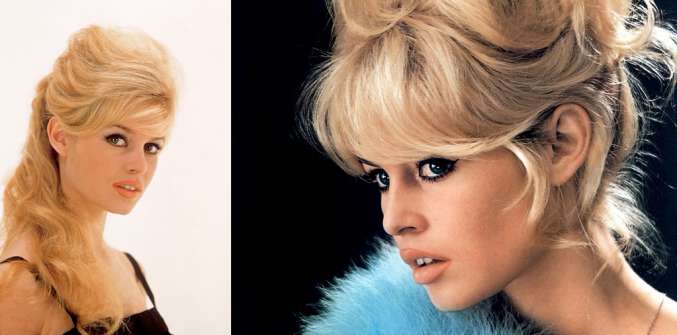
Brigitte Bardot
Brigitte BARDOT
.
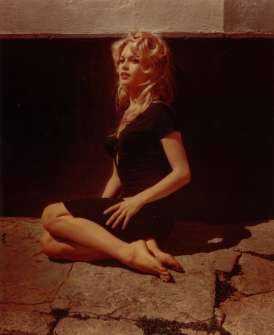
Brigitte Bardot in La Femme et le Pantin (1958)
Press photo by Fondation Jérôme Seydoux-Pathé, Paris, for the exhibition 'L’œil de Corbeau - Les photographies de Roger Corbeau exposées à la Fondation Pathé' (23 October 2025 - 31 January 2026). Photo: Roger Corbeau / Pathé Films / Studio Canal. Brigitte Bardot in La Femme et le Pantin / The Female (Julien Duvivier, 1958).
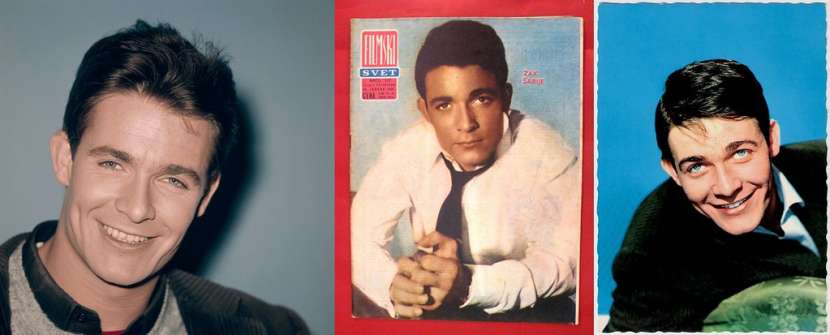
Jacques Charrier
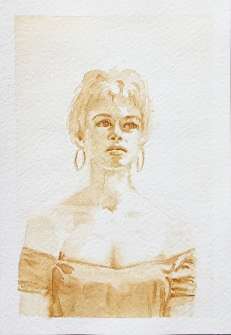
l'été
54719011563_fbc775a685_b
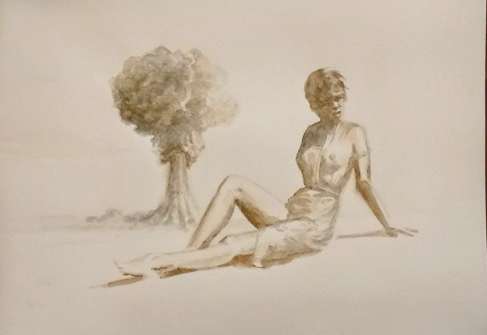
80 A.H.
54703540068_270b87b70b_b
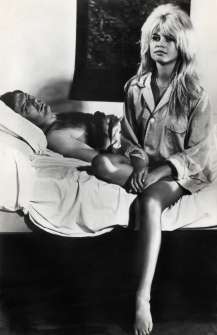
Brigitte Bardot and Marcello Mastroianni in Vie privée (1962)
Czechoslovakian postcard by Pressfoto, Praha, 1964, no. C 36. Brigitte Bardot and Marcello Mastroianni in Vie privée / Private Life (Louis Malle, 1962).Film actor Marcello Mastroianni (1924-1996) was Italy's favourite leading man since the 1950s, as well as one of the finest actors of European cinema. In his long and prolific career, Mastroianni almost singlehandedly defined the contemporary type of Latin lover, then proceeded to redefine it a dozen times and finally parodied it and played it against type.Beautiful French actress Brigitte Bardot (1934) was the sex kitten of the European film industry. BB starred in 48 films, performed in numerous musical shows, and recorded 80 songs. After her retirement in 1973, she established herself as an animal rights activist and made vegetarianism sexy.And please check out our blog European Film Star Postcards.
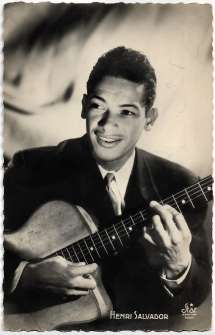
Henry Salvador
French postcard by Editions P.I. Photo: * Star, Paris.French Caribbean comedian, singer and cabaret artist Henri Salvador (1917-2008) was the first to sing Rock and Roll songs in France and was honoured for helping create the Bossa Nova. He appeared in several films but peaked in the 1960s when he had his own TV shows.Henri Gabriel Salvador was born in 1917 in Cayenne, French Guyana. His father, Clovis, and his mother, Antonine Paterne, daughter of an Indigenous Carib, were both from Guadeloupe, French West Indies. Salvador had a brother, André, and a sister, Alice. At 12, Henri (sometimes written as Henry) and his family moved to France. Salvador performed as a musician and comedian in Parisian cabarets from 1933. He learned to play guitar by imitating Django Reinhardt's recordings and collaborated with him in the 1930s. He began his musical career as a guitarist accompanying other singers. After years of cabarets, little jobs and military service, he got a real chance to aim for fame when he got hired by orchestra leader Ray Ventura. When Ray Ventura and his band went to play in Brazil during World War II, Henri Salvador became popular over there as a singer and funnyman. Back in France after the war ended, Henri Salvador left Ray Ventura behind and started his own career. His first record, which included 'Clopin-Clopant' and 'Maladie d'Amour' (covered by the Ames Brothers as "Mélodie d'Amour") became an instant hit. Salvador recorded several songs written by Boris Vian with Quincy Jones as arranger. Henri Salvador made his film debut in Le moulin des Andes (Jacques Rémy, 1945) with Nora Gregor. In the following years, he appeared with Ray Ventura in the comedies Mademoiselle s'amuse / Mademoiselle Has Fun (Jean Boyer, 1948), Nous irons à Paris / We Will All Go to Paris (Jean Boyer, 1949) with the Peters Sisters and Nous irons à Monte-Carlo (Jean Boyer, 1950) with the young Audrey Hepburn. His later films include the musical comedy Bonjour sourire! / Hello Smile! (Claude Sautet, 1956) with Jimmy Gaillard and Un clair de lune à Maubeuge / Moonlight in Maubeuge (Jean Chérasse, 1962) with Claude Brasseur.Henri Salvador is known to have recorded the first French rock and roll songs in 1957 written by Boris Vian and Michel Legrand — 'Rock'n Roll Mops', 'Rock hoquet, Va t'faire cuire un oeuf, man' and 'Dis-moi qu'tu m'aimes rock' — under the artist name of Henry Cording (a play on the word Recording). Despite this historical aspect, he never ceased claiming that he disliked rock and roll and even refused to talk about this subject later. Henri Salvador influenced Antônio Carlos Jobim in formulating the Brazilian Bossa Nova style. In 1957, Salvador composed the song ‘Dans mon île' and performed it on guitar, in the form of a samba with a very slow tempo and rich harmonies. He played this song in the Italian film Europa di notte, which was screened in Brazil in the spring of 1959 and seen by several musicians who warned Antônio Carlos Jobim. The song went on to become popular in Brazil. In 2023, the documentary film ‘Face B comme bossa, l'autre histoire d'Henri Salvador’ confirmed that this song was indeed one of the influences of this musical style in the late 1950s. In the 1960s, Salvador was the host of several popular television variety shows on French TV. In 1964, he scored a hit with 'Zorro est arrivé', which was adapted from The Coasters' U.S. hit 'Along Came Jones'. He is also famous for his rich, catchy laugh, which is a theme in many of his humorous songs. In 1969, Henri Salvador recorded a variation of 'Mah Nà Mah Nà' entitled 'Mais non, mais non' with lyrics he had written in French to Piero Umiliani's music. Salvador had many hits, including humorous songs ('Faut rigoler', 'Je peux pas travailler', 'Blouse du dentiste') and sweet ballads ('Le loup, la biche et le chevalier', 'Syracuse', 'Jardin d'hiver'). At the age of 70, Salvador was the voice-over of the crab Sebastian in the French dubbing of Disney's The Little Mermaid (1989) and sang the song 'Embrasse-la' ('Kiss the Girl'). After a period of relative obscurity towards the end of his life, he enjoyed considerable success, with new shows and tours, thanks to the album 'Chambre avec vue', in the early 2000s. His last performance took place at the age of 90, a few months before his death. Henri Salvador was married four times. His wives were Lyly Susini (1941-?), Jacqueline Salvador (1950-1976; her death), Sabine de Ricou (1986-1995) and Catherine Salvador (2001-2008; his death). His son is writer-director Jean-Marie Périer. He received the French Legion of Honor in 2004. Brazil honoured Salvador with the Order of Cultural Merit, partly for helping create the Bossa Nova. Salvador himself insisted that Brazilian jazz musician Antonio Carlos invented that musical genre. In 2008, Henri Salvador died of a ruptured aneurysm at his home. He was 90 years of age. He was buried next to his wife Jacqueline in Père-Lachaise Cemetery.Sources: Wikipedia (Dutch, French and English) and IMDb.And, please check out our blog European Film Star Postcards.
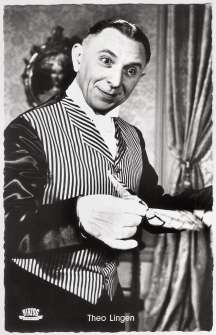
Theo Lingen in Opernball (1956)
German postcard by Kolibri-Verlag G.m.b.H., Minden-Westf, no. 2022. Photo: Erma / Herzog-Film / Brünjes. Photo: Herzog-Film. Theo Lingen in Opernball / Opera Ball (Ernst Marischka, 1956).German-Austrian comedian, director and author Theo Lingen (1903-1978) enjoyed for decades a huge popularity as the devoted servant or bureaucratic dignitary in films. The German and Austrian comedy isn’t imaginable without this brilliant character actor.Theo Lingen was born Franz Theodor Schmitz in 1903 in Hanover, Germany. He attended the Royal Goethe Gymnasium – the predecessor of the Goethe School – in Hanover but left before taking the Abitur (final exams). His theatrical talent was discovered during rehearsals for a school performance at the Boulevard Theatre in Schauenberg. Beginning his professional stage career in 1921, the young actor adopted as a stage name his middle name together with that of the birthplace of his father, Lingen in the Emsland region of Germany. He didn't confine to acting but also wrote theatre plays that he directed himself. He appeared in over 230 films between 1929 and 1978 and directed 21 films between 1936 and 1960. He played non-comic characters – and sometimes danced - in such musicals as Dolly macht Karriere/Dolly's Way to Stardom (Anatole Litvak, 1930) starring Dolly Haas, and Das Flötenkonzert von Sanssouci/The Flute Concert of Sans-Souci (Gustav Ucicky, 1930) and played friendly villains in the classics M (Fritz Lang, 1931) starring Peter Lorre and Das Testament des Dr. Mabuse/Dr. Mabuses Testament (Fritz Lang, 1933). But the funny effect which his performance had on the public, wasn't to be missed. From 1933, comedy was his domain, and the Austrian comic Hans Moser became his partner in 24 films. Together they made a contrasting pair in such popular entertainment films as the operetta Rosen in Tirol/The Bird Seller (Géza von Bolváry, 1940), Wiener Blut/Vienna Blood (Willi Forst, 1942) starring Willy Fritsch, and the comedy Schäm' dich, Brigitte!/Shame on You, Brigitte! (E.W. Emo, 1952) with Heinz Rühmann.From 1929 on, Theo Lingen performed in Berlin, for instance in Bertold Brecht's 'Dreigroschenoper' (The Threepenny Opera), and in avantgarde plays, but also in cabaret and revue programmes at the Kurfürstendamm. In February 1928, his daughter, Ursula, was born to Brecht's then-wife, singer Marianne Zoff. Brecht and Zoff divorced in September; Lingen and Zoff married later that year. Because Zoff was Jewish, which under the Nazi regime usually resulted in a professional ban, Lingen thought about going into exile, but because of his great popularity with the general public Josef Goebbels gave him a special permit to continue to perform. Lingen directed his first, short films in 1936, the four-part series of Eulenspiegel. From 1939 to 1956, he directed 18 feature films, including a buoyant film version of Paul Lincke's operetta Frau Luna/Mistress Moon (1941) with Lizzi Waldmüller, and Liebeskomödie/Comedy of Love (1942) with Magda Schneider. Till the end of the war he acted in such popular comedies as Die Finanzen des Grossherzogs/The Grand Duke's Finances (Gustaf Gründgens, 1934), Der Himmel auf Erden/Heaven on Earth (E.W. Emo, 1935), Ich liebe alle Frauen/I Live All Women (Carl Lamac, 1935) starring Jan Kiepura, Der Mann, von dem man spricht/The Man, About Whom One Talks (E.W. Emo, 1937) with Heinz Rühmann, and Sieben Jahre Pech/Seven Years Hard Luck (Ernst Marischka, 1940). One of his most successful appearances was his double role of a building contractor and a servant in the film version of Lingen's own play Johann (Robert A. Stemmle, 1942). In 1944 Lingen moved to Vienna, Austria.In 1945 Theo Lingen was chosen mayor as the temporary mayor of Strobl, an Austrian community, and in 1946 he got the Austrian nationality. From 1948 he was an ensemble member at the famous Burgtheater in Vienna and played there until his death many character roles. The post-war cinema at first offered him leading roles in remakes of successful early sound films, in sportive slapstick comedies, and Heimat films. Very funny is Jetzt schlägt’s 13/The Clock Ticks Thirteen (E.W. Emo, 1950) with Lingen and Hans Moser as two butlers who suspect each other of being mass murderers. Other popular films were Heidi (Luigi Comencini, 1952), Pension Schöller (Georg Jacoby, 1960) and Bei Pichler stimmt die Kasse nicht/Pichler's Books Are Not in Order (Hans Quest, 1961) with Georg Thomalla. During the 1960s the German entertainment film sagged more and more into triviality. Lingen often had to impersonate hysterical characters in such slapstick comedies as Die Lümmel von der ersten Bank/To Hell with School (Werner Jacobs, 1968), Pepe, der Paukerschreck/Pepe: His Teacher's Fright (Harald Reinl, 1969) and Tante Trude aus Buxtehude/Aunt Trude from Buxtehude (Franz Josef Gottlieb, 1971) with TV star Rudi Carrell. More demanding were his roles in TV films and series, and on stage. Theo Lingen died of cancer in Vienna in 1978. He was 75. His daughter Ursula Lingen also became an actress.Sources: Thomas Staedeli (Cyranos), Stephanie D'heil (Steffi-line - German), Filmportal, Wikipedia and IMDb.And, please check out our blog European Film Star Postcards.
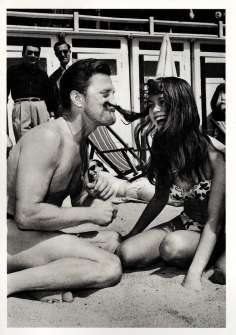
Kirk Douglas and Brigitte Bardot, Cannes, 1953
French postcard in the Collection Portraits de cinema by Editions Admira, Aix-en-Provence, no. PHN 67. Photo: Léo Mirkine. Caption: Kirk Douglas and Brigitte Bardot, Cannes (1953). Kirk Douglas and Brigitte Bardot co-starred in Un acte d'amour/Act of Love (Anatole Litvak, 1953).Cleft-chinned and steely-eyed American superstar Kirk Douglas (1916-2020) died earlier this month. The legendary actor, producer, and director made his film debut in The Strange Love of Martha Ivers (1946) with Barbara Stanwyck. Douglas soon developed into a leading box-office star throughout the 1950s, known for serious dramas, Westerns and war films. Our favourites are the two classics he made with Stanley Kubrick, Paths of Glory (1957) and Spartacus (1960). During his long career, he appeared in more than 90 films.Beautiful French actress Brigitte Bardot (1934) was the sex kitten of the European film industry. BB starred in 48 films, performed in numerous musical shows, and recorded 80 songs. After her retirement in 1973, she established herself as an animal rights activist and made vegetarianism sexy.And please check out our blog European Film Star Postcards.
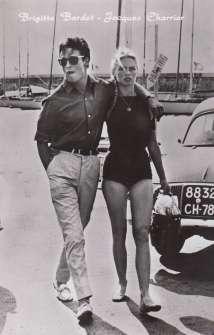
Brigitte Bardot and Jacques Charrier
Dutch postcard by Int. Filmpers, Amsterdam, no. 3500. Collection: Marlene Pilaete.The final 2023 La Collectionneuse post at European Film Star Postcards will go online on 30 December! Theme: Couples who were married in real life or who had had an affair.
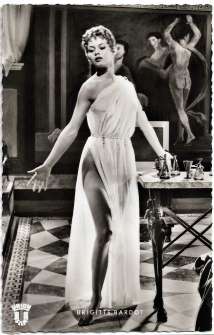
Brigitte Bardot in Mio figlio Nerone (1956)
West German postcard by Kunst und Bild, Berlin-Charlottenburg, no. S 780. Photo: Union Film, Den Haag. Brigitte Bardot in Mio figlio Nerone / Nero's Mistress (Steno, 1956). The mural in the background is an imitation of the fresque in the Villa dei Misteri in Pompeii.Beautiful French actress Brigitte Bardot (1934) was the sex kitten of the European film industry. BB starred in 48 films, performed in numerous musical shows, and recorded 80 songs. After her retirement in 1973, she established herself as an animal rights activist and made vegetarianism sexy.Brigitte Bardot was born in Paris in 1934. Her father, Louis Bardot, had an engineering degree and worked with his father in the family business. Her mother, Ann-Marie Mucel, was 14 years younger than Brigitte's father and they married in 1933. Brigitte's mother encouraged her daughter to take up music and dance. At the age of 13, she entered the Conservatoire Nationale de Danse to study ballet. By the time she was 15, Brigitte was trying a modelling career and found herself in May 1949 on the cover of the French magazine Elle. Her incredible beauty was readily apparent, Brigitte was noticed by Roger Vadim, then an assistant to the film director Marc Allegrét. Vadim was infatuated with Bardot and encouraged her to start working as a film actress. BB was 18 when she debuted in the comedy Le Trou Normand/Crazy for Love (Jean Boyer, 1952). In the same year, she married Vadim. Brigitte wanted to marry him when she was 17, but her parents quashed any marriage plans until she turned 18. In April 1953 she attended the Cannes Film Festival where she received massive media attention. She soon was every man's idea of the girl he'd like to meet in Paris. From 1952 to 1956 she appeared in seventeen films. Her films were generally lightweight romantic dramas in which she was cast as an ingénue or siren, often with an element of undress. In 1953, she made her first US production, Un acte d'amour/Act of Love (Anatole Litvak, 1953) with Kirk Douglas, but she continued to make films in France.Roger Vadim was not content with the light fare his wife was offered. He felt Brigitte Bardot was being undersold. Looking for something more like an art film to push her as a serious actress, he showcased her in Et Dieu créa la femme/...And God Created Woman (Roger Vadim, 1956). This film, about an immoral teenager in a respectable small-town setting, was a smash success on both sides of the Atlantic. Craig Butler at AllMovie: "It's easy enough to say that ...And God Created Woman is much more important for its historical significance than for its actual quality as a film, and that's true to an extent. Woman's immense popularity, due to its willingness to directly embrace an exploration of sex as well as its willingness to show a degree of nudity that was remarkably daring for its day, demonstrated that audiences were willing to view subject matter that was considered too racy for the average moviegoer. This had both positive (freedom to explore, especially for the French filmmakers of the time) and negative (freedom to exploit) consequences, but its impact is undeniable. It's also true that Woman is not a great work of art, not with a story that is ultimately rather thin, some painful dialogue, and an attitude toward its characters and their sexuality that is unclear and inconsistent. Yet Woman is still fascinating, due in no small part to the presence of Brigitte Bardot in the role that made her an international star and sex symbol. She's not demonstrating great acting here, although her performance is actually good and much better than necessary, and her legendary mambo scene at the climax is nothing short of sensational." During the shooting of Et Dieu créa la femme/And God Created Woman (1956), directed by her husband Roger Vadim, Brigitte Bardot had an affair with her co-star Jean-Louis Trintignant, who at that time was married to French actress Stéphane Audran. Her divorce from Vadim followed, but they remained friends and collaborated in later work.Et Dieu créa la femme/...And God Created Woman (Roger Vadim, 1956) helped her international status. The film took the USA by storm, her explosive sexuality being unlike anything seen in the States since the days of the 'flapper' in the 1920s. It gave rise to the phrase 'sex kitten' and fascination of her in America consisted of magazine photographs and dubbed over French films - good, bad or indifferent, her films drew audiences - mainly men - into theatres like lemmings.BB appeared in light comedies like Doctor at Large (Ralph Thomas, 1957) - the third of the British 'Doctor' series starring Dirk Bogarde - and Une Parisienne/La Parisienne (Michel Boisrond, 1957) which suited her acting skills best. However, she was a sensation in the crime drama En cas de malheur/Love is My Profession (Claude Autant-Lara, 1958). Hal Erickson at AllMovie: "This Brigitte Bardot vehicle ran into stiff opposition from the Catholic Legion of Decency, severely limiting its U.S. distribution. Bardot plays a nubile small-time thief named Yvette, who becomes the mistress of influential defence attorney Andre (Jean Gabin). Though Andre is able to shower Yvette with jewels and furs, he cannot "buy" her heart, and thus it is that it belongs to handsome young student Mazzetti (Franco Interlenghi). Alas, Yvette is no judge of human nature: attractive though Mazzetti can be, he has a dangerous-and deadly-side. En Cas de Malheur contains a nude scene that has since been reprinted in freeze-frame form innumerable times by both film-history books and girlie magazines." Photographer Sam Lévin's photos contributed considerably to her image of sensuality and slight immorality. One of Lévin's pictures shows Brigitte, dressed in a white corset. It is said that around 1960 postcards with this photograph outsold in Paris those of the Eiffel Tower.Brigitte Bardot divorced Vadim in 1957 and in 1959 she married actor Jacques Charrier, with whom she starred in Babette s'en va-t-en guerre/Babette Goes to War (Christian-Jaque, 1959). The paparazzi preyed upon her marriage, while she and her husband clashed over the direction of her career. Her films became more substantial, but this brought a heavy pressure of dual celebrity as she sought critical acclaim while remaining a glamour model for most of the world. Vie privée/Private Life (1962), directed by Louis Malle has more than an element of autobiography in it. James Travers at French Films: "Brigitte Bardot hadn’t quite reached the highpoint of her career when she agreed to make this film with high profile New Wave film director Louis Malle. Even so, the pressure of being a living icon was obviously beginning to get to France’s sex goddess and Vie privée is as much an attempt by Bardot to come to terms with her celebrity as anything else. Malle is clearly fascinated by Bardot and the documentary approach he adopts for this film reinforces the impression that it is more a biography of the actress than a work of fiction. Of course it’s not entirely biographical, but the story is remarkably close to Bardot’s own life and comes pretty close to predicting how her career would end." The scene in which, returning to her apartment, Bardot's character is harangued in the elevator by a middle-aged cleaning lady calling her offensive names, was based on an actual incident, and is a resonant image of celebrity in the mid-20th century. Soon afterwards Bardot withdrew to the seclusion of Southern France.Brigitte Bardot's other husbands were German millionaire playboy Gunter Sachs and right-wing politician Bernard d'Ormale. She is reputed to have had relationships with many other men including Sami Frey, her co-star in La Vérité/The Truth (Henri-Georges Clouzot, 1960), and musicians Serge Gainsbourg and Sacha Distel. In 1963, Brigitte Bardot starred in Godard's critically acclaimed film Le Mépris/Contempt (Jean-Luc Godard, 1963). She was also featured along with such notable actors as Alain Delon in Amours célèbres/Famous Love Affairs (Michel Boisrond, 1961) and Histoires extraordinaires/Tales of Mystery (Louis Malle, 1968), Jeanne Moreau in Viva Maria! (Louis Malle, 1965), Sean Connery in Shalako (Edward Dmytryk, 1968), and Claudia Cardinale in Les Pétroleuses/Petroleum Girls (Christian-Jaque, 1971). She participated in various musical shows and recorded many popular songs in the 1960s and 1970s, mostly in collaboration with Serge Gainsbourg, Bob Zagury and Sacha Distel, including 'Harley Davidson', 'Le Soleil De Ma Vie' (the cover of Stevie Wonder's 'You Are the Sunshine of My Life') and the notorious 'Je t'aime... moi non plus'.Brigitte Bardot’s film career showed a steady decline in the late 1960s and early 1970s. In 1973 just before her fortieth birthday, she announced her retirement. She chose to use her fame to promote animal rights. In 1976 she established the Brigitte Bardot Foundation for the Welfare and Protection of Animals. She became a vegetarian and raised three million French francs to fund the foundation by auctioning off jewellery and many personal belongings. For this work, she was awarded the Légion d’honneur in 1984. During the 1990s she became also outspoken in her criticism of immigration, interracial relationships, Islam in France and homosexuality. Her husband Bernard d'Ormal is a former adviser of the far-right Front National party. Bardot has been convicted five times for 'inciting racial hatred'. More fun is that Bardot is recognised for popularising bikini swimwear, in such early films as Manina/Woman without a Veil (1952), in her appearances at Cannes and in many photo shoots. Bardot also brought into fashion the 'choucroute' ('Sauerkraut') hairstyle (a sort of beehive hairstyle) and gingham clothes after wearing a checkered pink dress, designed by Jacques Esterel, at her wedding to Charrier. The fashions of the 1960s looked effortlessly right and spontaneous on her. Time Magazine: "She is the princess of pout, the countess of come hither. Brigitte Bardot exuded a carefree, naïve sexuality that brought a whole new audience to French films."Sources: Denny Jackson (IMDb), Hal Erickson (AllMovie), Craig Butler (AllMovie), James Travers (French Films), French Films, Wikipedia and IMDb.And please check out our blog European Film Star Postcards.
Plakat
53307847427_995f549d1d_b
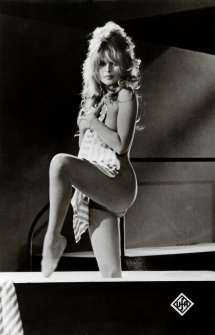
Brigitte Bardot
Dutch postcard by Gerbr. Spanjersberg N.V., Rotterdam, no. 1005. Photo: Ufa.Beautiful French actress Brigitte Bardot (1934) was the sex kitten of the European film industry. BB starred in 48 films, performed in numerous musical shows, and recorded 80 songs. After her retirement in 1973, she established herself as an animal rights activist and made vegetarianism sexy.And please check out our blog European Film Star Postcards.
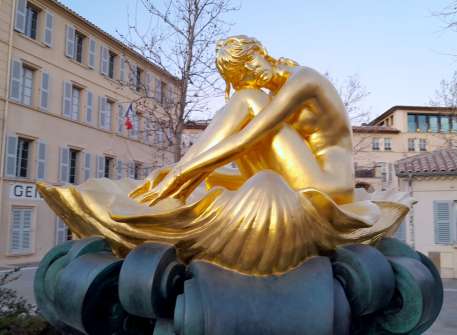
Saint-Tropez / l'iconique ''BB''
Oeuvre réalisée selon une aquarelle du maître italien de la bande dessinée érotique Milo Manara, elle-même inspirée par la fameuse ''Naissance de Vénus" de Botticelli.
Offerte à la cité à l'occasion des 83 ans de la star du cinéma des an-nées 60, la statue -de quelque 700kg et de 2,5m de hauteur- a été sculptée par des artisans italiens de renom, Liber Milian Garcia et Roberta Castellani, et réalisée par la fonderie Mariani de Pietrasanta (Italie),
Personnellement, je préférais la statue avant qu'elle ne soit dorée... Son nouvel aspect kitch me déplait totalement.
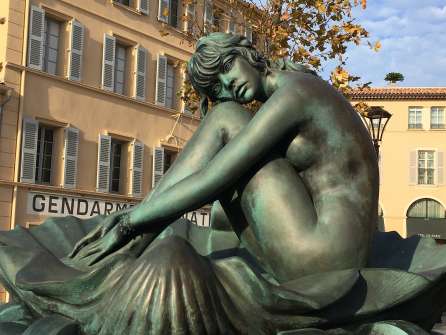
Saint-Tropez / Statue de Brigitte Bardot
Que serait Saint-Tropez sans le mythe de l'actrice au sommet de sa gloire et de sa beauté ?
S'inspirant d'une aquarelle du maître italien de la bande dessinée é-rotique Milo Manara, l'oeuvre, qui représente l'actrice sous l'effigie de la fameuse Vénus de Botticelli, a été inaugurée le 28 septembre 2017 sur la place Blanqui, juste devant l'ancienne gendarmerie de la ville, transformée en Musée de la Gendarmerie et du Cinéma.
Offerte à la cité à l'occasion des 83 ans de la star du cinéma des an-nées 60, la statue -de quelque 700kg et de 2,5m de hauteur- a été sculptée par des artisans italiens de renom (Liber Milian Garcia et Roberta Castellani) et réalisée par la fonderie Mariani de Pietrasanta (Italie),
Saint-Tropez / Statue de Brigitte Bardot devant le Musée de la Gendarmerie et du Cinéma
Oeuvre réalisée selon une aquarelle du maître italien de la bande dessinée érotique Milo Manara, elle-même inspirée par la fameuse ''Naissance de Vénus" de Botticelli.
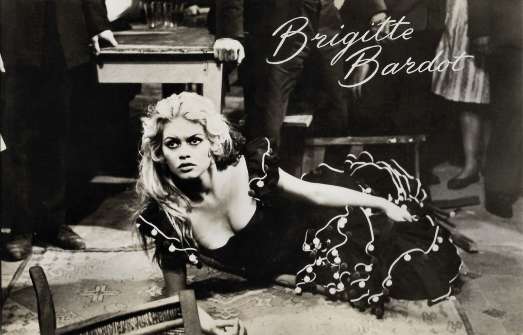
Brigitte Bardot in La femme et le pantin (1958)
Dutch postcard by Uitg. Takken, Utrecht, no. 3944. Photo: Pathé /N.V. City film, Den Haag. Brigitte Bardot in La femme et le pantin/The Female (Julien Duvivier, 1958).Beautiful French actress Brigitte Bardot (1934) was the sex kitten of the European film industry. BB starred in 48 films, performed in numerous musical shows, and recorded 80 songs. After her retirement in 1973, she established herself as an animal rights activist and made vegetarianism sexy.And please check out our blog European Film Star Postcards.
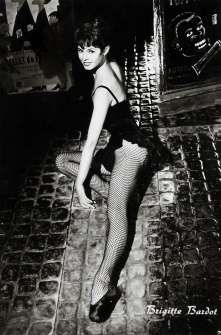
Brigitte Bardot on the set of Doctor at Sea (1955)
For Greg!Vintage postcard, no. 2043. Brigitte Bardot on the set of Doctor at Sea (Ralph Thomas, 1955).Beautiful French actress Brigitte Bardot (1934) was the sex kitten of the European film industry. BB starred in 48 films, performed in numerous musical shows, and recorded 80 songs. After her retirement in 1973, she established herself as an animal rights activist and made vegetarianism sexy.And please check out our blog European Film Star Postcards.
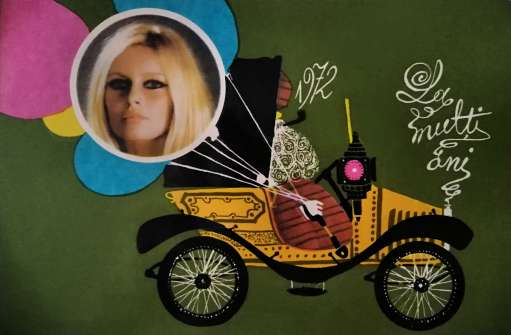
Brigitte Bardot, La multi ani 1972
Romanian postcard by Casa Filmului Acin, no. 106. Caption: La multi ani 1972. Collection: Alina Deaconu.Beautiful French actress Brigitte Bardot (1934) was the sex kitten of the European film industry. BB starred in 48 films, performed in numerous musical shows, and recorded 80 songs. After her retirement in 1973, she established herself as an animal rights activist and made vegetarianism sexy.Please, check out Alina's guest post at European Film Star Postcards, The Choice of Alina Deaconu.
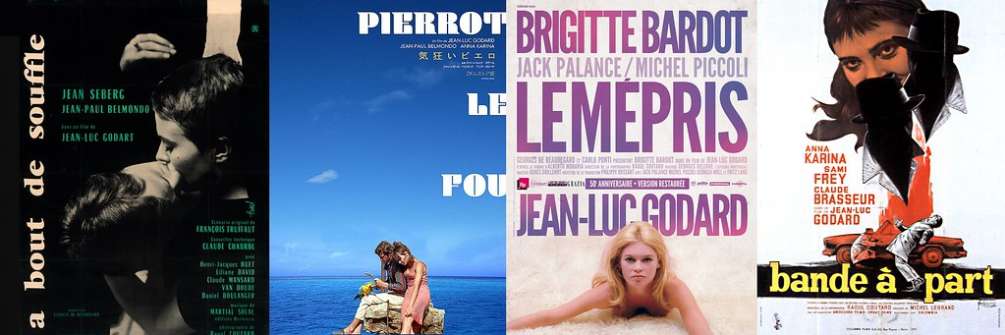
Jean-Luc Godard
Films de Jean-Luc Godard
À l'Opéra de Paris, où Maria Callas donne un concert (décembre 1958)
52302922130_e9545b1907_b
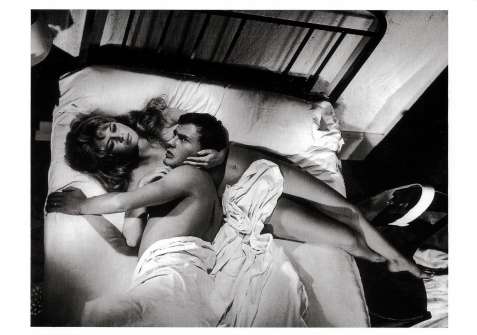
Jean-Louis Trintignant and Brigitte Bardot in Et Dieu crea la femme (1956)
Swiss postcard by News Productions, Baulmes / CVB Publishers, Grandson, no. 56783 Photo: Collection Cinémathèque Suisse, Lausanne. Jean-Louis Trintignant and Brigitte Bardot in Et Dieu... créa la femme/And God Created Woman (Roger Vadim, 1956).Jean-Louis Trintignant (1930) is one of the most talented and recognisable French actors of the post-war era. He showed a special talent for troubled characters like murderers or jealous husbands and won several awards for it. Trintignant starred in more than 100 films and enjoyed international acclaim with films like Et Dieu... créa la femme/And God Created Woman (1956), Un homme et une femme/A Man And A Woman (1966), Z (1969), Il Conformista/The Conformist (1970) and of course with Michael Haneke’s Amour/Love (2012). This year, Amour won the Academy Award for Best Foreign Film, and Jean-Louis Trintignant himself was awarded the César 2013 for Best Actor.Beautiful French actress Brigitte Bardot (1934) was the sex kitten of the European film industry. BB starred in 48 films, performed in numerous musical shows, and recorded 80 songs. After her retirement in 1973, she established herself as an animal rights activist and made vegetarianism sexy.And, please check out our blog European Film Star Postcards.
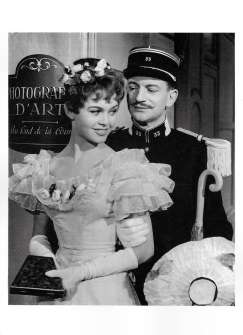
Brigitte Bardot and Yves Robert in Les Grandes Manoeuvres (1955)
Swiss-German-British postcard by News Productions, Baulmes / Filmwelt Berlin, Bakede / News Productions, Stroud, no. 56501. Photo: Collection Cinémathèque Suisse, Lausanne.Brigitte Bardot and Yves Robert in Les Grandes Manoeuvres / Summer Manoeuvres (René Clair, 1955), produced by Filmsonor and Rizzoli Films.Beautiful French actress Brigitte Bardot (1934) was the sex kitten of the European film industry. BB starred in 48 films, performed in numerous musical shows, and recorded 80 songs. After her retirement in 1973, she established herself as an animal rights activist and made vegetarianism sexy.Brigitte Bardot was born in Paris in 1934. Her father, Louis Bardot, had an engineering degree and worked with his father in the family business. Her mother, Ann-Marie Mucel, was 14 years younger than Brigitte's father and they married in 1933. Brigitte's mother encouraged her daughter to take up music and dance. At the age of 13, she entered the Conservatoire Nationale de Danse to study ballet. By the time she was 15, Brigitte was trying a modeling career and found herself in May 1949 on the cover of the French magazine Elle. Her incredible beauty was readily apparent, Brigitte was noticed by Roger Vadim, then an assistant to the film director Marc Allegrét. Vadim was infatuated with Bardot and encouraged her to start working as a film actress. BB was 18 when she debuted in the comedy Le Trou Normand/Crazy for Love (Jean Boyer, 1952). In the same year, she married Vadim. Brigitte wanted to marry him when she was 17, but her parents quashed any marriage plans until she turned 18. In April 1953 she attended the Cannes Film Festival where she received massive media attention. She soon was every man's idea of the girl he'd like to meet in Paris. From 1952 to 1956 she appeared in seventeen films. Her films were generally lightweight romantic dramas in which she was cast as ingénue or siren, often with an element of undress. She made her first US production in 1953 in Un acte d'amour/Act of Love (Anatole Litvak, 1953) with Kirk Douglas, but she continued to make films in France.Roger Vadim was not content with the light fare his wife was offered. He felt Brigitte Bardot was being undersold. Looking for something more like an art film to push her as a serious actress, he showcased her in Et Dieu créa la femme/...And God Created Woman (Roger Vadim, 1956). This film, about an immoral teenager in a respectable small-town setting, was a smashing success on both sides of the Atlantic. Craig Butler at AllMovie: "It's easy enough to say that ...And God Created Woman is much more important for its historical significance than for its actual quality as a film, and that's true to an extent. Woman's immense popularity, due to its willingness to directly embrace an exploration of sex as well as its willingness to show a degree of nudity that was remarkably daring for its day, demonstrated that audiences were willing to view subject matter that was considered too racy for the average moviegoer. This had both positive (freedom to explore, especially for the French filmmakers of the time) and negative (freedom to exploit) consequences, but its impact is undeniable. It's also true that Woman is not a great work of art, not with a story that is ultimately rather thin, some painful dialogue, and an attitude toward its characters and their sexuality that is unclear and inconsistent. Yet Woman is still fascinating, due in no small part to the presence of Brigitte Bardot in the role that made her an international star and sex symbol. She's not demonstrating great acting here, although her performance is actually good and much better than necessary, and her legendary mambo scene at the climax is nothing short of sensational." During the shooting of Et Dieu créa la femme/And God Created Woman (1956), directed by her husband Roger Vadim, Brigitte Bardot had an affair with her co-star Jean-Louis Trintignant, who at that time was married to French actress Stéphane Audran. Her divorce from Vadim followed, but they remained friends and collaborated in later work.Et Dieu créa la femme/...And God Created Woman (Roger Vadim, 1956) helped her international status. The film took the USA by storm, her explosive sexuality being unlike anything seen in the States since the days of the 'flapper' in the 1920s. It gave rise to the phrase 'sex kitten' and fascination of her in America consisted of magazine photographs and dubbed over French films - good, bad, or indifferent, her films drew audiences - mainly men - into theaters like lemmings.BB appeared in light comedies like Doctor at Large (1957) - the third of the British 'Doctor' series starring Dirk Bogarde - and Une Parisienne/La Parisienne (Michel Boisrond, 1957) which suited her acting skills best. However, she was a sensation in the crime drama En cas de malheur/Love is my profession (Claude Autant-Lara, 1958). Hal Erickson at AllMovie: "this Brigitte Bardot vehicle ran into stiff opposition from the Catholic Legion of Decency, severely limiting its U.S. distribution. Bardot plays a nubile small-time thief named Yvette, who becomes the mistress of influential defense attorney Andre (Jean Gabin). Though Andre is able to shower Yvette with jewels and furs, he cannot "buy" her heart, and thus it is that it belongs to handsome young student Mazzetti (Franco Interlenghi). Alas, Yvette is no judge of human nature: attractive though Mazzetti can be, he has a dangerous and deadly side. En Cas de Malheur contains a nude scene that has since been reprinted in freeze-frame form innumerable times by both film-history books and girlie magazines." Photographer Sam Lévin's photos contributed considerably to her image of sensuality and slight immorality. One of Lévin's pictures shows Brigitte, dressed in a white corset. It is said that around 1960 postcards with this photograph outsold in Paris those of the Eiffel Tower.Brigitte Bardot divorced Vadim in 1957 and in 1959 she married actor Jacques Charrier, with whom she starred in Babette s'en va-t-en guerre/Babette Goes to War (Christian-Jaque, 1959). The paparazzi preyed upon her marriage, while she and her husband clashed over the direction of her career. Her films became more substantial, but this brought a heavy pressure of dual celebrity as she sought critical acclaim while remaining a glamour model for most of the world. Vie privée/Private Life (1962), directed by Louis Malle has more than an element of autobiography in it. James Travers at Films de France: "Brigitte Bardot hadn’t quite reached the highpoint of her career when she agreed to make this film with high profile New Wave film director Louis Malle. Even so, the pressure of being a living icon was obviously beginning to get to France’s sex goddess and Vie privée is as much an attempt by Bardot to come to terms with her celebrity as anything else. Malle is clearly fascinated by Bardot and the documentary approach he adopts for this film reinforces the impression that it is more a biography of the actress than a work of fiction. Of course, it’s not entirely biographical, but the story is remarkably close to Bardot’s own life and comes pretty close to predicting how her career would end." The scene in which, returning to her apartment, Bardot's character is harangued in the elevator by a middle-aged cleaning lady calling her offensive names, was based on an actual incident and is a resonant image of a celebrity in the mid-20th century. Soon afterward Bardot withdrew to the seclusion of Southern France.Brigitte Bardot's other husbands were German millionaire playboy Gunter Sachs and right-wing politician Bernard d'Ormale. She is reputed to have had relationships with many other men including Sami Frey, her co-star in La Vérité/The Truth (Henri-Georges Clouzot, 1960), and musicians Serge Gainsbourg and Sacha Distel. In 1963, Brigitte Bardot starred in Godard's critically acclaimed film Le Mépris/Contempt (Jean-Luc Godard, 1963). She was also featured along with such notable actors as Alain Delon in Amours célèbres/Famous Love Affairs (Michel Boisrond, 1961) and Histoires extraordinaires/Tales of Mystery (Louis Malle, 1968), Jeanne Moreau in Viva Maria! (Louis Malle, 1965), Sean Connery in Shalako (Edward Dmytryk, 1968), and Claudia Cardinale in Les Pétroleuses/Petroleum Girls (Christian-Jaque, 1971). She participated in various musical shows and recorded many popular songs in the 1960s and 1970s, mostly in collaboration with Serge Gainsbourg, Bob Zagury, and Sacha Distel, including 'Harley Davidson', 'Le Soleil De Ma Vie' (the cover of Stevie Wonder's 'You Are the Sunshine of My Life') and the notorious 'Je t'aime... moi non plus'.Brigitte Bardot’s film career showed a steady decline in the late 1960s and early 1970s. In 1973 just before her fortieth birthday, she announced her retirement. She chose to use her fame to promote animal rights. In 1976 she established the Brigitte Bardot Foundation for the Welfare and Protection of Animals. She became a vegetarian and raised three million French francs to fund the foundation by auctioning off jewelry and many personal belongings. For this work, she was awarded the Légion d’honneur in 1984. During the 1990's she became also outspoken in her criticism of immigration, interracial relationships, Islam in France, and homosexuality. Her husband Bernard d'Ormal is a former adviser of the far-right Front National party. Bardot has been convicted five times for 'inciting racial hatred'. More fun is that Bardot is recognised for popularizing bikini swimwear, in early films such as Manina/Woman without a Veil (1952), in her appearances at Cannes and in many photoshoots. Bardot also brought into fashion the 'choucroute' ('Sauerkraut') hairstyle (a sort of beehive hairstyle) and gingham clothes after wearing a checkered pink dress, designed by Jacques Esterel, at her wedding to Charrier. The fashions of the 1960s looked effortlessly right and spontaneous on her. Time Magazine: "She is the princess of pout, the countess of come hither. Brigitte Bardot exuded a carefree, naïve sexuality that brought a whole new audience to French films."Sources: Denny Jackson (IMDb), Hal Erickson (AllMovie), Craig Butler (AllMovie), James Travers (Films de France), Films de France, Wikipedia, and IMDb.And, please check out our blog European Film Star Postcards.
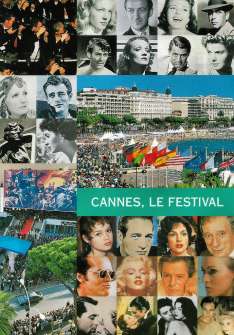
Cannes Film Festival
French postcard by Images - Distribution. Image: Photos D.R. Caption: Cannes (Alpes-Maritimes) Le Festival.Every year, in the third week of May, international filmmakers, stars, film industry professionals and thousands of journalists go to the Côte d'Azur. They visit the most prestigious film festival in the world, the Cannes Film Festival (Festival de Cannes).The Cannes Film Festival has been held every year in the French city of Cannes since 1946. The venue is the Palais des Festivals et des Congrès on the La Croisette promenade. The most important prize awarded at Cannes is the Palme d'Or (Golden Palm) for the best film in the International Competition. The Golden Palm is sometimes shared by several films in the same year. Other prizes awarded by the jury for the film as a whole are (in descending order) the Grand Prize of the Jury (Grand prix du jury), the Prize of the Jury (Prix du Jury) and the Special Prize of the Jury (not necessarily awarded every year). There are also prizes in the individual categories of female actor, male actor, director and screenplay. The awards in Cannes are given by a jury made up of several people, usually experienced and award-winning professionals from the film industry. Other juries also award competition films here. The most important are the FIPRESCI Prize of International Film Critics (Prix de la FIPRESCI) and the Ecumenical Jury Prize (Prix du Jury oecuménique). In addition to the main competition, there is also the short film competition with the Palme d'Or for short films (Palme d'Or du court métrage), the Cinéfondation competition, in which works by film students are awarded, as well as the Un Certain Regard series, in which the Prix Un Certain Regard has been awarded since 1998. Within the framework of the international film festival, both the directors' association Société des Réalisateurs de Films with its La Quinzaine des Réalisateurs and the critics' organisation Syndicat français de la critique de cinéma with its La Semaine Internationale de la Critique hold their own independent parallel event at which a number of prizes are also awarded.The Cannes Film Festival receives a lot of media attention, it is attended by many film stars and is a popular opportunity for film producers to present their new films and sell them to distributors. The film stars are transported in luxurious limousines to the famous red carpet, where they climb the "24 stairs to glory" and to be hidden from public view. From the 1950s onwards, Cannes became the biggest event in world cinema. Gradually, as the critic André Bazin wished, the festival became more concerned with cinema and less with mundanities, patriotism and diplomacy. Until the 1970s, embassies presented the films chosen by their governments. Major filmmakers presented major works at the festival: Roberto Rossellini, Federico Fellini, Ingmar Bergman, Elia Kazan, Joseph L. Mankiewicz, Robert Wise, William Wyler, Michelangelo Antonioni, Vittorio De Sica, Andrzej Wajda, Satyajit Ray, Luis Buñuel and Akira Kurosawa. In 1997, on the occasion of the 50th Cannes Film Festival, Ingmar Bergman was awarded the "Palm of Palms" in the presence of many previous winners.In 2012 the president of the Festival at the time, Gilles Jacob,expressed a regret about the monumentality of the event, which had lost its humanity compared to the time when Kirk Douglas played football with journalists and the stars walked to the beach: "The Festival should stop growing, so as not to become an embarrassment. Cannes is the most beautiful city for a film festival, but it must remain a pleasure, not a constraint. [...] There are more and more people and media who want to come, we can't forbid them. [...] When the stars come down to the bottom of the steps, some talk to people, others don't. Many give nothing but the usual, devote themselves to their work. Many just give the agreed upon, spend a short day with the press, and leave. It's almost like a factory."The Cannes Film Festival was conceived on the initiative of the French Minister of Education and Culture, Jean Zay. Originally planned for 1939, the first Cannes International Film Festival took place for the first time from 20 September to 5 October 1946 due to the Second World War. In 1948 and 1950, the festival was cancelled due to financing difficulties. In 1955, the best film was awarded the Palme d'Or for the first time. The trophy, designed by French jeweller Lucienne Lazon, replaced the "Grand Prix" which had been awarded until then. As a result of the Paris May riots, the 1968 festival was cancelled on 19 May. Louis Malle had already resigned as a member of the jury the evening before. Malle, François Truffaut, Claude Berri, Jean-Gabriel Albicocco, Claude Lelouch, Roman Polański and Jean-Luc Godard invaded the Great Hall of the Palais des Festivals and demanded the interruption of the screening as a show of solidarity with the striking workers and students. The action was also seen as a response to the dismissal of Henri Langlois as director of the Cinémathèque française shortly before. In 2014, Gilles Jacob became honorary president after 38 years of directing the Festival, his successor is Pierre Lescure. The Film Market facilitates exchanges between buyers and sellers in the film industry and has become the world's leading platform for the international film trade. In 2007, it hosted over 10,000 participants from 91 countries. In 2017, the festival celebrated its 70th edition, inviting award-winning filmmakers and screenings of series by great filmmakers. Today, the official selection is intended to reflect the world's film production. The competition generally highlights auteur or research films. The question of creating an award for original music has been raised.Sources: Wikipedia (French, Dutch and German).And please check out our blog European Film Star Postcards.
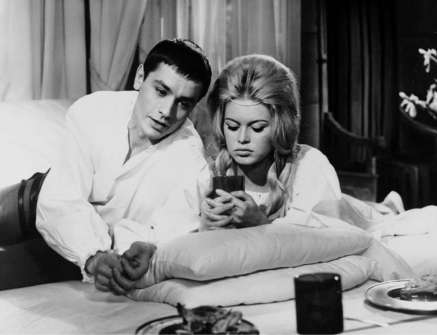
Alain Delon and Brigitte Bardot in "Les Amours Celebres". (1961).
51752726472_0dc7b2226d_b
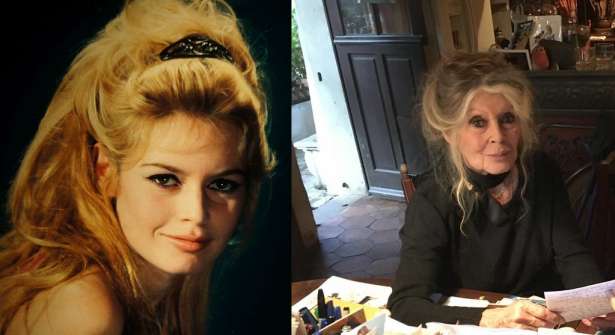
Happy 87th Birthday, Brigitte Bardot. (Born 28 September 1934).
1960s and 2018.
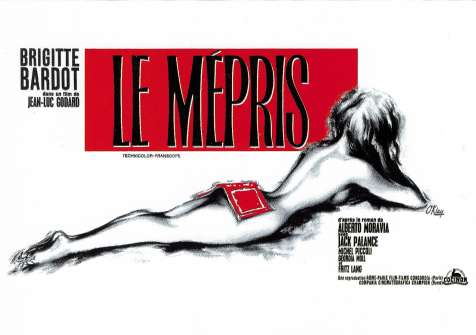
Le Mépris (1963)
French postcard by BS, no. 31, 2005. French poster for Le Mépris/Contempt (Jean-Luc Godard, 1963) starring Brigitte Bardot. Poster design: Pierre Okley, 1963.Jean-Luc Godard (1930) is a French film director and screenwriter. He is one of the most important members of the Nouvelle Vague (New Wave). Godard first received global acclaim for his feature À bout de souffle/Breathless (1959), helping to establish the New Wave movement. Godard's films have inspired many directors including Martin Scorsese, Quentin Tarantino, Robert Altman, Rainer Werner Fassbinder, and Wong Kar-wai. He has been married twice, to actresses Anna Karina and Anne Wiazemsky, both of whom starred in several of his films.Jean-Luc Godard was born in Paris in 1930. His father was a doctor who owned a private clinic, and his mother came from a preeminent family of Swiss bankers. The family returned to Switzerland during World War II. In 1949 he started studying ethnology at the Sorbonne. During this period he got to know François Truffaut, Jacques Rivette and Éric Rohmer. In 1950 he started a film newspaper 'Gazette du cinéma' with Rivette and Rohmer and collaborated on their films. In January 1952 he started writing for the film magazine 'Les cahiers du cinéma', which had been founded the year before by André Bazin. In 1953 he worked as a construction worker at a dam in Switzerland. With the money he earned, he made his first film, Opération Béton/Operation Concrete, a short documentary film about the construction of the dam. In 1956 he returned to France and resumed his work at Cahiers. During that time he made several short comedies and tributes to Mack Sennett and Jean Cocteau. In 1959 he directed his first feature film, À bout de souffle/Breathless (1960), based on a screenplay by François Truffaut. This film played a key role in the birth of the Nouvelle Vague. It broke with many then prevailing conventions, with its references and influences from the American (gangster) film, the low budget, and the rough editing. Jean-Paul Belmondo and Jean Seberg starred and the film was a huge success with audiences and critics. Godard won the Silver Bear for this film at the Berlin Film Festival 1960. Jean Seberg was nominated for a BAFTA Award. That year Godard also married Anna Karina, who would appear in many of his films. In 1964 they formed a production company, Anouchka Films. They divorced in 1965.In 1961 Jean-Luc Godard made his first colour film, the comedy Une femme est une femme/A Woman Is a Woman (1961) starring Anna Karina, Jean-Claude Brialy, and Jean-Paul Belmondo. It is a tribute to American musical comedy, filmed in cinemascope. Godard proved to be very productive during those years. His first flop, the war film Les Carabiniers/The Carabineers (1963), was a tribute to Jean Vigo. That year he also made one of his greatest successes, Le Mépris/Contempt (1963) with Brigitte Bardot, Michel Piccoli, Jack Palance, and Fritz Lang. Then followed Bande à part/Band of Outsiders (1964) with Anna Karina and Sami Frey, Pierrot le fou/Crazy Pierrot (1965) with Jean-Paul Belmondo and Anna Karina, and the Science-Fiction film Alphaville/Alphaville: A Strange Adventure of Lemmy Caution (1965) with Eddie Constantine. The film won the Golden Bear award of the 15th Berlin International Film Festival in 1965. Other films from those years were Masculin, feminin (1966) with Jean-Pierre Léaud, and Week-end (1967) with Mireille Darc. Around the student uprisings of 1968, Godard became interested in Maoism. At that time he started an experimental political phase, which lasted until 1980. In the summer of 1968, together with Jean-Pierre Gorin, among others, he founded the Dziga Vertov Group, which wanted to make "political films political". Some films from that time are Le Gai Savoir (1968), Pravda and One Plus One/Sympathy for the Devil (1968), the latter of which includes a unique recording of the studio build-up by the Rolling Stones of the classic Sympathy for the Devil. In 1972 he made Tout va bien (1972), with Jane Fonda and Yves Montand in the lead roles, followed by Letter to Jane, a film about a photograph of Jane Fonda, which Gorin and Godard discuss. In 1972 he also met Anne-Marie Miéville, his later wife, with whom he made many films. This phase ended in 1980.After twelve years of low budget, militant left-wing, and otherwise experimental film and video projects outside of commercial distribution, Jean-Luc Godard's first film that was more mainstream and accessible again was the drama Sauve qui peut (la vie)/Every Man for Himself (1980) with Isabelle Huppert, Jacques Dutronc, and Nathalie Baye. His films after that time are more autobiographical. For example, in Sauve qui peut (la vie)/Every Man for Himself there was a character named Godard. In 1982 and 1983 he made three related films Passion (1982), Prénom Carmen (1983) and Je vous salue, Marie (1984). The latter film was dismissed as blasphemy by the Catholic Church. The film King Lear (1987), which he made with Norman Mailer, also caused controversy. It was a bizarre postmodern take on the Shakespeare play, with theatre director Peter Sellars as a descendant of Shakespeare, Burgess Meredith as the mobster Don Learo, Jean-Luc Godard as the professor, and Woody Allen as a character called Mr. Alien. Not entirely coincidentally, Mr. Alien was also nicknamed Jean-Luc Godard. From 1989 to 1998, he made the series Histoire(s) du Cinéma, about the twentieth century and the history of film. His most recent film is the avantgarde essay Le Livre d'image/The Image Book (2018).Sources: Wikipedia (Dutch and English), and IMDb.And, please check out our blog European Film Star Postcards.
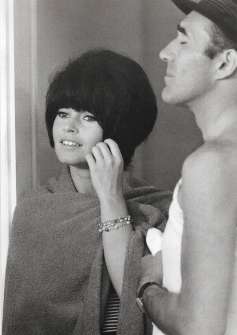
Brigitte Bardot and Michel Piccoli in Le Mépris (1963)
French postcard in the Collection Cinéma series by Editions Art & Scène, Paris, no. CF 101, 1996. Brigitte Bardot and Michel Piccoli in Le Mépris(Jean-Luc Godard, 1963).Beautiful French actress Brigitte Bardot (1934) was the sex kitten of the European film industry. BB starred in 48 films, performed in numerous musical shows, and recorded 80 songs. After her retirement in 1973, she established herself as an animal rights activist and made vegetarianism sexy.Michel Piccoli (1925-2020) was one of the most original and versatile French actors of the last half-century. He appeared in many different roles, from seducer to cop to a gangster to Pope in more than 200 films and TV films. Among the directors he worked with are Jean Renoir, Jean-Pierre Melville, Jean-Luc Godard, Agnès Varda, Luis Buñuel, and Alfred Hitchcock.And, please check out our blog European Film Star Postcards.
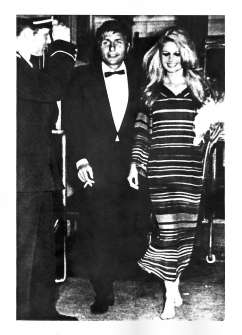
Guess Who
Small Dutch collectors card.Yes, Martha Hyer was yesterday's star on the tiger skin! Jim, Sophia and Agnieszka, you were all right. Well done! For today, I've uploaded 5 cards. The beautiful woman on all the cards is an easy guess: it's BB! But who is the guy with whom Brigitte Bardot is walking hand-in-hand on two of the cards. One clue: he was not an actor! Good luck and share your thoughts in a comment.About the cards: they must date from the early 1960s. We think someone took photos of magazine pictures. According to the seller at Marktplaats, all the photos had been published in Dutch Oh-la-la magazines like De Lach, in English 'The Smile'. A little anecdote: as young kids in the 1960s, Truus and I read 'De Lach' at home. Our parents received these magazines from our grandmother. Grandma never read them, but out of pity for the man who sold the magazines, she refused to cancel the subscription and gave the magazines to my father. As young kids, Truus and I loved the magazines too, and like serious beauty-contestant judges, we gave all the models numbers for who we liked best.Greetings from Amsterdam, BobAnd, please check out our blog European Film Star Postcards.
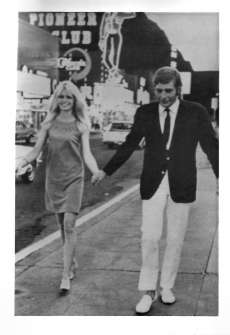
Guess Who
Small Dutch collectors card.Yes, Martha Hyer was yesterday's star on the tiger skin! Jim, Sophia and Agnieszka, you were all right. Well done! For today, I've uploaded 5 cards. The beautiful woman on all the cards is an easy guess: it's BB! But who is the guy with whom Brigitte Bardot is walking hand-in-hand on two of the cards. One clue: he was not an actor! Good luck and share your thoughts in a comment.About the cards: they must date from the early 1960s. We think someone took photos of magazine pictures. According to the seller at Marktplaats, all the photos had been published in Dutch Oh-la-la magazines like De Lach, in English 'The Smile'. A little anecdote: as young kids in the 1960s, Truus and I read 'De Lach' at home. Our parents received these magazines from our grandmother. Grandma never read them, but out of pity for the man who sold the magazines, she refused to cancel the subscription and gave the magazines to my father. As young kids, Truus and I loved the magazines too, and like serious beauty-contestant judges, we gave all the models numbers for who we liked best.Greetings from Amsterdam, BobAnd, please check out our blog European Film Star Postcards.
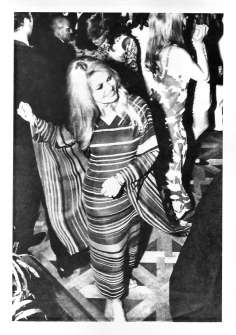
Guess Who
Small Dutch collectors card.Yes, Martha Hyer was yesterday's star on the tiger skin! Jim, Sophia and Agnieszka, you were all right. Well done! For today, I've uploaded 5 cards. The beautiful woman on all the cards is an easy guess: it's BB! But who is the guy with whom Brigitte Bardot is walking hand-in-hand on two of the cards. One clue: he was not an actor! Good luck and share your thoughts in a comment.About the cards: they must date from the early 1960s. We think someone took photos of magazine pictures. According to the seller at Marktplaats, all the photos had been published in Dutch Oh-la-la magazines like De Lach, in English 'The Smile'. A little anecdote: as young kids in the 1960s, Truus and I read 'De Lach' at home. Our parents received these magazines from our grandmother. Grandma never read them, but out of pity for the man who sold the magazines, she refused to cancel the subscription and gave the magazines to my father. As young kids, Truus and I loved the magazines too, and like serious beauty-contestant judges, we gave all the models numbers for who we liked best.Greetings from Amsterdam, BobAnd, please check out our blog European Film Star Postcards.
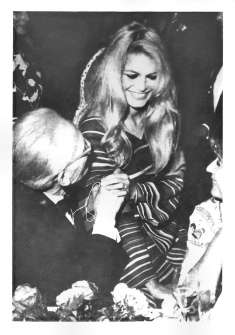
Guess Who
Small Dutch collectors card.Yes, Martha Hyer was yesterday's star on the tiger skin! Jim, Sophia and Agnieszka, you were all right. Well done! For today, I've uploaded 5 cards. The beautiful woman on all the cards is an easy guess: it's BB! But who is the guy with whom Brigitte Bardot is walking hand-in-hand on two of the cards. One clue: he was not an actor! Good luck and share your thoughts in a comment.About the cards: they must date from the early 1960s. We think someone took photos of magazine pictures. According to the seller at Marktplaats, all the photos had been published in Dutch Oh-la-la magazines like De Lach, in English 'The Smile'. A little anecdote: as young kids in the 1960s, Truus and I read 'De Lach' at home. Our parents received these magazines from our grandmother. Grandma never read them, but out of pity for the man who sold the magazines, she refused to cancel the subscription and gave the magazines to my father. As young kids, Truus and I loved the magazines too, and like serious beauty-contestant judges, we gave all the models numbers for who we liked best.Greetings from Amsterdam, BobAnd, please check out our blog European Film Star Postcards.